OBITUARY
Cristobal Maymi
12 October, 1921 – 17 April, 2010
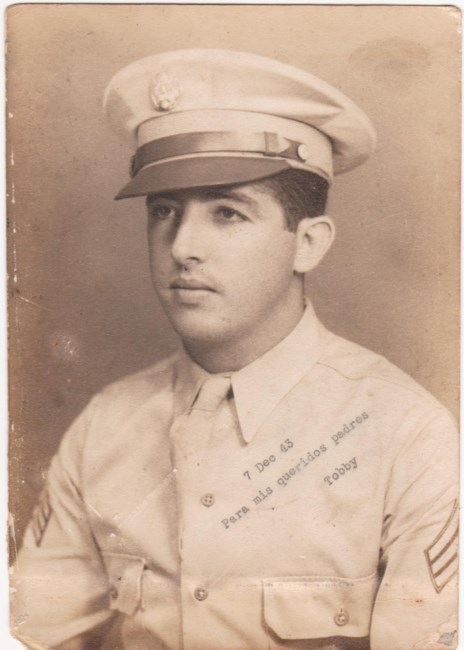
Cristóbal Maymí took his name from the historic figure who left an enduring legacy throughout the Americas that coincided with Cristóbal’s birthdate - October 12 - in the year 1921. And throughout his life Cristóbal exhibited the character, bearing and gallantness that for many eclipsed even that most noble benchmark. But even more, Don Cristobal, Tobi, Papi, “awayweto”, lived each day with love, caring, compassion and an attentiveness to all of us blessed by his presence. He shared over sixty-two of his eighty-eight plus years with his beloved María Hebé. And after what for him must have been too-long an absence, he once again joined her and their loving, Eternal Father on April 17, 2010. Each of us has a memory, a recuerdo, of the times together and the special events, or simple occasions, we shared.
Friends are invited to visitation with the family from 6:00 p.m. to 8:00 p.m., with a Rosary beginning at 7:00 p.m., Wednesday, April 21, 2010 at Earthman Bellaire Funeral Home, 6700 Ferris, Bellaire, TX 77401. The Mass of the Resurrection will be held at 10:00 a.m., Thursday, April 22, 2010, at St. Vincent de Paul Catholic Church, 6800 Buffalo Speedway, Houston, TX 77025. Rite of Committal with full military honors will follow at 12:30 p.m., at Houston National Cemetery, 10410 Veterans Memorial Dr., Houston, TX.
But some may not be as familiar with the family history and many individuals that shaped and nurtured Cristóbal. The following story was written by his daughter Brenda recently as she sought to preserve and carry forward the memory and love of family. We hope you enjoy the anecdotes (and the recipes) and that it will stir in you thoughts of family, of friends, and of how much we each mean for one another. Carry that in your heart and in your prayers each and every day. But also reflect the fine example of Cristóbal and share that spirit in all you do.
En mi Viejo San Juan
I believe that most people have a song, a scent or a taste that evokes their most cherished childhood memories and dreams, when life is the color of innocence and laughter sprouts from the soul. For me, En Mi Viejo San Juan is the song-anthem, which identifies my Puerto Rican family and heritage. The nostalgia of its lyrics, a hymn of love for the homeland, brings to memory faces of loved ones, many now gone, and years of family history and traditions.
Puerto Rico is an enchanting island in the Caribbean. Its sparkling-sand and azure beaches kissed by the sun and adorned with graceful palm trees dazzle the eyes. Lush and vibrant mountains lavished with indigenous flora are home to the coquí, a tiny inch-long frog that with its melodious nocturnal symphony serenades the Borinqueños to sleep. It is the land of the “ay, bendito,” an exclamation of empathy frequently used by Puerto Ricans which characterizes the goodness and nobility of its people; Puerto Ricans are loving, warm hearted, and caring people. Truly, I don’t know if it is due to its paradisiacal landscape or the sun or its beaches, but Puerto Ricans love life and love people. This is my father’s country. This is the country of the Maymí and Borrás families, who settled in Puerto Rico in the late 1800’s. These are the families that I am proud to say I descend from: good, hard working and with deep seeded traditions that have been handed down through generations.
Most of my childhood memories are tied to my father’s family and the family’s favorite vacation place: Salinas. When the Maymí clan got together, life was wonderful. My father, my noble hero, was the fifth of nine siblings, six boys and three girls. They in turn married and had another batch of Maymís. In birth order, my uncles’ and aunts’ names were: Zara, Pedro, Ángel, César, Cristóbal (my father), Norka, Alicia, Roberto, and Miguel. Another important member of the family who was brought up as a tenth child was María, my grandparents’ godchild. María never married and after my father and his siblings married, she dedicated her life to caring for my grandparents. Then there were my father’s cousins and the children of the cousins, who were just as close as his brothers and sisters. The family tree was everlasting and family reunions were an opportunity for the adults to visit, cook, and share experiences and for the children to play, fight, and grow up together in a loving and wholesome environment.
For us (the children of the children), vacation was a synonym for fishing and the sea, but not any sea. Of the 365 days of the year, we spent at least 150 in Salinas. Puerto Rico is famous for observing local and U.S. holidays. Christmas celebrations, the brightest in the world, begin in late November and end in mid January and we celebrated at the beach! That’s how deeply in love we were and are with the sea. Passion for the sea and fishing runs in our family like the blood ties that bind us. In fact, at one point all the houses in Salinas were owned either by a Maymí or a Borrás member of the family.
Salinas—today Playa Santa— is a beach cove surrounded by mangroves and reefs on the Caribbean coast of Puerto Rico. My father says that his family and residents of Ensenada, his hometown, and adjacent towns made this spot their favorite vacation place because of the translucent beauty of its waters, so crystalline that you could see the pure white sand glistening under the water. The cove is framed by coconut palm trees and beach grape trees, which provide shelter from the sun, coconut water, and sweet berries that quenched our thirst on warm days.
In Salinas, salt deposits in estuaries formed from in-flowing seawater, which over the years formed into sand hills. I remember the many times my cousins and I scratched our knees when we climbed to the top of those hills as part of our childhood adventures. The beauty of the hills is stunning when sunrays bathe the sand, making the crystals sparkle like tiny diamonds.
My father’s caramel-colored eyes light up as he recounts how this love for the sea dates back to our ancestors who came from islands in the Mediterranean Sea and Atlantic Ocean.
Nicolás Borrás, my grandmother’s father (on my father’s side) was born in Tenerife, the largest of the Canary Islands. He worked as a nautical engineer and specialized in building docks. He also had a thriving trading business that required traveling from Tenerife to Puerto Rico, his port of destination, where he sold all types of merchandise. At one point, he was contracted by the Ponce City Public Works to build docks in Ponce and later in Ensenada, where construction of a Sugar Mill was underway. Both are cities located in the southern part of Puerto Rico. In Ponce, he met my great-grandmother, Manuela Velázquez.
Once married, my great-grandmother navigated back and forth with her husband. My dad says that due to the long duration of the trips, two months or more, his mom, Antonia Borrás—my grandmother—and many of her siblings were born at sea while en route to either country. This explains why part of his mother’s family is registered as Spanish subjects and others as Puerto Rican (American citizens), in the 1920 U.S. census for Puerto Rico. My grandmother, Mami Toña, as we all affectionately called her, was born in June of 1890.
Jose “Tito” Maymí Landrón, my great-grandfather (my father’s grandfather on his father’s side) was born on the Island of Corsica located in the Mediterranean Sea, close to the southern part of Italy and birthplace of Napoleon Bonaparte. He emigrated to Spain and from there traveled to Puerto Rico. Besides raising cattle and owning a farm, my great-grandfather had some type of mail carrier business—similar to Wells Fargo. He ran a route from Toa Baja to San Juan. He also ventured into politics running for Mayor on the Liberal ticket and almost got lynched. That ended his short-lived career in politics. Tito married Rosario Martínez Martínez—my father’s grandmother—and from this union my grandfather Pedro (my grandfather) was born on 31 January 1890.
Tito owned a small dairy with milk cows. He made cheese and sold milk in bulk to adjacent villages. My great-grandmother Rosario would help him distribute the products in a small wood cart hauled by a mule.
Business was good for a while and they made a small fortune, which they saved under their mattress because they did not trust banks (I don’t either). On one occasion, Tito decided to go partying in Toa Baja where local festivities were taking place and took his savings with him. At the festival, there were many games and Tito gambled all night long and lost all of his hard-earned fortune. For two or three days, he refused to go home and face Rosario, and decided to temporarily board at a friend’s house. Once Tito faced Rosario with the truth about the loss of all the savings, she got so angry that she refused to keep helping in the dairy and they closed it. Tito had to fire hired hands and go back to work the fields without any help.
Years later, Tito died and Rosario went to live with her youngest daughter, her namesake. During that time my great-grandmother contracted an eye infection that caused her to lose one of her eyes (doctors decided to remove her eye). My grandfather Pedro suffered very much with this situation and committed himself to helping his mother, providing her moral and financial assistance for the rest of the time she was alive. My grandfather (Papi Pedro as all his grandchildren fondly named him) was living and working with the South Puerto Rico Sugar Company in Ensenada where his godfather mentored him.
Papi Pedro worked in the laboratories at the sugar mill. As a chemist, he was in charge of supervising and testing samples of raw sugar for quality at the different production stages. The sugar cane would arrive in trucks from the docks (built by my great-grandfather Nicolás) and was taken to the mills were it was ground to extract cane syrup and the pulp or bagasse was used as fuel for the boilers. The syrup was transferred to a centrifuge to filter impurities then it passed to a boiler where the process of transforming the syrup into sugar would begin. At this point, Papi Pedro would add carbon dioxide and the milk of a lime to the liquid sugar mixture and as it slowly heated to the boiling point, the process of clarifying began. He would place samples of the syrup in a testing glass every half hour until the liquid would slowly form into heavy dark syrup, and then to magma and finally crystallize. This raw sugar was then transferred into two hundred pound twine sacks to be shipped to the U.S. for refining. A new load of sugar cane would arrive and the process began anew. My grandfather worked from eight to twelve hours a day. He would leave home at six in the morning and return at six in the afternoon. Mami Toña, my grandmother, would send my father or one of my uncles to the mill with lunch and dinner for Papi Padro.
Papi Pedro was a very loving, kind and giving person at home, with extended family and friends, and even with strangers. My father says that he helped any one who was in need. Many times friends would ask him to help their kids get jobs at the mill and Papi Pedro would speak for them, mentor them and they were hired. Roberto Albertheston, a good friend of my father, was hired by Papi Pedro to work at the mills. Roberto worked at the mills until he was drafted by the U.S. Army. Many years passed until my father saw him again. The occasion: Papi Pedro’s funeral. Roberto never forgot my grandfather.
Papi Pedro enjoyed spending time with his sons. His hobby and passion was fishing. He taught his kids all there was to know about fishing. My cousin Angel Maymí remembers visiting our grandparents’ house as a child, and going into a sort of workshop where Papi Pedro kept a large fishing inventory, which consisted of outboard motors, fishing rods, fishing cast nets, lines, harpoons and many other implements.
“I enjoyed watching Papi Pedro personally weave or repair the casting nets and plumb lines after a fishing trip,” said Ángel.
My father says that Papi Pedro was not a conventional fisherman. His passion for the sea took him out to the sand bars in mid-ocean where he would cast his fish-nets to trap squids and other types of fish. He would harpoon large snappers, octopus and lobsters. Papi Pedro, my father and uncles would literally walk the boat to the sand bars. A fishing adventure would take up to 12 hours. They would leave at dusk and return at dawn.
“These were wonderful times with my father. All of us strongly bonded with him and created many memories through fishing,” my father said.
But the adventure didn’t end with the catch. There was a family ritual. As soon as they returned from the sea, Papi Pedro, who loved to eat from his catch, would clean the fish, start a fire, and boil water in a big kettle. He would then cook in the kettle the lobster, shrimp and any other conch meat he had caught. He would add lime, salt and pepper to the fish and deep-fry it. And then, all would feast!
Ángel said that Papi Pedro would take home what was left of the catch and prepare his famously delicious Escabeche.
“Papi Pedro’s recipe was unique,” he said. “He would place thick slices of barracuda in a big jar and cure it with vinegar, olive oil, garlic, bay leaves, black peppercorns, onion rings and a bit of salt. Two or three days later, the Escabeche was ready.” Papi Pedro would always have Escabeche ready for family and friends. He would serve it for breakfast with freshly baked bread.
Papi Pedro had a lot of patience when he taught his sons how to fish. Some times, teaching became a personal hazard. My father recalls that on one occasion Papi Pedro was teaching uncle César how to throw a fishing line and instead of landing in the water, the line hooked Papi Pedro. Papi Pedro felt something was pulling at his ear, and when he looked at my uncle he saw that his eyes were wide open; only then did he realize what had happened. Uncle Baby (Angel’s dad) rushed to find a pair of pliers to cut and remove the fishing hook. Papi Pedro was not upset, but from that day on he made it a point that to avoid such accidents, the kids would have to stand up-wind while casting the line.
Once, Papi Pedro went fishing in his boat from Ensenada to Caña Gorda with a friend and my uncle Miguel (Guelo). They were in the middle of the bay when a big storm with high winds and heavy rain developed and the high waves capsized the boat. The three of them held on to the boat. Papi Pedro’s friend insisted in swimming to shore to get help and drowned. Uncle Guelo said that the storm was so strong that Papi Pedro went under, and that he (uncle Guelo) was barely able to grab his hair and pull him back up. They floated for 7 hours and were rescued by some fishermen who had passed them earlier in the day. The irony of it all was that Papi Pedro being such an experienced fisherman didn’t know how to swim!!!
My grandparents, their nine children and Goddaughter, María, lived on Brandon Street in Ensenada. Ensenada developed as a small community for employees of the South Puerto Rico Sugar Company. A hotel was built especially for single executives who worked with the company. The houses in Ensenada where employees with important positions lived were spacious and made out of wood and painted in white. They had beautiful landscaping and blooming gardens. The streets were wide and flanked by Flamboyan trees that formed arches with their long branches and adorned the scenery with their flame-colored flowers.
In contrast, the houses built for the blue-collar workers were smaller and all painted in yellow. These houses did not have plumbing. They had communal showers and latrines.
My grandparents’ house had four bedrooms, one bathroom, an ample kitchen, a dining room and a balcony. The floors were made of mahogany. It had plumbing and electricity, which was a luxury in those days. Mami Toña loved gardening. In the back yard she planted all types of vegetables and fruits, which helped her feed her army of children. She loved flowers and had an amazing garden, which she maintained throughout the years. My cousin Arbuéz recalls the beautiful roses that Mami Toña planted around the house. “They were a rainbow of colors and you could smell them from a distance,” he said.
My cousin Provi, aunt Zara’s daughter, remembers the delicious fruit preserves and “limbers” (ice cubes made out of natural juices) from the fruits in Mami Toña’s garden, which she sold and also offered to her grandchildren when we visited. Mami Toña was an expert at crochet. She loved to make large and small tabletoppers and give them to her family. She learned a variety of stitches and crocheted beautiful patterns. My cousin Myra, uncle Guelo’s older daughter, still owns a beautiful bag that Mami Toña made for her. (I still have the tabletop she made for my mother’s dining table.)
Mami Toña was also famous for her culinary talents. She cooked both Puerto Rican and Spanish dishes. Her Puerto Rican specialty was the pasteles, which she prepared for all family festivities, but especially during Christmas time. She grated green plantains and two varieties—white and yellow—of a root called yautia for the masa and added milk, salt and annatto seed for color and flavor. She would then cut pork meat into small cubes and baste them in orange juice. The next step was to marinate the meat with sweet peppers, culantro, garlic, oregano and salt. She prepared the rest of the ingredients for the stuffing: cubed cured ham, onions, tomatoes, green bell peppers, raisins, chick peas and stuffed olives. Once all the ingredients were ready, she would combine annatto with pork lard, soften this mix and pour it over the meat. As soon as the masa was ready, Mami Toña would start forming the pasteles. First, she would cut the long plantain leafs into 12 square inch pieces. Second, she would place ¼ a cup of masa on the plantain leafs and top it with the pork mix. She would wrap (like you wrap a gift) and tie the pastel and the cook them in a big pot of boiling water until they were done. This is just a rough idea of the work that Mami Toña went through when she made the pasteles for the family to enjoy. And, boy did we. Ah, I forgot to mention the quantity, close to 300! My father remembers having to help tie the pasteles, when he was young. He said it was fun because of the anticipation of having the whole family over for Christmas vacations.
Mami Toña was a loving and generous mother who cared for her children and made sure that they were well educated. She was always busy, but found time to enjoy her family. She would gather with her children in the living room and listen to radio programs or play cards. Arbuéz recalls that Mami Tona taught him to play a Spanish card game called “Brisca”. Maria would also play with them.
With nine children, Mami Toña’s life was never boring. She was very tolerant, but if things got out of hand she would not hesitate in disciplining. Teen mischief was not wanting in the Maymí household and, like with other generations, car stories abound and Mami Toña handled them well (maybe?).
Papi Pedro had bought a green Plymouth—my grandfather’s favorite color was green, he used green on everything—with my uncle Pellín, who also was working at the mill. Since the sugar refinery was two blocks from my grandparents’ house, they would walk to their jobs, and Mami Toña would keep the keys to the car. The Plymouth replaced a Studebaker Papi Pedro had owned for a long time. That car was a four-door convertible and had big tires with wooden rims and a straight eight-cylinder gasoline engine. Since the car was giving Papi Pedro problems, he decided to buy the Plymouth.
On one occasion, my dad (16 at the time) stole the keys to the new Plymouth and drove to the City of Yauco, 10 miles from Ensenada, to visit his girlfriend Catalina. To get to Yauco he had to drive through hilly unpaved roads. On his way back two acquaintances asked him for a ride. It had been raining and the road was muddy and slippery. The car started to swerve and my father was terrified. He was afraid he would end up in a ravine. The two guys offered to help and got down from the car and placed themselves on each side to keep it straight. Bad luck would have it that the car veered and hit against the side of the hill. This made a big dent in the car. My father sat in the car not knowing what to do. His friends advised him to drive to Guánica and said they would help him wash the car.
Before heading home, my father went to look for his brother, my uncle Pellín, to face him and tell him about the accident. Uncle Pellín was understanding and told my dad that they needed to take care of the car before my grandfather saw it. He asked permission from his “boss” (Papi Pedro), saying that he was sick and left with my father (who had stayed outside) to look for a mechanic. The mechanic was able to fix the dent but did not have the exact color of the paint—the green color—and painted it in a similar green. When my uncle and father got home, they told my grandmother what had happened. She was such a loving mom that she did not tell Papi Pedro.
Two or three days later, Papi Pedro noticed the off-green color on the car. Uncle Pellín assumed responsibility and explained that he had had a small accident. Papi Pedro, not happy with the color, went to the dealer and found the exact green and had the car painted.
My dad had been fortunate this time and escaped the now legendary punishment that my grandfather would apply when they were caught in mischief. My cousin Angel heard from the uncles (and I from my dad) that when they got in trouble Papi Pedro (or Mami Toña) would dress them with long gowns and lock their clothes away and send them to their rooms early. Little did my grandparents know that my uncles had figured out a way to fix the gown “problem”. My uncles had managed to hide large safety pins, which they used to pin a crotch, and made pants out of the gowns. They tied a string of bed sheets to the foot of a heavy chair, and slid out of the window, played in the street with their friends and went back up. The fun in their faces didn’t last long when they saw Mami Toña waiting for them at the end of the “rope” with Papi Pedro’s belt. . .
Mami Toña was very loving and she knew how to discipline without being harsh.
“I remember when I lived with them for a while,” my cousin Aner said. “Mami Toña enrolled me in pre-K and I didn’t like going, so every day I would break all my pencils and every day she would buy new ones. I don’t know where she found so many pencils. The truth is that my plan failed and Mami Toña’s prevailed!”
Life continued its tranquil course for the family. My grandparents prospered and the boys and girls grew into young adults in a wholesome and peaceful environment, until peace was interrupted by war. When the United States decided to enter WWII, my grandmother lived the darkest period of her life. Five of her six sons were at war at the same time. My father was shipped to the North African front and from there to Italy, Corsica, Southern France and finally to the German border to fight the Axis forces. My uncle Pellín was in Europe close to my father’s battalion. Uncle Baby was sent to the South Pacific front, uncle Roberto was stationed in Fort Dix and uncle César in Saint Thomas in the Virgin Islands repairing Army vehicles.
My father’s company was ordered to climb the Alps and descend into Germany. He has many painful stories that he hesitates to talk about. Due to the bombing, my father’s hearing was severely affected, and he became disoriented. He was sent back to the states in a hospital boat and spent seven months in different hospitals where he was treated. My father never fully recovered his hearing.
Mami Toña wrote letters to her sons and shipped pasteles, home made fruit preserves, lechon asao (roasted pork) and arroz con gandules through a private company contracted by the U. S. Army. The Red Cross was in charge of distributing the goods to my father and my uncles. While her sons were at war, my grandmother made a promise to Jesus that if her sons’ lives were spared, she would go around her neighborhood, on her knees, asking for donations for the poor. They all came back and she kept her promise. Two decades later, the story sadly was written differently. My cousin Pedro Antonio Maymí Martínez, uncle Ángel’s younger son, was killed in Viet Nam. His name appears on the Viet Nam Memorial in Washington.
At the end of WWII, my father remained in the states because he was in the hospital receiving treatment for his loss of hearing. My uncle Pellín went to stay with him and there he met the woman who would be his wife: my aunt Antonia served in the Women’s Army Corps and was assigned to the hospital where my father was being treated. My other two uncles returned to Ensenada, but had to migrate to New York due of the lack of jobs. In New York, my uncle César married his hometown sweetheart, aunt Virginia Octaviani, who was living there, and my uncle Roberto met and married a friend of my mother, aunt Nelly Downing. Eventually all the brothers returned to raise their children in Puerto Rico, except my father and uncle Roberto.
My aunts, Zara, Alicia and Norka, like my uncles, grew up in a loving and nurturing environment. They helped my grandmother, especially aunt Zara who was the oldest child. Mami Toña taught them to crochet and how to cook and make sweets. They attended school and played with cousins and friends. As a young adult, aunt Zara worked as a cashier with aunt Pepa, one of Mami Toña’s sisters, at the South Puerto Rico Sugar Company General Store. Aunt Pepa was married to the General Manager of the store. Aunt Zara married Samuel Rodríguez—the son of good friends of the family—and set up residence in Ponce. They had four children: Pedro, Jorge, Roberto, and Providencia.
Aunt Alicia studied bookkeeping in San Juan and was hired by the U.S. Army. There she met her husband, Clarence Jolliffe who was stationed at Fort Buchanan, a U.S. Army base in Puerto Rico. They married in Ensenada and returned to the base where they resided until he was transferred to West Virginia. They had two children: Dennis and Linda. Aunt Alicia worked for more than 25 years at the Pentagon. She was in charge of processing student admissions to West Point Academy.
Aunt Norka, the baby girl, graduated from high school and stayed at home with her parents. She married her hometown sweetheart, Alfredo Chacón, and lived in Ensenada all of her life. She had two children: Alfredo and Myrna. Aunt Norka and uncle Alfredo were the pioneers of the family; the first to buy land at Salinas and build a summer home, which eventually became their permanent residence. This was the beginning of a new tradition that for many years kept the family together.
Salinas had been my grandparents’ favorite beach where they would take their children on weekends and during vacations, and also where Papi Pedro would go fishing with the boys. Once my aunt Norka bought land there, most of the members of the immediate and extended family started to buy and build summer homes. Salinas became the family’s favorite reunion place for the Christmas season, which began with Thanksgiving and ended on Epiphany (Three Wise Men). The family would also meet there during summer, and especially for San Juan Day, celebrating the Patron Saint of Puerto Rico. Puerto Ricans celebrate this holiday by going into the water at midnight. This action symbolizes the Baptism of Jesus in the Jordan by Saint John. Puerto Ricans believe that the negative in their lives will be washed away.
Salinas was a very safe place where the kids played till late at night and went from house to house visiting all the cousins, sharing adventures and enjoying the refreshing waters of the cove. What we enjoyed most was sleeping in rooms that would accommodate at least four bunk beds.
My cousin Provi remembers how preparations for Christmas would begin months prior to the festivities. During the year Papi Pedro and Mami Toña would buy three pigs and would feed them. When it was time, one of Papi Pedro’s hired hands would come to the house to slaughter the pigs. The man would stab the pig in the aorta and blood would gush out. Papi Pedro would assign one of the boys to collect the blood in a salted pan. With the blood Mami Toña would prepare morcillas or blood sausages. The pig was placed in a kettle with boiling water to remove all of its hair, the eyes, and toenails. Once the surface of the pig was clean, they would slash it from the throat to the thighs. Then to clean the inside of the pork, they would remove the intestines, the liver, and all the entrails. To prepare the pig for roasting, they would make incisions on the surface of the pig and insert in the holes a mixture of olive oil, lime-juice, fresh ground garlic, crushed oregano, pepper and lots of salt. This mixture was also rubbed on the insides of the pig. The pig was then nailed to a long wood stick and roasted whole, over a pit for eight hours to 12 hours, depending on the size and weight of the pig. The cooking process required constant basting with a mixture of oil and annatto that would give the pig a golden color. During Christmas season, three pigs were slaughtered, one for Christmas Eve, one for New Years and one for Three Kings day.
My grandfather had another tradition. During Christmas he would keep a jar filled with Christmas candy.
“I remember how lovingly Papi Pedro would call us one by one and ask us to grab a candy from the jar. He secretly kept the jar in his room because he was diabetic,” Yvette said.
A special treat was dessert. Mami Toña would make Arroz con Coco. She would buy dry coconuts, remove and grate the pulp. She would place the pulp in a thin cloth and run hot water through it to extract the pure coconut milk. She would dilute part of the milk and boil it for 15 minutes and add salt, cinnamon, fresh-ground ginger, nutmeg, sugar and raisins. Next, she added rice and the remaining pure coconut milk. She would let the mixture cook until solid, wait for it to cool and serve after sprinkling it with ground cinnamon. If you got there late, chances were that the dessert would be all gone!
The spirits were also home made by my grandmother. My favorite, which I now make and have handed down the recipe to my children, is Coquito. This home-made liqueur is prepared from the milk of dry coconuts (the process for extracting the milk is the same as the one for the Arroz con Coco) white Puerto Rican rum, egg yolks, condensed milk, nutmeg and cinnamon.
It was the love, simplicity, kindness, and wisdom of Mami Toña and Papi Pedro that kept our family united, even after their death. Their moral values and hard work yielded an amazing breed of human beings, who in turn handed all their rich family traditions to their children (us) and we in turn have passed the torch to our children and, hopefully, they to our grandchildren and on. Unfortunately, cancer runs in our family in all of its mutations. Out of the nine siblings, only two are alive—Cristóbal (my father) and uncle Miguel (the youngest)—six died of cancer and one of an asthma attack, most at an early age. In our generation, my cousin Myrna (aunt Norka’s daughter) died at age 27 of a cancerous brain tumor; her husband and two children still live in Salinas.
In 2006, I visited Puerto Rico and stayed in Salinas with my uncle César and aunt Virginia (Viña). I got together with my cousins and went to a beautiful park in Ponce. We laughed and reminisced about our childhood. I felt time stop, and we were still running around in Salinas with our grandparents smiling and enjoying their children and grandchildren. The next day, my husband and I spent the whole morning in the azure waters of the cove, with a sweet breeze caressing us, and the lazy sunrays reflecting on the cellophane waters. My eyes blurred as my heart sang the last verse of En Mi Viejo San Juan: Mi cabello blanqueo/ya mi vida se va/ya la muerte me llama/ y no pude volver/al San Juan que yo ame/pedacito de patria…
I thank my father, Cristóbal Maymí, my uncle Miguel Maymí, my cousins Arbuéz Maymí, Provi Rodríguez Maymí, Yvette Maymí-Acosta, Myra Maymí, Angel Maymí (Babyto) and Aner Maymí for making this first part of our family story possible.
While the family was settling back into the beauty of Puerto Rico, my father was discovering a love that rivaled and then eclipsed the joys of his youth. In 1945, while on leave in New York City, he met a beautiful woman on a train. That was my mother. Months later they married and when my father was discharged, they stayed in New York where my sister Marianne and I were born, beginning a new chapter in the Maymí story.
Show your support
Add a Memory
Share Obituary
Get Reminders
Services
SHARE OBITUARYSHARE
- GET REMINDERS
v.1.18.0