
OBITUARY
Helen Rees
2 October, 1936 – 5 March, 2015
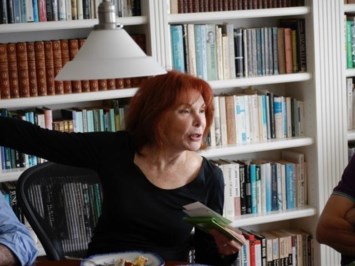
Perhaps because she was an activist and a mayoral appointee long before she reinvented herself as one of Boston’s top literary agents, Helen Rees often viewed life through the prism of politics.
“I love politics,” she told the Globe in 1978 while she was running Boston’s Office of Cultural Affairs for Mayor Kevin White. “But I don’t have a traditional view of politics. I think we’re all political. I think when you go to the grocery store to get a good cut of meat there’s a political interchange between you and the grocer. People don’t like to think of it that way because it’s very unfashionable.”
Bringing that cut-to-the-chase acuity to the task of getting good contracts for authors, she launched the Helen Rees Literary Agency in 1983, a bold move in an industry nested in New York City. Skipping nimbly from the fax machine that initially allowed her to work far from publishing houses she stayed on the cutting edge as the industry moved into e-books. Over the years, she made her biggest mark bringing fame and high sales to writers in the business book field. Ms. Rees also represented writers who already had prominent careers, such as Alan Dershowitz and John Kerry, and others who needed a good agent’s guidance to turn proposals into published books.
“She had a passion for words, and she respected and admired men and women who could put words together. On occasion she would say to me, ‘My job is to get the words out of their heads and onto paper and put it out there,’ ” said Larry Moulter, a former colleague who is executive in residence at the University of Massachusetts Boston’s Center for Collaborative Leadership. “She was remarkable because she not only had a good nose for what a successful book idea would be, but she also knew how to pull the project together, when the author might be wandering aimlessly, and ensure it was a publishable work.”
Ms. Rees, who had been ill with a liver ailment physicians couldn’t diagnose, died Thursday, two days after being admitted to Beth Israel Deaconess Medical Center. She was 78 and had lived in a 26th-story Boston waterfront condo with sweeping city views that were ever-changing with the play of light on landmark buildings. “Someone visiting here said to me, ‘Helen, you are a high priestess,’ ” she told the Globe in 2006 as she admired the view. “I like that image.”
She also took an expansive view of her role in her writers’ careers. Ms. Rees wasn’t the sort to wait for proposals to meander over the transom.
“The last word that would describe her was a ‘passive’ agent. She wouldn’t wait for you to call her. She was giving you ideas for books,” said Dershowitz, a Harvard Law School professor emeritus Ms. Rees represented for 30 books.
“She never would allow things to just happen,” Dershowitz said. “She didn’t believe in destiny and fate. She said, ‘You make your own success.’ She had to be in control. ‘Nothing is just going to happen,’ she said. ‘We have to make it happen.’ ”
The second of three siblings, Helen Cherner grew up in Washington, D.C. Her father ran a car dealership, and her mother, who played piano and violin, died when she was 17.
Ms. Rees studied history and philosophy at George Washington University, graduating in 1960 with a bachelor’s degree. She married Dr. Michael Rees, with whom she had four sons and settled in Greater Boston. Their marriage ended in divorce.
In the 1969, while living in Brookline, she was among the coordinators of the Vietnam Moratorium that drew 100,000 antiwar protesters to Boston Common in the city’s largest demonstration. A Democratic Party activist, she ran unsuccessfully for a state representative seat the following year. Then in 1972, she was elected to serve as a national committeewoman at the Democratic National Convention, drawing support from the likes of economist John Kenneth Galbraith, who promoted her candidacy in a Globe letter to the editor.
Ms. Rees was executive director of the Massachusetts Children’s Lobby and a fund-raiser for Combined Jewish Philanthropies before White appointed her to run the cultural affairs office. She had served for two years when the city Finance Commission issued a report claiming she had misused funds, such as billing calls from her home phone to her office number and not distinguishing between personal and professional use in mileage reports. “I’ve come to this business with 20 years’ experience of working for what I care about,” she told the Globe in November 1979. “I don’t think my accusers understand my work.” City Corporation Counsel Joseph Alviani reviewed the report and cleared her the following month, saying he found no evidence of wrongdoing.
Tiring of politics, Ms. Rees left the cultural affairs office in 1980. After launching her literary agency, though, there was no shortage of political writers among her clients. Along with Kerry she represented former US senator Barry Goldwater, former US attorney general Edwin Meese, and Palestine Liberation Organization leader Yasser Arafat. She even persuaded former Afghanistan president Hamid Karzai to write a book.
Many of her authors, however, wrote about business. “Helen was the preeminent commercial, mass market literary agent in this area,” Moulter said. “She did major, major business books with marquee names.”
Donna Carpenter, a writer who worked with Ms. Rees on business books, wrote in an e-mail that her friend “changed my life in ways large and small. In more than 30 years of business, we never had a contract. She meant what she said, and she did what she said.”
Ms. Rees also had a sure hand with best-selling crime books. She shepherded the memoir of Kevin Weeks, a former associate of James “Whitey” Bulger, and with Moulter she negotiated the sale of Boston Herald columnist Howie Carr’s 2007 book “The Brothers Bulger.”
About 20 years ago, prompted by a friend’s dare, Ms. Rees placed a personals ad in Harvard magazine. From among the replies she chose David Shaw, an environmental chemist who taught at the University of Alaska Fairbanks. “Here’s the one guy who was 5,000 miles away and who wasn’t going to be bothering her for drinks and dinner,” he joked.
They corresponded for about six months before meeting. “In an almost Victorian, old-fashioned way, we got to know each other,” he said. “These weren’t e-mails, they weren’t texts, they weren’t faxes. These were for the most part handwritten letters.” They married in 1996.
In addition to her husband, Ms. Rees leaves four sons, David of Queens, N.Y., Kevin of Manhattan, N.Y., Geoffrey of Chicago, and Lorin of Brookline; two stepsons, Daniel Shaw of Portland, Ore., and Matthew Shaw of Los Angeles; her siblings, Harvey Cherner of Palm Beach, Fla., and Peggy Zeitler of Munich; five grandchildren; and four step-grandchildren.
A memorial service will be held at 1:30 p.m. Thursday in Levine Chapel in Brookline. Burial will follow in Baker Street Jewish Cemeteries in West Roxbury.
“She was a force of nature,” Dershowitz said. “Somebody once described Helen Rees as not a noun, but an active verb with an exclamation point after it.”
Never just an agent, Ms. Rees was close to her writers, suggesting potential new friends along with possible new projects, and bonding in friendships that transcended work relationships.
“She would always say to me, ‘We’re growing old together,’ ” Dershowitz recalled. “We were always in this together. She was a guide to what we should do at our age. I’m going to miss her. I have more books in my head, and without Helen, it’s going to be very difficult.”
Bryan Marquard can be reached at [email protected].
Show your support
Add a Memory
Share Obituary
Get Reminders
Services
SHARE OBITUARYSHARE
- GET REMINDERS
v.1.18.0