
OBITUARY
Mrs. June Avril Young
13 November, 1930 – 30 March, 2009
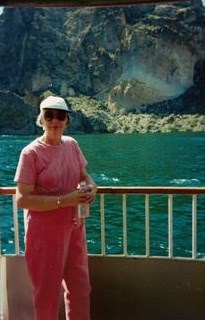
June Avril Garner was born 13 November 1930. She was born in the family home, at 2719 Ward St. in Vancouver. It was a snowy day. June's mother recalled that when the doctor arrived to assist with the birth, there were snowflakes on his head and shoulders.
June was the daughter of John William Garner and Ellen Lily née Abercrombie. Her father came to Canada early in 1915. His father died on the first day of World War I (1 August 1914) of complications of tuberculosis. His mother was ill and unable to care for him and his siblings (there were seven other children: Grace, Florence, David, Cyril, Doris, Herbert, and Percy) so he was sent from London to Canada in one of the resettlement schemes that existed at the time. This was run by a Christian charity called Fegans, which specialized in caring for children in need. He went to Copeland, Ontario, which is just west of Hamilton.
In the mid-20s, John Garner went back to England to visit his family. His sister Grace had married Harold Abercrombie, the brother of Ellen Lily Abercrombie, to whom my grandfather was naturally introduced. John Garner returned to Canada. Subsequently, Ellen sailed third class from Southampton to Canada on the Canadian Pacific liner Montnairn. (It must have been a rusty old thing; it was sold to be broken up only two years later.) She arrived in Quebec on 8 July 1827and married June's father at Vancouver on 16 July 1927. John Ogilvy Garner, June's older brother, was born to the couple in 1928.
Soon after June's birth, her family moved to Britannia where her father took a job in the copper mine, then the largest in the British Empire. (Her father is described as a miner on June's birth certificate.)
June always had an excellent relationship with her brother. Speaking of their youth, her brother recalled that
In those days I was always the available big brother who could slay dragons in her eyes and she was the one with the valuable trait of common sense who could set me on the right path. Over the long years this love and respect for each other's strengths, forged in our early childhood, never changed.
Her brother shared a few stories of June's childhood.
June's mother, at various times, wanted to make her family known to her relatives in England. As part of this, June and John were groomed to within in an inch of their lives and then taken on the two and a half hour boat ride to Vancouver. (At the time, this was the only way to travel to Vancouver from Britannia.) In Vancouver they were hustled off to Spencer's department store. Here dress clothing was purchased. From there they were marched off to the photographer's where their mother explained in impossibly detailed terms what she wanted while they quietly rolled their eyes. One of the pictures in displayed on the memorial website is of the two children, June seated in a chair and John standing behind her. Take a good look at this picture. You can see the fold lines in the clothing. How this detail escaped their mother's keen eye was beyond their comprehension but caused the children much amusement. John was required to write to his father on a regular basis; June was off the hook because she was too young.
In another picture from the Britannia years June and John are dressed in their Sunday finest to go to church. Their mother would have deemed anything less sacrilegious. Their father would stand them on a chair and polished their shoes till they shone like the finish on a grand piano. The church itself was unique. It was a two-story building and served two congregations. The first floor served the United Church and the second floor served the Catholics. The kitchen and social areas were where both congregations got together. Perhaps June's acceptance of other people's right to worship as they chose started in this church.
As a girl, June often wore pigtails and there is a story about how this came to be. At one point, her mother had a miscarriage and developed pleurisy. It took her mother a long time to recuperate. Someone had to do June's hair and it was her brother John. At first the pigtails were accompanied by yowling and bickering while John learned how to produce them. Once he got good at it, June allowed him to do her hair long after their mother recuperated. He continued to do so well into her teens. It was these years that they cemented their relationship and they talked about their lives and problems. It was a loving friendship that continued all of their lives.
June was a bit of tomboy growing up. Her nickname was “Toughie” Garner. During the Second World War, June longed to have adventures and serve in the forces. She once recalled that she was aware that the Soviet Union allowed women to serve at sea and that she dreamed of running away to join the Soviet navy. Around this time, June, her brother and her mother moved back to Vancouver, where she attended high school. Her father continued to work at the mine, visiting his family regularly.
In 1953 June met Orvil “Red” Young, then a merchant sailor, on a blind date. (June told Jim early in their acquaintance that she was not comfortable calling him Red. He never liked the name Orvil, so he told her that he had sometimes been called Jim as a boy. So Jim it became, and remained the for the rest of his life.) June had recently attended a shower for the sister of June Morrison, a childhood friend she had not seen in some time. June Morrison told June that they must be in touch again soon. She and her husband, Jim Morrison, arranged a blind date for June Garner and Jim Young. June said years later that when she first saw him standing on the doorstep, she knew this was the one. The two couples went dancing. Apparently it was not a great success. Jim was never much of a dancer. The second date, a few days later, was also not a huge success. Jim took June to a hockey game, the first she ever saw. Unfortunately, she needed glasses but left them off for the date and could not even see the puck. Still, Jim knew a good thing when he saw it. They met on February 3rd and, on Valentine's Day, Jim told June that he loved her and told a good friend that he had met the woman he would marry.
Jim and June were married on 8 January 1954. June wished to wait until the spring, a more traditional time for a wedding, but Jim was impatient and they were married in the winter. They flew to Victoria on a rickety old airplane – Jim often recalled the harrowing flight – for their honeymoon. On 30 June 1954 Jim went down to the docks, intending to go on another voyage. When he arrived at the ship, he found that he could not bear to be parted from his wife and he went back ashore. He never sailed again. He returned to the apartment he and June were renting, much to her surprise.
At time of her marriage, June was working in the office of a paper company. She always said that it was a toilet paper factory, just to add a little garnish to the story, but the company produced a wide range of paper products. After the birth of her first son, she continued working and Jim Jr. was placed in the care of Josephine “Auntie Jo” Kinniston, who lived across the lane. June was thus an early example of a working mother. At this time, June and Jim were living on East 13th Avenue in Vancouver, in a house purchased with the assistance of her parents. James Orvil Young was born in 1957, followed by Scott William Harold Young in 1961, Lynne Marie Young in 1963 and Douglas Ian Garner Young in 1965.
Within a couple of years of the birth of their first child, June and Jim moved to Burnaby, first to 1090 Cliff Ave. With the growing family, June left the work force for a time to devote her attention to her children.
With her marriage, June became more involved in progressive politics. She attended NDP conventions and worked tirelessly for both provincial and federal candidates. One of her family's most prized possessions is a letter written by Tommy Douglas, thanking Jim and June for all of their work in an election in which he was elected in the old riding of Burnaby-Coquitlam. Until very late in life, she continued to volunteer in the office of her local NDP MLA.
Doug's name is a reminder of these political activities. When he was being taken home from Royal Columbian Hospital, Jim and June saw Tommy walking along North Road and stopped to say hello, and told him they were going to name their youngest son in his honour.
June was an early opponent of nuclear weapons. In 1961, when she was expecting Scott, she participated with some other women in a protest against such weapons at Burnaby City Hall. It was, for the time, a brave action. The women really had no idea what the reaction would be. Recall that this was at the height of the cold war. In later years, she laughed, wondering what picketing Burnaby City Hall would do to stop nuclear weapons.
During the 60s money was not abundant and June had to be a frugal housekeeper. She always made sure, however, that her children were well-turned out and properly fed. Every dinner included a homemade dessert. Sometimes this was tapioca, which her husband loved but the children hated. Sometimes it was lemon pie, which everyone loved. Jim always said that she made the best pastry he had ever tasted.
Not every dessert idea was successful. When Lynne-Marie was about 11 or so, she developed a hankering for donuts. June agreed it sounded like fun and she and Lynne-Marie found a recipe and collected what they needed. June was in the habit of doubling recipes to feed her family of six, all good trenchermen. Unfortunately, they had a recipe for six dozen donuts. They made those donuts, about 6 at a time in a small deep fryer, until they had about 150 donuts covering every flat surface we could find in the house. Lynne-Marie and her mum were laughing like crazy about the volume of donuts as everyone began to arrive home to the two of them scrambling to find plates and pans and flat surfaces on which to put donuts, all the while laughing at the situation.
June was always committed to her children's education. In the early sixties, when the provincial government was contemplating a new university, and debating where to build it, she wrote a letter encouraging the authorities to build it on Burnaby Mountain. She pointed out that she had a young son who would grow up to attend the new University. In due course, Simon Fraser University was built on Burnaby Mountain and James did go there for his B.A. Perhaps June would not have been so anxious to write this letter, if she had known that she would end up typing dozens upon dozens of James's undergraduate essays.
June began an involvement with the Guiding movement when Lynne-Marie was old enough to join Brownies. She poured all of her vast energies into ensuring that her Brownies, and subsequently her Guides, were well trained. The girls were encouraged to earn as many badges as they could and to aspire to earning the Canada Cord. Lynne-Marie recalls that not every guide leader was as conscientious. She transferred out of June's Lochdale group during her final year of Guides. Lynne-Marie wanted to join the Sperling group, where she had many friends. At the time, she was one badge short of her Canada Cord. At the conclusion of the year in the Sperling group, Lynne-Marie was still one badge short. June did not make a big deal about this, but she must have been disappointed that her daughter did not complete the Canada Cord. June remained active in the guiding movement until the very end, serving as secretary of her section of the Trefoil Guild.
Gardening was always a big part of June's life. Particularly at the house at 1071 Yorston Court (where the family moved in 1971) and at 6311 Denbigh Ave. she cultivated huge flower and vegetable gardens. Her grandchildren will remember with pleasure picking raspberries in the garden on Denbigh.
June was always a dutiful daughter. Her parents moved from Britannia to Discovery in the Northwest Territories, where her father worked as a safety officer in the gold mine. After his retirement, June's parents moved to Burnaby to be near their daughter. After that, June ensured that her parents were part of every family celebration: every birthday, every Thanksgiving, Christmas and New Year. In the summers her parents would be taken on outings, often to the beach at White Rock.
When her father died in 1973, June spent a great deal of time taking care of her mother. She did everything including working as her cleaner, occasionally bringing Lynne-Marie as reinforcement.
June was an exemplary mother in law. Her love for her children's spouses was as unconditional as her love for her own children.
She was happy to offer advice if it was requested, but she never presumed to interfere. Well, perhaps she would tighten the discipline of her grandchildren a little, when, as often happened, they were left with her. This began with her first two grandchildren, Brandon and Sierra, who often went on short trips with Jim and June. The tragic early death of Sierra was almost certainly the lowest point in her life. Scott's other children, Sydney and Nick were a great source of joy to her, but no one can replace a lost child.
With her daughter's children, June shared a particularly close relationship. Lynne-Marie and her husband David Connor ensured that June was able to spend lots of time with the girls, Tamara, Heather and Katelyn. June spent endless hours driving them to preschool, ballet classes and music lessons. She would care for them while they were sick so that Lynne-Marie would not have to use her vacation days tending them. June was there for every Christmas concert and for enrollment or advancement ceremony. June and Jim often went on holidays with Lynne-Marie, Dave and their girls. The girls' success in Guides (particularly Tamara being about to receive the Canada Cord) was a source of great satisfaction to her. Towards the end of her life, June was especially excited by Tamara's growing athletic abilities and would often attend her soccer and lacrosse games. On one memorable occasion, Heather had a spa birthday. Lynne-Marie and her friends provided facials, manicures and hairdressing. Nana chipped in by giving everyone of the girls a shoulder massage. Perhaps most memorable of all were the endless hours the girls spent playing in the backyard on Denbigh Ave., swinging in the hammock and playing with Amigo.
It is a testament to the love Piers and Julia felt for their Nana that they both cried tears of anguish on being told that she had died. Piers sobbed, saying with the candor of a child, “But I don't want Nana to be dead.” No one did.
June liked to be independent and recognized that the same independence had to be extended her children. When Lynne-Marie was entering grade nine, she and June went shopping for a new winter jacket. Lynne-Marie wanted the stylish bomber jacket that all of the girls were wearing that year. June insisted on a warmer jacket. An argument ensued right then and there at the Eaton's in the Brentwood Mall. June eventually laid down the law and bought the unstylish coat, but later that night, she went to Lynne-Marie and told her that she (June) had been wrong. In future, Lynne-Marie would be given an allowance and permitted to choose her own clothes. Lynne-Marie wore the hated coat for two years. When she bought a new one, she chose a comprise length: midway between hip and waist. This was the only argument June could ever recall having with her daughter. That is astounding enough. That she could succeed in raising a daughter as committed as she was to compromise makes the story even more remarkable.
June loved the small ceremonies that mark a life. When Lynne-Marie was married, June made a copy of a photograph of her mother, Ellen, putting on the veil of her wedding dress. June and her daughter looked forward to the day when Lynne-Marie would do the same for some daughter of her own.
Perhaps the climax of June's married life was the 50th wedding anniversary celebration. This huge event was attended by scores of people from all aspects of life with Jim. Burnaby mayor Derek Corrigan, in recognition of all that the couple had contributed to the city, proclaimed the anniversary “Jim and June Young Day.”
Jim had little more than a year to live at the time of this anniversary. He began a rapid decline at the end of January, 2005 and was dead on March 20th. During the difficult period his decline that June's strong sense of duty and dignity was most evident. She visited Jim in the hospital, and then the hospice, every day. Before visiting, she made sure that she was nicely dressed and made up. She wanted to look her best and to put on a brave face so that Jim's last days would be as pleasant as possible.
After Jim's death, June's friends and children rallied around. Doug and Scott began a practice of meeting her for dinner every Tuesday night. They would take turns choosing the restaurant and hosting the dinner. Lynne-Marie always enjoyed a close relationship with her mother, and continued to spend a great deal of time with her. After Jim's death, she would have a weekly dinner at her daughter's house.
June always knew that Jim would predecease her and, in her sensible way, went about making new friends late in life. Throughout most of her middle years, her friends had mainly been Jim's friends from politics, and she knew that she would need her own friends to sustain herself. These proved to be some of the very best friendships of her life. She took up Tai Chi and joined a walking club. She became active in the Trefoil Guild. She was an enthusiastic bridge player, believing that it would keep her mind sharp (and it seems to have done so). She was not a good player, however, and always felt sorry for her partners.
In July and August of 2005, she went to Europe for the first time. Traveling with James and his family, she saw a good deal of Scotland and England and then made stops in the Netherlands and Paris. In some ways, it was the trip of a lifetime. She particularly enjoyed staying in Durham Castle. At the tower of London she shyly asked James to take a picture of her with one of the red-coated guardsmen. James and his family enjoyed traveling with June so much that they returned to England the following summer for a shorter time. On this second trip, she particularly enjoyed walking over the hills of southern England to see the White Horse of Effington.
June had a lifelong desire to contact her long lost cousins in England. Unfortunately, it as only after these trips to England that James, in the course of tracing the family history, made contact with many of her cousins. She corresponded extensively with Pauline Strauss, daughter of her uncle Harold Abercrombie. June and Pauline immediately hit it off.
On the weekend before her death, June went to Victoria to visit her eldest son and his family, traveling with Doug. Her health was failing. A long-time sufferer from diabetes, June's kidney's had recently been damaged. She was receiving excellent treatment and her family was hopeful that she was recovering, and everyone hoped that her condition would be brought under control. She spoke with James and Laurel about the possibility of going to England again in the summer to visit Pauline Strauss. She told James that all of her life she wished to see another person with a face like hers. Clearly, however, she knew that her health was failing. She gave a number of documents relating to family history, including her birth certificate, to James. She had a discussion with Doug and James about possibly transferring ownership of her house to her children. Although she was in some discomfort (in part because she was suffering from a cold), she passed a pleasant weekend with her Victoria relations. Piers and Julia will always have cherished memories of that last visit.
On the evening of Sunday, March 29th, Doug drove her home. She must have died some time during the night. Doug phoned at 9 a.m. and did not receive an answer. She did not answer again in the early afternoon so Doug went around to the house on Denbigh Ave. He found June lying peacefully in her bed. The examining doctor concluded that her blood pressure had risen due to the kidney damage and this had triggered a massive heart attack. She had not suffered and likely was never conscious. She died in her own bed, at home, which is what she wanted.
June will be remembered as a strong and independent woman with a profound sense of justice and rectitude, who loved her family and was deeply committed to her community. She will be sorely missed by all who knew her.
Show your support
Add a Memory
Share Obituary
Get Reminders
Services
SHARE OBITUARYSHARE
- GET REMINDERS
v.1.18.0