
OBITUARY
Mary Webber
9 May, 1917 – 2 January, 2015
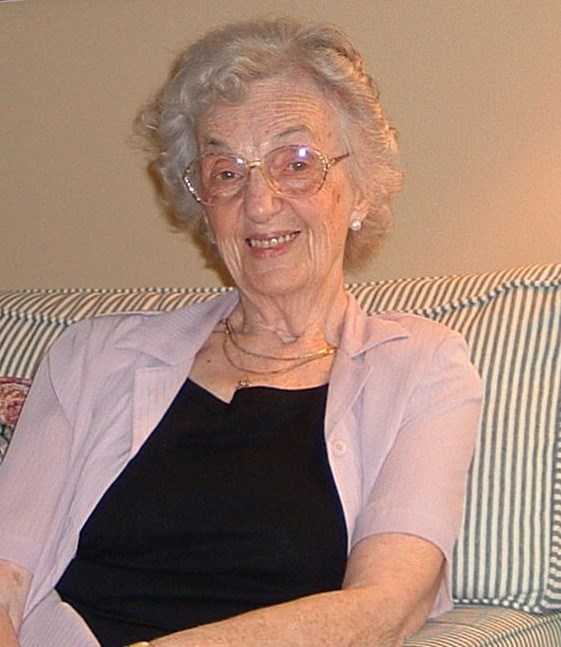
Mary Elizabeth Webber (nee Davidson) went to be with the Lord on January 2, 2015 in Surrey, BC at the age of 97. She was born in Neptune, SK in 1917. She is predeceased by Jack her husband of 56 years, her sister Annie, brother Robert (Bob) and great grandson Joshua Peters.
She will be lovingly remembered by her sons, John (Carol) Webber and George Robert (Bob) Webber. She will also be sadly missed by her grandchildren Tracy Rameriz, Jennifer (Chris) Peters and Kelly (Chad) O’Neill and her great-grandchildren Julia and Eli Peters, and Dublin and Teagan O’Neill. Also remembered lovingly by Inga (Alex) MacDougall and other nieces, nephew and cousins.
A gathering of Family and Friends will be held for those in the Lower Mainland at Seven Oaks Alliance Church, Abbotsford, BC on January 16, 2015 at 2:00 PM. A graveside service will be held in Port Dover, ON on June 27, 2015. Further details will follow.
The family thanks Elim Village and especially the staff at the Harrison and Emerald for the wonderful care they extended to Mary for eight years.
Memorial Donations may be made in Mary Webber’s name to the Mennonite Brethren Biblical Seminary, www.mbseminary.ca or to your local church.
"My Story" by Mary Webber
I was born on a farm near Neptune, Saskatchewan in 1917, one of 3 children. We lived in a one-room shack on drought and grasshopper-stricken gumbo land that wouldn't even grow weeds, so in 1919 we moved to Radville where my father found employment with Canadian National Railways. Radville, a small town a few miles north, was a railroad terminal of 1200 souls. Most of the people, except for merchants and professionals, were railroaders. The children of these trainmen had a caste system, if your father was not an engineer or a conductor you were nobody. My father was a switchman on the freights. I often think of Radville.
Though I now live on the north shore of Lake Erie I haven't forgotten my home town where I spent 20 years of my life.
In reverie I sometimes go back there. I walk its streets and think of the people who lived in each house. I look over town at the old red brick school house. I even visit the cemetery finding engraved in stone names of people I knew. I go to the prairie that stretched for miles behind our house. I pick wild flowers again, daisies, violets, blue bells and wild roses; I find meadowlarks' nests with their three blue eggs. So often when I was a small child I wandered those prairies alone. Also in memory I return to my Radville home. It was a small house, only four rooms, two upstairs and two down. The pipes from the kitchen stove and from the heater in the other room warmed the bedrooms above. Our light was from a kerosene lamp on the kitchen table. There the family gathered, we children to do our homework, dad to read his paper, and mother to dam socks. We had no running water, so carried our water from Schurman's pump a block down the street. We had no bathroom, but as someone put it, "Our bath was a path". My mother cooked on a wood and coal stove and washed on a wash board. But in spite of all we lacked, we were happy and life was good. When we kids, my sister Annie and I were small we were bathed in a galvanized laundry tub on the kitchen floor every Saturday night. Next morning we were dressed for Sunday School. I remember the fragrances-of our under-things dried in the out-of-doors. I loved my white knee socks and my black-patent leather slippers. I gloried in wearing my pink organdy Sunday dress.
So, all dressed up, my sister and I would go off to Sunday School in the custody of a grown-up neighbor girl. As we hopped and skipped happily down the street I would keep looking back at my mother in the window. She would watch us until we were out of sight.
I was a happy child. All I needed to make me happy was my mother. She was my life. Let me tell you about her. She was a large, jolly woman who loved a good joke and would laugh so hard she would wet herself. She was given to hospitality and loved to see people coming past the window. My mother was a great cook. 0 those sugar cookies! Those cinnamon buns! Those
three-layer banana cakes! Those inch-deep pumpkin pies! How good it was to come home from school and find such goodies on the kitchen table.
Ethel Davidson, my mother, was the only girl of a family of six. Her five brothers spoiled her, she admitted. We enjoyed hearing stories about this family such as the time she, aged 15, and her brother Howard, aged 17, went to a dance. When "Ladies Choice" was announced, Ethel too shy to ask one of the locals asked her brother to dance. Howard was not a bit pleased and said, "Now why did you have to ask me? Why didn't you let somebody else have me"?! Another story Ethel told was after she was married. Two of her brothers came to visit and took in the local dance. Ethel had been telling them about a woman who was very pregnant but never missed a dance. Ethel said she was afraid the woman would have that baby right on the dance floor. So when the two returned from the dance Ethel asked if the woman was there and they said, Yes and she was the belly of the ball.
Ethel had a good sense of humor, but it was not always there when I needed it, like the time I found a nest of baby mice in the barn (I was about 10). It was a cold, rainy day and I needed something warm to put my mice in. I went into the shed at the back of the house and found my mother's nice warm toque she wore to hang out clothes. "Just the thing", I thought as I put the mice in the toque and left for school. After school I could hardly wait to get home to my mice. But what did I find? There, flung in a mud puddle, were my mice! Who could have done such a thing? I would find out; I stormed into the house ready to speak my mind to
whomever. Then I saw my mother converging on me. She wasn't a bit happy with me. As I listened with growing alarm as she described putting on the toque and six slimy mice sliding down her nose and on down her neck under her dress, I thought it the better part of wisdom if I didn't register my complaint after all
Ethel is remembered for her hymn singing. She always sang whether washing down a wall or stirring up a cake: "What a Friend We Have in Jesus", "Are you Washed in the Blood?", "When the Roll is Called Up Yonder I'll Be there." Little did she realize that her children and grandchildren were listening and being influenced for good as she sang. Ethel died in 1982. She is buried in an Anglican churchyard in Mississauga. Every day at 8 a.m., twelve noon, and at six o'clock in the evening the Carillon plays hymns over her grave.
My father, Robert Elmer Davidson was born in Hillsboro, North Dakota in 1886. He was one of four children. As well as Rob there was Maude, June, and Walter. Rob farmed near Neptune until 1919 when the family moved to RadviIle. Life was hard for my dad. Many times in his life he struggled to make ends meet, being laid off work for months at a time. The garden he planted year after year helped to feed the family, although drought and grasshoppers were often a problem. Rob retired from the railroad in 1945. He and my mother moved to Saskatoon where for several years he kept city parks as a gardener. He died in 1961 and is buried in Saskatoon.
One of my favorite persons was my paternal grandfather, Hugh Davidson. He really loved my sister Annie and 1. Hugh was born in Goderich, Ontario in 1863. He farmed in St. Claud, Minnesota and later in Hillsboro, North Dakota. Latterly, in 1905, my grandfather took a homestead near Maxim, Saskatchewan. My grandparents were in their older years when they came to live in Radville, when we children came to know them. Grandpa had painful arthritis which twisted and lamed his hands and feet. Being so fond of him we children felt sad about this disability. He died in 1930. I mourned him a long time. I have never forgotten my grandpa Davidson.
My father's mother was Mary Ella Newman, born in Galesberg, Maine in 1865. She was the first lady school teacher in St. Claud, Minnesota. It was there she met my grandfather. Her schoolyard bordered on his farm. I imagine they chatted over the fence and I
am sure he often admired her from a distance; Grandma was a pretty lady. Of course in time the predictable happened, Mary Ella Newman became Mary Ella Newman Davidson. The Davidson's farmed over 16 years in Hillsboro, North Dakota. Then they got an irresistible government offer; land in South Saskatchewan could be had free if a man stayed on it and worked it six months. My grandparents took the offer and arrived in the Maxim area in 1905. Their homestead was near Big Goose Lake which was one mile long and one half mile wide. Grandma organized sports days, picnics and boating parties each summer. These were
popular events for the farm people. My grandmother was accomplished in many ways. She was a photographer, an artist, a
writer, a tailoress. As well, she was a wonderful cook, and carried off the prizes at the local fairs for her-pies, cakes, buns and bread. I think the farm women were jealous of Grandma, they called her "The Duchess". She, unlike many of them, was always attractively dressed. I never saw her when her hair was not neatly coiffed. Grandma would have her housework done early each day and could be found outside in her hammock doing her needlework.
"She thinks she's superior", said her detractors. When my uncles were overseas in the First World War Grandma sent them food parcels and encouraging letters. Remembering, after her death, her kindness to them and her accomplishments, and also the unkind remark said about her, "She thinks she's superior", they gave her the honor due her, they said "She was superior".
Grandma died in 1954. She is buried in Melfort, Saskatchewan.
My mother's father, William Alexander Smith was born and raised in Toronto. He got a degree from Toronto University. Was it a law degree or did he become a Presbyterian minister? Nobody is sure. He followed neither vocation, but became a laundry man. I'm disappointed about that, I would have liked to brag about him a little. Grandpa Smith moved his family to Maxim, Saskatchewan in 1906. He took an active part in community affairs; he was Secretary of the Municipality, Justice of the Peace, and Deputy Sheriff. Grandpa died in 1940 and is buried in Moose Jaw, Saskatchewan.
I never knew my maternal grandmother; she died before I was born. Annie Cromar Smith was born and raised in Owen Sound, Ontario. She met and married my grandfather when she was a tailoress in Toronto. They had six children, Leonard, Howard, Bemard, Willard, Edward and a daughter, Ethel. Annie was revered by all who knew her. I heard a lot about her kindnesses like sitting all night by the bed of a sick neighbor. She died of womb cancer at the age of 52. She is buried somewhere on the prairie. No one knows where this lonely grave is. (Note: since Mom wrote her story her grandmother's grave has been found in a small
plot in a farmer's field. A stone and plaque has been placed.)
I was in many plays and concerts while growing up in Radville. I don't say I was any thespian, but it was fun and one time it was even lucrative. A talent scout from CKCK Regina came to Radville one summer. All who were interested in being "discovered" were invited to perform in the local "War Memorial Hall". Certain of us were chosen to sing or whatever over radio station CKCK Regina. Winners would receive a cash prize. We winners went to Regina.
A week later, back at home, Mom and I sat nervously by the radio waiting for the winners to be announced. And then the announcement came, "Mary Davidson first prize". My mother and I danced all over the house. The prize was $25.00. I had never seen $25.00. With it I bought a three quarter length pale blue coat and like the "Sweet Little Alice Blue Gown," till it wilted I wore it.
Being interested in the entertainment business, I was often in dramas and stage presentations put on by the churches and other groups of Radville. One year the Provincial Drama Festival was held at Radville. Several plays from Regina were entered. Radville
presented a one-act play called "The Florist Shop". I had the lead in it and the judges gave me "Honorable Mention".
The time now came for me to get a job. I went to Regina as a domestic. One day while scrubbing floors and doing other mundane jobs, I began to long to be in a play. The name of one of the Regina directors in the Radville Drama Festival came to mind, Mrs. Biddell. I phoned her, she remembered me very well, she said. She was at that time casting a play called "Henry Aldridge" for Regina Little Theater. She offered me the part of Henry's mother. I was delighted. Mrs. Biddell then asked me to quit my job and come and work for her to free me for play practice. I did that. I got parts in other plays as well: "Arsenic and Old Lace", and "Dear Ruth", among them.
Housework was boring me greatly by now. I wanted to take a business course, but I had no money. "The president of the College remedied that, I could enroll in the course and pay when I got a job. A Mrs. Robinson answered my ad in the paper regarding a place to work for my board. When she came to pick me up I was looking into the eyes of my former school teacher in
Grade 4 at Radville. While at the College another student and I became editors of the school newspaper. I took the first copy home to my boarding house.
Al Ritchie, Mrs. Robinsou's brother, was there that evening. He took an interest in the paper. "When you finish your business course", he said, "and you are looking for a job go downtown and see Mr. Black, M.P. I am going to give him this paper. Tell him I sent you." For weeks after finishing my course, I tramped the streets looking for a job, but I could find nothing. One day I noticed Mr. Black's name on the window of one of the buildings. I had been too shy to approach him, but I was desperate, I went to his office. He took the paper out of his desk drawer and asked what he could do for me. ','I need a job", I said. He picked up the phone, and I soon found myself sitting over in the department of Agriculture building as a clerk. Of course, I wasn't using my stenography so when a stenographic position opened in Ottawa a couple of years later I applied for it and got it.
While in Ottawa I was able to find opportunities to be in several one-act plays. After being in Ottawa a year a phone call came from a man who was with me in the cast of "Arsenic and Old Lace". He offered me a job as a writer with radio station CKBI, Prince
Albert. I was delighted at the prospect of being in radio. As well as writing advertising I had my own radio program called "Eaton's Melody Time." I loved the work. At last I had found what I wanted to do.
Each day I went down to Eaton's to see what was on sale. Then I would come back and write up about it, add articles interesting to women and suitable music, and put it on the air. After a time there I went to CKRC Winnipeg. I was only there a week when a further opportunity arose. Walter Dales, a former manager at CKBI, Prince Albert phoned me from Montreal. He had opened a radio script office there and asked me to join the staff. I accepted.
We wrote radio scripts for most of the radio stations in Canada. I stayed in Montreal one year. My next move was back to CKRC Winnipeg to write advertising. A radio program called "Mary's Radio Digest" was given to me, sponsored by Red and White Stores.
Then life took on an even more interesting turn. One day a fellow writer asked me to go that evening to the Staggette's Ball. I said, "No, I don't have a boyfriend". She said, "I'll get you one".
That night when I got home from work the phone rang. A voice said, "This is Jack ,....... Webber". There was something about the name and the voice that seemed to be destiny. He arrived around eight to take me to the Ball. He drove up in a shiny black Pontiac. He was in "tails", I was done up in a white evening gown.
Did he call me again after that? Yes and things began to warm up swimmingly. I was in a play at that time called "Laura" for Winnipeg Little Theater. The play was to be presented in two weeks. Jack volunteered to take me to play practice at 7:30 each evening and pick me up at 11:30. When the play opened Jack was in the audience and after the play there arrived backstage
for me one dozen red roses from guess who? We were engaged in October 1947 and married in March 1948.
We moved to Stoney Creek and in 1950 put in our name to adopt a baby. Every week I went down to the Children's Aid to see if there was a baby yet. I often went home and cried when week after week there was no baby. One day, I prayed so hard I shook all heaven and God revealed to me that the baby was on its way. I started knitting little things. Three months later we had a baby boy. We named him John Alexander after his father.
It was around this time that I found Christ or He found me, whichever it was. I had gone to Church and Sunday school all my life, but had never understood salvation until the night that Jack's mother took me to hear Charles Templeton. But let me backtrack
several years. During the first year of our marriage in Winnipeg we lived in a small house in a grove of trees. It was very quiet there except for the birds which sang all day. I felt close to nature and I also felt the awesome presence of God. Jack had a Bible given him by his mother when he was 12. She had written in it, "Remember thy Creator in the Days of Thy Youth". Jack wanted it left on the dresser. I dusted the dresser and the Bible regularly. I recalled what my mother had said about the Bible: "That's
God's book. He speaks to us in that book." I was both fascinated and scared, and decided to take a quick look inside it. I carefully lifted a corner of it, but it got me. It said, "Thou art a whited sepulcher appearing beautiful unto men but inwardly full of all decay." In other words, you are dead spiritually and I was shocked but knew it was true. Scared not to, I visited the dresser top often and I found out a lot more about myself that I needed to change.
To reform I quit everything I thought might be displeasing to God. I tried to do good. I was seemingly left with the understanding that heaven or Hades hinged on my success or failure to reform. For three years I tried to please God. Trying not to be angry or critical, or impatient. I tried doing kind deeds. Though I failed more than not, I dared not stop trying. Then one day my small son pulled up my neighbor's garden. The woman was so angry and abusive that the lid blew off all my good intentions and I let her know what I thought of both her and her garden with some choice words. When my anger cooled I saw how hopeless was my attempt to be righteous. I was at the end of my rope. I gave up. Now it seemed that God had returned for my answer. He seemed to have His arms folded and to be looking down at poor little me like a great giant. "W-E-L-L?" He seemed to say. I said, "I can't do it so I'll do the best I can for the rest of my life and then I'll die and go to hell."
It was later that same week that Jack's mother asked me to attend an evangelical meeting. As the speaker described the sun-tanned young man walking the beaches of Galilee I somehow knew He was God. As the stormy sea was stilled, and the winds ceased at this Man's bidding, as sicknesses were healed and sinful ones forgiven, I knew this Man was God. Finally, I saw Jesus Christ on a cross. The speaker said "He is there taking the punishment your sins deserve." I knew then that God would forgive me my sins. I invited Him into the center of my being.
I have stopped trying to be a Christian in my own strength, I have learned that "I can do all things through Christ who strengthens me" and through the Holy Spirit who indwells me. A second son, George Robert, was born in 1954. We now commenced the joys and sorrows of raising these boys to manhood. Those years passed quickly. John is now a business man, a consultant, with headquarters in Vancouver. Bob, as George Robert's called, became a lawyer although he hasn't been steadily employed as such. He met with a tragic accident at age 18 and has been in a wheelchair for 32 years. Bob has shown great courage in the way he has come through these difficult years.
Our family has grown. John married Carol Batt, a wonderful girl whom we all love.
Since Mom wrote this story the following section has been rewritten to update the family history. They have three daughters, Tracy, Jennifer and Kelly. They are all married and we have four great grandchildren,Julia Faith Peters, Elijah Matthew Peters, Dublin John Russell O'Neill and Teagan Faith O'Neill.
Show your support
Add a Memory
Share Obituary
Get Reminders
Services
SHARE OBITUARYSHARE
- GET REMINDERS
v.1.18.0