OBITUARY
Dr. Samuel Berkowitz
January 14, 1933 – February 26, 2026
Born on January 14, 1933, in New York City to David Berkowitz and Clara (nee Wetstein) Berkowitz, Sam grew up in Williamsburg, Brooklyn, in a close-knit Jewish immigrant community. His mother had come to NY from Poland and his father from Romania. He, his parents, and his younger brother Paul lived in a small apartment and made do with very little, but hard work and high expectations were part of his daily life. He had his first job at age 9, in a corner candy store, and later delivered newspapers, and thenworked at the U.S. General Post Office near Penn Station. His grandmother, Pesha Wetstein, was a strong presence in his early years and remained an important figure in the stories he told about his childhood. From an early age, Sam understood the value of a work ethic, education, and persistence.
His father worked as a day laborer unloading ships on the docks before finding work as a cook in a Romanian restaurant on the Lower East Side. In time, through years of hard work and consistency, he purchased that restaurant and turned it into Sammy’s Roumanian Steak House, a place that later became famous (perhaps infamous), for its kitschy charm, lively atmosphere, and unique bar and bat mitzvah celebrations.
As a boy, Sam loved baseball. He recalled sitting in the parking lot outside Ebbets Field, listening to Red Barber announce Brooklyn Dodgers games over the PA system because game tickets were too expensive. Jackie Robinson was his boyhood hero. He was also an ambitious autograph collector, seeking autographs from many of baseball’s early greats, as well as from Broadway and Hollywood stars who passed through New York City. He told stories of sneaking into hotels and even hospital rooms in pursuit of autographs. He was sometimes caught and thrown out, but rarely discouraged. Sam stayed determined throughout his long life… if something mattered to him, he did not give up easily!
Sam attended New York City public schools and earned admission to Stuyvesant High School, one of the city’s most competitive public schools. He went on to the City College of New York, earning a BBA in Business. He was a member of the CCNY boxing team in 1952 and 1956, beginning a lifelong love of boxing that he later shared with his son Matthew.
From 1953 to 1955, Sam served in the United States Army towards the end of the Korean War. He did not see combat and liked to joke that his main contribution to the war effort involved “peeling a lot of potatoes”. His military service made it possible for him to continue his education under the G.I. Bill. After his discharge, he returned to CCNY to earn a master’s degree in Psychology, then moved to Maryland to pursue his Ph.D. in Clinical Psychology at the University of Maryland, College Park. Through education, discipline, and effort, he built a solid middle class life for himself and his family.
Sam and his former wife Joanne lived overseas in the mid-1960’s while he taught college-level psychology classes through a University of Maryland program serving U.S. Army bases. They lived in Japan, Korea, and Okinawa for one year, and in France, Germany, and Turkey for one year. Sam taught active-duty service members, their families, and government employees, and traveled extensively on weekends and school breaks. The experience sparked a love of travel and exploration of other cultures that stayed with him for life. He and Joanne cultivated many wonderful relationships from these travels.
In the 1960s, Sam was active in the civil rights movement. He marched on Washington with Dr. Martin Luther King Jr. and participated in other demonstrations. He and a Black friend deliberately entered “whites only” restaurants in protest of segregation laws. He believed deeply in fairness and human dignity.
In 1973, Sam and Joanne moved their young family to Columbia, Maryland, drawn to the new community’s intentional commitment to racial, religious, and socioeconomic diversity. It was not simply a real estate decision, but a reflection of their values. Sam believed in fairness, inclusion, and mutual respect, and he wanted his children to grow up in an environment that celebrated the richness of human diversity.
Sam worked for the state of Maryland for many years, including at the Regional Institute for Children and Adolescents (RICA) and other institutions serving individuals with developmental disabilities. He later established a private practice in Clinical Psychology, working with children, adolescents, adults, and couples, and offering parenting education as well. He was dedicated to his clients and to the idea that people could grow and change with the right support. He finally retired at the remarkable age of 89.
Sam’s commitments extended beyond his profession. Raised in a strict Jewish household, he kept kosher and attended Hebrew school weekly as a child, even enduring harassment on the streets outside from those who resented Jewish students. His Jewish identity remained central to him throughout his life. He also found deep personal meaning in Buddhist teachings later in life, drawn to their emphasis on compassion and empathy. Those values guided him in his work and in his relationships.
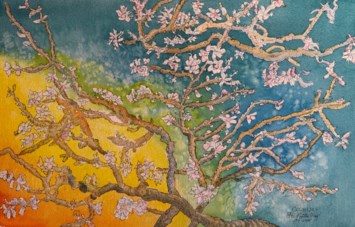
In his 40’s, Sam took up watercolor painting. This became a serious avocation. He joined the Baltimore Watercolor Society and exhibited in numerous juried shows. He was proud of his artistic accomplishments, but he took the greatest pleasure in creating personalized paintings for his children, grandchildren, and friends. His artwork hangs in many homes, leaving us with many visible reminders of his creativity and love.
The boy who snuck into Babe Ruth’s hospital room for an autograph never lost his enthusiasm for collecting. He continued to seek autographs from Hall of Fame baseball players and boxers, traveling around the country to shows with his son Matthew. These trips were as much about time together as they were about the collectibles.
Sam was a true extrovert. He loved conversation, and especially loved to “kibbitz” (a Yiddish word for playful banter). At family dinners, in checkout lines, or doctors’ offices, he was always drawn to joke with the people around him. He enjoyed trading quips with those he loved, and his teasing was always understood to be a sign of affection. Even in his later years, as Parkinson’s disease and Alzheimer’s gradually limited his mobility and cognitive functioning, his playfulness and humor remained.
Sam was predeceased by his former wife, Joanne (nee Ratner) Berkowitz, as well as by his parents, David Berkowitz and Clara (nee Wetstein) Berkowitz, and his beloved grandmother, Pesha Wetstein.
He is survived by his three children: Lisa Drexler and her husband Ken Drexler, and their sons Colin, who is engaged to Rachel, and Nathaniel; Matthew Berkowitz and his wife Arianna Berkowitz, and their children Madelyn and Jonah; and Daniel Berkowitz and his wife Paradee Berkowitz, and their children Hailey and Elijah. He is also survived by his brother Paul Berkowitz and his wife Joan Berkowitz, and by his nieces and nephews Theresa LaMotte and her husband John LaMotte, Marci Villaneuva and her husband Jesse Villaneuva, Jill Ratner and her husband Elon Shacter, and Daniel Ratner and his wife Celia Saino.
Sam’s life spanned from the era of the Brooklyn Dodgers to the digital age (which he mostly chose to ignore; he never adapted to smartphones or computers), from listening to games outside the stadium to guiding generations of therapy clients and students. He believed in hard work, education, kindness, family, and a well-timed wisecrack. He will be remembered for his intellect, his convictions, his art, and his fierce love of his children and grandchildren.
Family will receive friends at Witzke Funeral Homes, Inc., 5555 Twin Knolls Rd., Columbia, MD 21045 on Wednesday, April 8th from 9:00 AM to 10:00 AM, where a memorial service will begin at 10:00 AM. A committal service will follow at Columbia Memorial Park, 12005 Clarksville Pike, Clarksville, MD 21029 at 11:30 AM. A reception will immediately follow the committal at Witzke Funeral Homes, Inc.
In lieu of flowers memorial contributions may be made to the Alzheimer's Association,
Show your support
Add a Memory
Share Obituary
Get Reminders
DONATIONS
Services
SHARE OBITUARYSHARE
- GET REMINDERS
v.1.18.0