OBITUARY
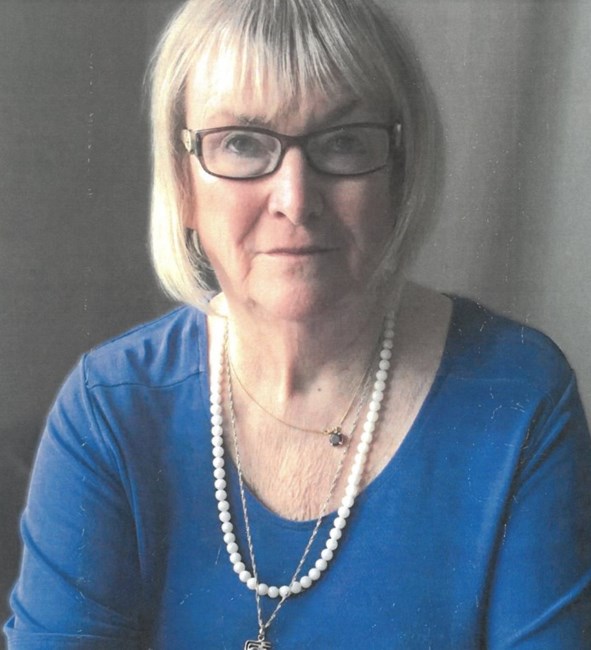
Veronica Eley
25 February, 1950 – 21 September, 2026
In lieu of flowers, the family invites donations to Songbirds Have Flown Away, a memorial collection of her last poems, written 2021-2026. Contributions can be made by INTERAC E-TRANSFER to [email protected], with “Veronica’s Poetry” in the message field.
Veronica possessed a rich and unmistakably authentic personality. She saw deeply into other people and into the sad—and sometimes merry—truths of the world. She had a remarkable gift for speaking about what she saw in language that was at once frank, unexpected, and naturally poetic. For example, on recently reading through the poetry of her late son David in preparation for his memorial book of poems, Spells Spoken to the Caves—which she helped edit—she confided to her husband that it was “like walking backwards across a bridge.”
Veronica was born in Middleton, Manchester, England, in 1950, the youngest of four children of Gordon and Mary (Carroll) Eley. The family came to Halifax in 1952, settled in Dartmouth the following year, and moved to Antigonish in 1958. Veronica attended St. Francis Xavier University, the School of Creative and Performing Arts at the University of Calgary, and Memorial University, studying Religious Studies and Philosophy, before completing a B.A. in Philosophy at Atkinson College, York University.
After living in Newfoundland from 1972 to 1974, she moved to Toronto. There she worked as a secretary at Atkinson College, then as a women's shelter and housing support worker before finding the work that would occupy much of her professional life: teaching adult literacy with the Toronto District School Board from 1994 until 2011. She cared deeply about people whose intelligence or possibilities had too easily been overlooked.
In 2002, Veronica completed a Master of Education at OISE, University of Toronto. The experience became important far beyond the degree itself. Together with therapy, it helped her undertake what she called a process of “creative remembering”: recovering and giving language to experiences that had remained psychologically unresolved. Journaling opened what she described as a fluid connection between “soul, brain, pen and paper.” Out of that process came some 600 poems.
Poetry became for Veronica not simply an art but a means of knowing herself. She wrote that through its transformative role in her healing, “I became for the first time in my life a fully integrated person.” Equally important was the idea of the witness—another person who could affirm that feelings and events had truly occurred. After retiring to Dartmouth in 2016, she gathered some of this work into The Blue Dragonfly: healing through poetry, published in 2021. The book found readers and reviewers well beyond Canada, including in the United States, Ireland, the UK, Singapore and India. A revised edition and a second collection of her poetry are intended for posthumous publication.
Behind that achievement lay a lifelong search for what Veronica herself called “a safe place.” Her life was marked by profound psychological pain and a long engagement with therapy. That sensitivity extended well beyond her own experience: she responded instinctively to vulnerability and suffering, in people and animals alike, moving quickly from empathy to care, and responding with fierce indignation to cruelty, injustice, and the indifference of those with power. She did not sentimentalize these experiences. Her characteristic response was to look hard at the world, to name what she saw, and to fight her way toward the things in life that gave her pleasure and meaning.
And Veronica knew how to seize life’s pleasures. She loved her family, her work and her cats. She was passionate about food and formidable in the kitchen. She loved clothes, knew that she was beautiful, and enjoyed dressing accordingly. With characteristic amusement, she called herself a “glamour puss”—another fancy cat in the house. She also possessed a striking singing voice, much remarked upon by those fortunate enough to hear it. In her poem “mist,” she remembers her maternal grandfather, Gerald Carroll, who worked in a cotton factory and sang at family gatherings “in a beautiful, Irish tenor voice”—a family inheritance she carried in her own way. She also loved film, dramatic series and comedy. As illness made her increasingly housebound during the last decade of her life, these became not merely entertainment but an important part of her engagement with the world: its stories, absurdities, sorrows and laughter. Seriousness and suffering never entirely defeated her appetite for the sensuous, comic and beautiful.
Her family life contained both deep attachment and great loss. She was reunited in 1996 with her daughter, Krista, whom she had given up for adoption in 1970, and mother and daughter became close. In December 2023, Veronica, her husband Roger, and their older son Bern lost the younger son and brother, Aeriel-David Skelly Langen. In the years following his death, the family worked together on the memorial collection of poetry, with Veronica and Roger as editors and Bern contributing photographic work. Spells Spoken to the Caves was completed in the final week of Veronica's life.
Veronica was diagnosed unexpectedly with advanced cancer on August 14. She was admitted to hospital on September 10 while further diagnostic work was still under way and died before treatment could be offered. Through the bewildering speed of her illness, repeated procedures and increasing pain, she faced what was happening with stoic clarity. She neither denied the seriousness of her condition nor surrendered her hope that there might still be time for treatment and more life.
She is predeceased by her son, Aeriel-David Skelly Langen. She is survived by her husband, Roger Langen; her son, Bern Alysaundre Langen; her daughter, Krista Thibodeau Short; her four grandchildren, Christopher, Amy, Meghan, and Sam; her great-grandchild, Ozzie; her sisters, Christine and Bernadette (Robert Scott); her brother, Fr. David Eley, S.J.; the English cousins, Chris Carroll (Irene), Andrew Carroll (Kathie), and younger members of the English family; close friends Pauline Smith, Halifax; Marsha and Terry McDonald, Dartmouth; Katie Parnham, Portugal Cove, Newfoundland; Myrna Lang, Calgary; and Elizabeth Sedgwick, Toronto; and by her cat, Girlie.
She is also remembered with love by Roger’s brother, Scott Langen, and his wife, Trudy Matthews, whose steadfast friendship and support meant much to Veronica and Roger over many years, especially in times of crisis.
A memorial gathering was held for Veronica in the Chapel & Reception Room at A.L. Mattatall Funeral Home, Dartmouth, at 2:00 p.m. on September 26. Veronica's poetry was read, and remembrances shared by those who knew and loved her. The gathering was streamed and recorded for those unable to attend.
While at Victoria General Hospital and before being taken down the hall to palliative care, Veronica asked that the following message be shared in farewell —
“Sending out a message to Love, and all.”
Show your support
Send Flowers
Add a Memory
Share Obituary
Get Reminders
- SEND FLOWERSSEND
FLOWERS SHARE OBITUARYSHARE
- GET REMINDERS
v.1.18.0