
OBITUARY
Twyla Ethel Denney
23 April, 1924 – 7 December, 2023
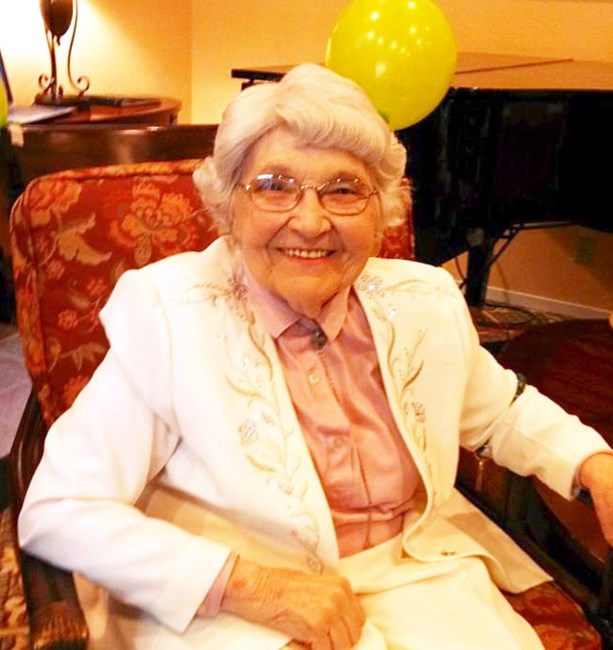
Twyla Denney was born April 23, 1924, in La Junta, Colorado. She went into the presence of her Lord and Savior, Jesus Christ, on December 7, 2023, in Visalia, California. She is survived by her three sons, Jim, Tim, and Tom, Jim’s wife Deborah, grandchildren Bethany Williams and Ryan Denney, Bethany’s husband Wade Williams, great-grandchildren Benjamin, Peter, and Eleanor Williams, and sister Ruth Rogalsky and her husband Frank.
Twyla, the fourth of five children in the Unruh family, spent her childhood on farms in Colorado and Wyoming. Though the Unruhs were “mainline Mennonites,” the only nearby church was a strict “Old Mennonite” congregation. A few weeks before Twyla was born, women from the Old Mennonite church gave Twyla’s mother, Anna, a baby shower. They brought food and gifts—and a missionary speaker who led a Bible study.
The Unruh home had no electricity or phone. When Anna went into labor with Twyla, she asked a neighbor lady to call her husband at work. Twyla’s father Henry picked Anna up at 5:15 pm and rushed her to the hospital. Twyla was born forty-five minutes later at 6 pm.
Her father liked the name Twyla and her mother liked Ethel, so she was called Twyla Ethel throughout her childhood. Soon after she was born, two women came to take her picture for the La Junta Beautiful Baby Contest. In the award ceremony at the local movie theater, Twyla won first prize—but her parents weren’t there to accept it. As Mennonites, they weren’t allowed to set foot in a theater.
Twyla’s early years were shaped by Old Mennonite traditions. She wore bonnets, prayer coverings, plain dresses, and no jewelry. Even after the family moved to California and attended a less strict Mennonite church, Twyla continued to wear plain Mennonite clothing. When she was thirteen, her parents gave her a necklace for Christmas—but for years, she couldn’t bring herself to wear jewelry.
As a child, Twyla loved animals. Her parents raised chickens and Twyla was horrified to learn that any undersized or sickly hatchlings had to be killed. One day, Twyla decided to rescue a sickly chick. All through lunch, she pleaded with her mother not to kill the little chick. She looked mournful and wouldn’t touch her food. Later, Twyla’s mother found the little girl with tears running down her face and the chick cradled in her arms. The chick was allowed to live.
The Unruh family farmed for a while outside of Eden, Wyoming, elevation 6,600 feet. The people there said there were only two seasons in that part of Wyoming—winter and July. When people walked outside, icicles would form in their hair. At Christmastime when Twyla was four, she looked out the window and saw a man approaching the house with icicles hanging from his beard and hair. Twyla shouted, “It’s Santa Claus!”
When Twyla was six, her mother underwent surgery. When Twyla went to the hospital to visit her mother, she was impressed by the nurses in their starched white uniforms. She told her dad, “I’m going to be a nurse someday.”
Twyla lived through the Great Depression. The depths of the Depression took place when she was twelve or thirteen and living in Colorado. There were times when Twyla’s mother would climb up to the roof of their barn, raise her hands toward Heaven, and pray the Lord’s Prayer—and she would repeat one line of that prayer with extra emphasis: “Give us this day our daily bread!”
Twyla’s family lived in a number of houses in Colorado and Wyoming, but the only house that had electricity was near Rocky Ford, Colorado. The family bought a radio (paid for in weekly installments of one fryer chicken every Saturday) so they could listen to her father’s quartet broadcast from the La Junta radio studio on Sunday afternoons.
The family could only afford one light bulb at the Rocky Ford house. An electric cord hung from the ceiling in each room. They would unscrew the bulb and take it to whichever room needed light.
Twyla later recalled that, even in the depths of the Depression, she never thought they were poor. In fact, she spoke fondly of her childhood. “We lived in a nice big house that we called the Red House,” she said. “It was on the Santa Fe trail, and my dad had his heart set on farming that land. The Arkansas River ran behind our property. It was a beautiful setting, with many trees along the river. My brothers, Chester, Gilbert, and Quentin, loved to swim in that river. We had so much faith in God that we never seemed to lack for anything.”
When she was ten, Twyla sang her first duet in church alongside her fourteen-year-old brother Quentin. At a Sunday night service, they sang, “Back of the Clouds the Sun is Always Shining.” They sang a cappella because the Old Mennonites did not allow instruments in church.
Around that time, ten-year-old Twyla had her first experience as a “nurse” tending a “patient.” She recalled, “Quentin was riding a horse when another horse kicked up and cut a gash in his leg. I helped bandage the wound, then Dad took him to the hospital to have his leg stitched. There was a lot of blood, but it didn’t bother me. I guess I was cut out to be a nurse.”
Twyla’s little sister Ruthie was born when Twyla was eleven. Her mother had to stay in the hospital for five weeks, so everybody pitched in to do chores. Twyla’s specialty was doing dishes and helping brother Gilbert with the cooking.
When Twyla was thirteen, her family decided to move from Colorado to California. The night before they were to leave, Twyla woke up screaming—something had crawled up on her arm. She shook it off onto the floor. Her mother and father rushed into the room and saw the creature on the floor—a scorpion. Fortunately, Twyla had somehow shaken it off before it could sting her.
Twyla’s oldest brother Chester went ahead of the family, hitchhiking out to California with less than a dollar in his pocket. He wrote back, saying there were no jobs in California. Twyla’s mother felt she should show the letter to her husband—but Gilbert and Quentin convinced her to burn the letter. They all wanted to go to California, and they were afraid that if their dad read it, he’d change his mind about going.
They loaded up the old Oakland hard-top automobile and drove from Colorado to California (by way of Kansas and Oklahoma to visit relatives) along Route 66. They crossed the Mojave Desert in August of 1937. As Twyla recalled years later, “It was so hot! Ruthie was just two. My parents had a lot of courage to strike out across the country like that—and a lot of faith in God.”
They settled in Reedley, where there was a thriving Mennonite community—and countless vineyards and orchards producing an abundance of fruit. At thirteen, Twyla found work picking and packing figs and grapes. The family rented a little house near the church for $25 a month.
When she was fifteen and attending high school in Reedley, Twyla and her friend Ethel Harter agreed to each write a novel. It turned out to be a lot harder than they expected. “I got two pages written,” she later said with a laugh, “and that was the end of that. Ethel got about as far as I did.”
Twyla’s dream of a career in nursing continued through high school. “I saw a nurse walking to the hospital late at night,” she recalled. “And I thought, ‘That nurse is going to help sick people get well. That’s what I want to do.’”
The summer after graduating from high school, Twyla worked in the packing house to earn money for college. She attended the Bible Institute of Los Angeles (now Biola University) where her studies ranged from chemistry (a requirement for nursing) to Bible and missions courses. “I didn’t excel in chemistry,” she recalled, “but I did pass. I needed to make 80, and I got an 81, so God helped me through that one.”
While in college, Twyla worked at Clifton’s Cafeteria near Pershing Square in Los Angeles. One of her regular customers was a distinguished-looking gentleman in his sixties. He would order lunch and would always leave a nice tip and a hand-written poem for Twyla. He never signed the poem and he never gave his name.
One day, Twyla was talking to her customer and she said she would soon graduate from college and return home to Reedley. The gentleman said, “When is your last day of work?” She told him.
On her last day at Clifton’s, the gentleman came and ordered lunch as usual. He gave her a poem, which he had folded. It was a busy lunch hour and Twyla didn’t get to open the folded sheet of paper until she got home.
She opened the poem and saw that he had signed it. He was the famous poet Edgar A. Guest. “I had all those poems saved in a box,” she recalled, “but they got ruined when a hard rain left a foot of water in our basement in the 1950s. I wish I had kept them in a safer place.”
After graduating from Biola, Twyla applied to a nurses training school in La Junta, Colorado. She was accepted—but was afraid to tell her parents. She knew they didn’t want her to move so far away. “I ordered the clothes and shoes I needed for nursing school,” she said, “and I hid them under my bed so Mom and Dad wouldn’t see them. Then, two weeks before I was supposed to go, I told them. Dad wasn’t happy with the idea, but Mom convinced him that if that’s what I wanted to do, I should go to Colorado.”
After one year in Colorado, Twyla returned to California and completed her training at Fresno County Hospital. After she took her final exams, she told her mother she would get a letter—and she’d know just by looking at the envelope if she had passed or not. If the letter was addressed to Twyla Unruh, R.N. (for “Registered Nurse”), she had passed the exam.
One day, while at her parents’ home in Reedley, she went out to get the mail. Moments later, her mother heard a shout. The usually quiet and reserved Twyla ran into the house, calling out, “Mama! Mama! I made it! I’m a nurse!”
One day in early 1951, Twyla told her parents the big news: She had a boyfriend. His name was Leland Denney—and he was the one. Her mind was made up. In August 1951, after a short engagement, Lee and Twyla were married.
Twyla recalled that she was nearly late for her own wedding. She was the last one to leave the house in Reedley—everyone else had gone to the church. She had a feeling she was forgetting something—but what? Then she thought: We don’t have rose petals for the flower girl’s basket! She went to her mother’s rose bushes by the side of the house and cut off one of the white roses. Then she dashed to the church and gave the rose to one of the bridesmaids, who plucked the petals for Twyla’s niece, Laurel, the flower girl.
After a beautiful wedding ceremony, Lee and Twyla honeymooned at the Mount Hermon Christian Conference Center near Santa Cruz. In addition to horseback riding, hiking, and enjoying the scenery, Lee and Twyla attended meetings at the Bible conference. From the outset, they were committed to keeping Jesus Christ at the center of their marriage.
After the honeymoon, Lee and Twyla stayed for a month in an apartment at the Five Points fire station where Lee’s parents lived. Then they moved to Coalinga, where he worked as a banker.
In May 1953, Lee and Twyla welcomed their first son, Jim, born the day before Mother’s Day. Their second son Tim was born in April 1956. Their third son, Tom, was born in November 1961—three months premature and weighing only three pounds. The family brought him home from the hospital just before Christmas.
Twyla would sing a German lullaby to her babies while rocking them to sleep: “O wie wohl ist mir am Abend, mir am Abend, wenn die Abendglocken läuten, Glocken läuten.” (“Oh, how lovely is the evening, is the evening, when the bells are sweetly ringing, sweetly ringing.”)
Music was the heartbeat of Lee and Twyla’s marriage. Leland sang “Oh Promise Me” at his wedding to Twyla, and they both sang a duet of “Jesus Leads” at Twyla’s parents’ golden wedding celebration. Jim, Tim, and Tom remember how their mother used to play and sing, “Give the World a Smile Each Day (Helping Someone On Life’s Way)”—and how she used to live the message of that song. Lee and Twyla sang countless duets at church, including “Blessed Assurance” and “What a Friend We Have in Jesus.”
Also central to Lee and Twyla’s relationship was a passion for children and needy people. They were involved in several Christian ministries—Child Evangelism Fellowship, Message of Life, and many others. Their home was a welcoming place for family, friends, exchange students, and their sons’ school friends (who sometimes showed up unannounced at dinnertime, but never left hungry).
Lee and Twyla celebrated their golden wedding anniversary in August 2001. They were joined by more than a hundred friends and family members.
Lee passed away quietly in his sleep in May 2014, and Twyla joined him in Heaven nine years later. The songs they are singing together now would be amazing to hear!
Show your support
Add a Memory
Share Obituary
Get Reminders
FAMILY
Leland DenneyHusband (deceased)
Timothy DenneySon
James D. Denney (Debbie)Son
Thomas DenneySon
Twyla also leaves two grandchildren and three great grandchildren to cherish her memory.
Services
SHARE OBITUARYSHARE
- GET REMINDERS
v.1.18.0