
OBITUARY
Charles Cooper Britton
April 27, 1922 – March 26, 2025
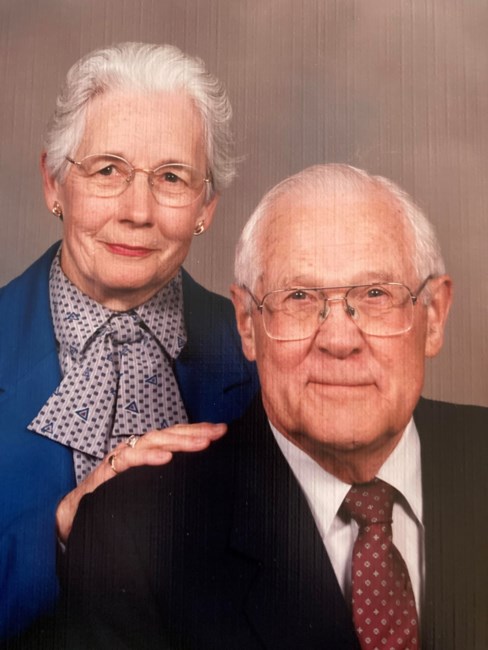
Charles Cooper Britton died on March 26, 2025, at his home in Fort Collins, Colorado, aged 102. He lived a truly American life, growing up in the Dust Bowl and Great Depression, serving in World War II, and going on to become a college professor. He built a home with his wife of 72 years and raised a family of two sons.
He was born on April 27, 1922, in Whitley City in the coal mining region of southeastern Kentucky, the oldest of the four sons of Olney Loren and Pearl Ethel Britton. The family moved to Texas in 1927, eventually settling in West Texas where Charles’ father worked for the Quanah, Acme & Pacific Railroad. His mother returned to Kentucky with her four boys each summer by train, which gave Charles vivid memories of his parents’ families. Later in life, one of his uncles, who was clerk of McCreary County, arranged for him to be commissioned a Kentucky Colonel. He remained attached to Kentucky throughout his life, attending family reunions and bringing his children and grandchildren to his birthplace to celebrate both his 80th and 90th birthdays.
Charles attended elementary school in Dougherty, Texas. He joined the Boy Scouts as a participant in the “Lone Scout” program designed for boys in areas without a troop. Despite the lack of fellow Scouts, he remembered the projects and outdoor activities with his designated Scoutmaster as formative. He graduated from Quanah High School in 1940. He was a gifted athlete and served as captain of all three of the school’s sports teams—baseball, football, and basketball.
Frank Dougherty, who had founded the eponymous town in 1928, made it possible for Charles to go to college through personal encouragement and by providing Charles with a loan for his first-year tuition and expenses. Charles enrolled at what is now Texas Tech University to study engineering. He repaid Mr. Dougherty’s loan, and paid his on-going tuition and expenses, by working on exploration crews in the West Texas oil patch during college summers and in the office of the college’s president, Clifford B. Jones, during term time.
At Texas Tech, Charles enrolled in the Reserve Officers’ Training Corps and was called to active duty in June 1943 to serve in World War II as an officer in the U.S. Army Signal Corps. After training in fixed station (high power) radio transmission, he was deployed to the Southwest Pacific Theatre, first serving in New Guinea and then in Luzon, Philippines, where he was assigned to Sixth Army Headquarters. In the occupation of Japan, he served at General MacArthur’s Supreme Allied Headquarters in Tokyo. Following his discharge from active duty in 1946, Charles continued as an Army reservist. He retired from service in August 1963 with the rank of major.
Charles returned to Texas Tech in the fall of 1946 on the GI Bill and graduated with a degree in electrical engineering the following year. He then accepted employment with the General Electric Company in New York and Massachusetts. While there, he made the decision to pursue a vocation in teaching rather than working in industry.
He married Maxine Harp of Abernathy, Texas on August 15, 1948. They had met at Tech on a blind date arranged by his college roommate. Together they completed their graduate degrees at what is now Iowa State University in 1950, and both then obtained teaching positions at Colorado A&M (now Colorado State University). Charles served on the electrical engineering faculty, with a career stretching from the time of vacuum tubes to the world of microchips. He remained devoted to teaching throughout his career, with students recognizing and appreciating that devotion—some saying he was one of the best professors they had.
In the summer of 1967, Charles was a fellow in the history of science and technology at the Smithsonian Institution in Washington, D.C. He then created an undergraduate course at CSU that was in the vanguard of the developing interest in the history of technology, and through the National Science Foundation, also taught summer seminars on the topic for high school teachers. He also served for a number of years as instrumentation engineer at CSU’s Foothills Engineering Research Campus. From 1974 until his retirement in 1986, he was Assistant Dean of Engineering, coordinating with administrators at other university engineering programs in Colorado and traveling across the state to encourage pre-engineering students at local community colleges. He was active in the American Institute of Electrical Engineering, Institute of Radio Engineers, Instrumentation Society of America, and American Society of Engineering Education.
Locally, Charles was part of the Engineers Club, Men’s Science Club (now the University Science Club), and Sigma Tau honorary society. He was an avid outdoorsman—hunting, fishing, and camping with friends and family. He also pursued a personal interest in nature photography. He loved art and literature. Throughout his service in World War II, he carried with him a one-volume compendium of Shakespeare’s plays and sonnets.
After retiring, Charles wrote and published a number of works on family, Colorado and railroad history, including The Quanah Route: A Texas Short Line Railroad (1990). He and Maxine traveled through most of the continental U.S. and Alaska, often pursuing genealogical research, and traveled several times to Paris and London where their sons’ families were living. He took particular joy in his grandchildren, all of whom spent significant time individually with their grandparents in Fort Collins.
Charles is survived by his son Edward (Katherine) of Washington, D.C., and grandchildren Peter (Stephanie), Gillian (Aaron) and great-grandchildren Milo and Cedar, and Matthew (Gabriella); and by his son Joseph (Karla) of Albuquerque and Hillsboro, New Mexico, and grandson Nicolas (Tess).
Services will be at St. Luke’s Episcopal Church, 2000 Stover Street, on Monday, April 7 at 10:00 am. A private burial will follow at Grandview Cemetery.
Show your support
Add a Memory
Share Obituary
Get Reminders
Services
SHARE OBITUARYSHARE
- GET REMINDERS
v.1.18.0