
OBITUARY
Edwin deSteiguer Snead
2 December, 1929 – 22 January, 2015
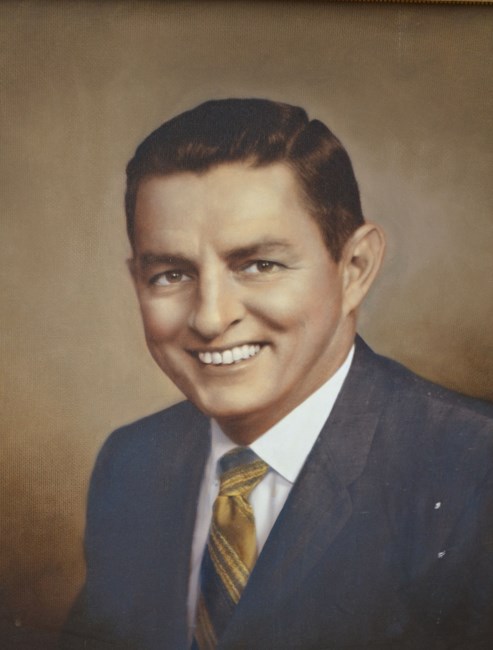
A pillar of the Georgetown community, Ned was well-known for both his innovative ideas and his controversial opinions. From his teenage years he worked with his father, Edwin Brazelton Snead, and later his brother, William Brazelton Snead, to make Texas Crushed Stone the most productive limestone quarry in the United States.
In the 1960s Ned ventured out of the family business temporarily and studied computer programming at IBM in Houston. Always an early adopter of new technology, Ned brought business computing back to Georgetown in the form of DATALAB, a computer he based at Texas Crushed Stone and time-shared to businesses that were just entering the digital age. Even the City of Georgetown used DATALAB to handle water and electricity bills for its customers.
In 1992, at an age when most men are retiring, Ned created Georgetown Rail Equipment Company (GREX). GREX is a rail services company providing the railroads with specialty equipment and innovative technological products and services to maintain and repair track all over North America. Much of the equipment that GREX uses was invented and patented by Ned, including the DUMP TRAIN, a train that unloads itself by way of a conveyor belt running the length of the train. Also unique to GREX is the SLOT MACHINE, ballast cars that connect, forming one continuous car in which a front end loader can run from front to back. Ned holds 26 patents for various inventions related to the rail industry. Often Ned would have an idea and others would tell him, “That won’t work” or “We don’t need that.” He never let negative opinions deter him from pressing on with his invention. Sometimes the idea didn’t work, but often enough he would come up with a product that was both ingenious and economically viable. GREX has grown exponentially since its inception and now enjoys an international reputation for state-of-the-art rail services.
Ned was born December 2, 1929 in Texarkana, Texas to Annie Louise deSteiguer (Mama Lou) and Edwin Brazelton Snead (Pop). They moved to Austin in 1932. Ned got his start in engineering as a young boy. He made a gear sprocket for a home-built motor scooter out of a round piece of steel, drilling 50 evenly spaced holes around the edge and then flame-cutting and grinding the extra steel to form the points. He learned to fly small airplanes while still in high school, a skill which became a life-long hobby. Maybe he had time for all these projects because he never watched a television show until 1951.
Ned studied mechanical engineering at Texas A&M. He joined the Corps and played trombone in the Aggie Band. Academically, he carefully calculated the minimum amount of work he would have to do and still qualify for the Tau Beta Pi Honorary Engineering Society. He proudly wore his Tau Beta Pi tie tack for decades after he graduated.
After college, Ned served the Air Force as a second lieutenant in Korea as a communications officer. Although Ned acknowledged that military service taught him more, and in less time, than any other experience of his life, he also admitted that he was not well-suited to Air Force life. It seems he felt obligated to point out to his superior officers how things could be run much more efficiently, advice that was not well received.
Returning from Korea, Ned had three daughters with his first wife, Susie. He was a stellar Daddy. He gave us piano lessons using IBM cards stuck behind the keys to explain chord theory. He played silly guitar songs to us almost every night to put us to sleep. He built a pigeon coop in the backyard and let us raise baby pigeons. He made us read Dale Carnegie’s book “How to Win Friends and Influence People.” We went camping and canoeing and had picnics on the family “barge” in Lake Austin. He joined the Girl Scouts.
Ned threw himself headlong into new projects. He invented his own golf club that could be used as both an iron and a putter. He loved singing in barbershop quartets. He studied American Sign Language and promoted it as a method of international communication. He ran for US Senate. He built a high speed sailboat and flew ultra-light aircraft. He learned to scuba dive. He visited China many times and created a program in Georgetown and Jarrell elementary schools to teach children to speak Chinese. He was a charter member of the Georgetown Sunrise Rotary Club and faithfully attended the early morning meetings until the month before he died.
Early in his career selling limestone for road building, Ned’s contact with a few unscrupulous public officials led him to make a resolution. “For the rest of my life, I will do nothing that has to be kept hidden.” An extra sale was not worth compromising his integrity.
In 1982 Ned and his new fiancee Sherron Smith Jordan crashed an airplane into Lake Buchanan. Ned sustained a concussion and would have drowned had not Sherron persuaded him to crawl out through the broken windshield and take his boots off for a swim. Ned remained absolutely devoted to Sherron until the day he died. They had 32 wonderful years together and had fun traveling the world together. Their door was open to friends and Sherron was always ready to cook up something delicious when guests would drop by.
Ned is survived by his loving wife Sherron, children (and spouses) Bonnie and Bill Stump, Cindy and Paul Wood, Jeannie Snead and Glen Kotulek, Jennifer and Kirk Roddie, and Vernon Jordan, plus 14 grandchildren and 5 great grandchildren. He is also survived by his first wife Suzanne Kerr Snead, and by his brother and sister-in-law Bill and Nancy Snead.
A memorial service will be held January 31 at 2 pm at First United Methodist Church with a reception to follow. In lieu of flowers, please consider a donation to either the Georgetown Sunrise Rotary Club or the Ned Snead Memorial Scholarship for Innovation and Engineering at Union State Bank.
Show your support
Add a Memory
Share Obituary
Get Reminders
Services
SHARE OBITUARYSHARE
- GET REMINDERS
v.1.18.0