OBITUARY
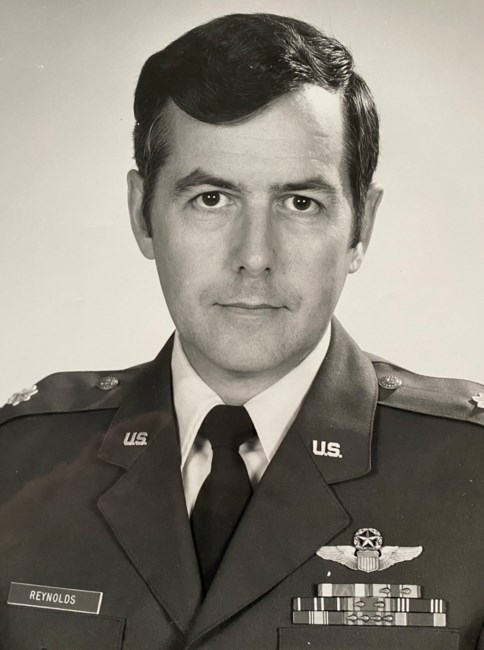
Col. Robert E. Reynolds
March 12, 1935 – April 28, 2022
Col. Reynolds is survived by his wife Marilyn, by daughter Elizabeth and her two daughters, Caroline and Cameryn Mason, her husband Tim Goodrich, and by son David Reynolds and his wife Sonja, all of Shreveport, LA., Col. Reynolds’ brother Charles G. Reynolds and his wife Fausta, of Salem Lakes, WI.
The 30 year Air Force veteran was preceded in death by his mother in 1968 at age 54 and his father in 1997 at age 88.
Robert Eugene Reynolds was born on March 12, 1935 in Clifftop, WV, a small coal mining town. His father, Robert Ellsworth Reynolds, worked as a coal miner, time clerk, and deputy assessor. His mother Buena Elloise Willis Reynolds had the most difficult of jobs: mother and housewife. Brother Charles was born January 12, at Boonsboro, WV , a hilly town where many of the men worked in the coal mines at Alloy, WV, home of a large metals plant along the Kanawha River. Coal mine wages at Clifftop were $3.00 a day. The Alloy coal mine paid $5.00 per day. The Reynolds family moved into company housing at Alloy in 1938, about 100 yards from the company store. What convenience!
In 1940 Robert’s father bought 33 acres of land on Opossum Creek Road, a winding road about 55 miles southeast of Charleston, WV. The Reynolds family moved into their new home at Opossum Creek in 1941.
The Reynolds brothers went to a two-room school at Victor, WV, for the first six grades. They went to seventh and eight grade at Ansted Grade School in Ansted, WV. Robert graduated from Ansted High School in 1953. Charles graduated in 1954. After graduating high school, Robert attended West Virginia Institute of Technology in Montgomery, WV.
Before joining the Air Force Robert worked various jobs; however, Robert’s fascination with flying began as a young kid when he was invited to take plane rides with a close neighbor who happened to have a private airplane and airstrip on his property. Fate was soon sealed and Robert joined the Air Force pilot training program August 15, 1955 at the age of 20 to begin fulfilling his dreams. Robert was commissioned a Second Lieutenant and was awarded his Pilot wings on December 4, 1956 from the USAF Air Training Command specializing in the Jet Fighter Pilot program at Laughlin Air Force Base, TX.
The T6 and T33 served as his training planes. The F86D All Weather Fighter Interceptor was his first duty plane. He flew the F6D while stationed on Okinawa. From Okinawa he went on temporary duty to help deter China in the Quemoy Matsu crisis in 1958. His superior officer had three pieces of guidance: “If you meet an enemy plane, shoot it down, if you don’t meet an enemy plane, at least break the sound barrier. And, three, don’t drink the local water.”
On leaving Okinawa, Reynolds was assigned to train on and fly the B47 Strategic Bomber, which he flew from November 1959 to April 1963. Assigned to the 68th Bomb Wing at Chennault AFB, Lake Charles, LA, he also participated in alert duty in England and Morocco.
In April 1963 Reynolds’ next plane was the B58 Hustler Bomber, at the time flying about 1300 miles per hour, the fastest plane in the world – fighter or bomber. He was assigned to the 305th Bomb Wing at Bunker Hill AFB, Kokomo, IN. While stationed at Bunker Hill AFB, he was nominated to be one of the first pilots for the SR71 Program. The SR71 had a top speed of about 2500 miles per hour. A slight defect in his vision during the Space Pilot physical kept him from completing the SR71 program. “You came in second to John Glenn for endurance” said the Evaluation Officer.
Soon after, in 1969, the peripatetic pilot was transferred to the FB111B program and after training was assigned to Plattsburgh AFB, NY. He was the first pilot ever to log 1,000 hours in the FB111B. His 528th Bomb Squadron won the Strategic Air Command Bombing and Navigation Competition and was awarded the Fairchild Trophy. While at Plattsburgh AFB, he graduated with a Bachelor of Science from Plattsburgh State University in New York. He then graduated from Squadron Officers School and the Industrial College of the Armed Forces.
South Korea was his next assignment, where he was Wing Chief of Safety for the 51st Composite Wing. He maintained flight status by flying the T33.
His next assignment was to the 509th Bomb wing, Pease AFB, Portsmouth, NH, in August 1976. There he served as Assistant Director of Operations, Deputy Base Commander, Base Commander and Deputy for Operations. His Wing won the Fairchild Trophy. While at Pease AFB, Reynolds was promoted to Colonel.
From March 1980 to July 1981 he served as Director of Operations, 42nd Air Division, Blytheville AFB, Blythville, ARK.
Col. Reynolds was not only an exceptional pilot, he was adept at evaluating air crews. From July of 1981 to August of 1984 he was Chief, Operations Division, Directorate of Aircraft Inspections, Office of the Inspector General, Strategic Air Command Headquarters, Omaha NE. His organization completed more than 70 Operational Management Effectiveness Inspections of SAC, Air National Guard, and Air Force Reserve units in the United States, Europe, and the Far East.
Col Reynolds spent his final year in the Air Force as Director of Safety, Headquarters Eighth Air Force, Barksdale AFB, Shreveport, LA. He retired from the Air Force September 1, 1985. During his 30 year career he had flown more than 20 different aircraft, including the T-34A, T-28A, T-33A, F-86D, F-86L, B26, SA-16A, B-47E, RB-47E, C-45, F-102A, Hustler B-58, C-47, Boeing 727, KC-135A, B-52, F-111A, FB 111A, Piper Cub, and Cherokee 180. Col. Reynolds logged more than 4,500 flight hours. His military decorations and awards include The Legion of Merit, Meritorious Service Medal with two oak leaf clusters and Air Force Commendation Medal with two oak leaf clusters.
The 30-year veteran once recalled the two most stressful moments in his Air Force career. While flying a sortie at Quemoy Matsu, the engine of his F86D flamed out. After a moment of panic he followed procedures, and after dropping a few thousand feet, he got the engine restarted. One day while flying the F111B, he lost part of his tail assembly. With great care he landed without incident.
From July of 1986 to September of 1994, he served as Operations Administrator of the International Airport in Des Moines, IA. There he met and was photographed with the first President George Bush and remembered this being an interesting time working in the civilian world with the airlines, military operations, public relations, political leaders, and the FAA.
Col. Robert E. Reynolds enjoyed retirement in Shreveport. He loved researching his family history, furthering his knowledge through educational programs, and taking time everyday to enjoy feeding and watching birds and wildlife in his backyard. He and Marilyn especially enjoyed playing with the grandchildren and watching them grow up. Robert stayed active with the Air Force Association, Military Officers of America, and The Order of Daedalians.
Among the programs on his computer was Microsoft Flight Simulator. It is possible that after flying a mission on Flight Simulator, he would get on YOUTUBE and watch one of the dramatic readings of “High Flight,” a poem by John Gillespie Magee, Jr.
In memory of Col. Robert E. Reynolds, USAF, Retired, please donate online in memoriam to Daedalions.org scholarship programs. Your donation will help aspiring young Americans pursue careers as military aviators.
Show your support
Add a Memory
Share Obituary
Get Reminders
Services
SHARE OBITUARYSHARE
- GET REMINDERS
v.1.18.0