OBITUARY
David Johnson
17 August, 1919 – 15 May, 2014
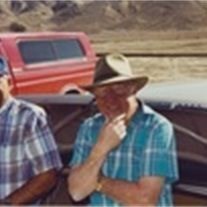
David Johnson is one of the most unforgettable characters you will ever meet. David's lover for building model planes can only be topped by his loved for flying them or talking about them or his love for his wife, Dottie, who was always at his side.
David loved people and felt it was his duty to liven things up when it got a little dull. He has been known to fake a fall at a Hemet Model Masters club meeting when some member began to nod off or challenge some of the younger flyers to a 75-yard foot race at the flying field - quite a feat for a man 79 years old (in 1998). Davis was an excellent flyer and he delighted in thrilling the crowd with unbelievable maneuvers.
David trained student pilots for years and although he never kept a record, we would estimate he has trained over 100 Radio Control (RC) pilots. When you asked David what his greatest thrill in model airplanes has been you would expect him to say something like his big wins at a scale meet with his Super Marine 1/5-scale seaplane or some of his wins in aerobatic flying. It would even be reasonable for him to mention he was the first to fly an RC model over the Arctic Circle.
But, what David is most proud of is the method he developed to teach the deaf to fly RC. The way David's method worked was to stand behind the deaf student, placing his hands on the pilot's shoulders and gently nudges his student in the direction he wants him to move the controls. This method requires a second instructor on the buddy-box to take over in emergency situations.
If you were to listen to Dave exchanging insults with his flying buddies, you might be inclined to think he was a pretty tough customer, but when he spoke of his flying buddies who have fallen victim to cancer, you could see his eyes cloud up and his speech failing him; it is pretty obvious that under that mask was a soft-hearted guy.
David was born August 17, 1919 in Hollywood, California. He was raised in West Los Angeles near the Cloverfield Airport. He started building his first models in the 1930s. They were solid balsa wood kits. He progressed to Free Flight rubber-powered scale. One of his first successful models was a Megow kit by Al Williams - the famous Gulf Hawk airplane. Davis won his first place trophy in rubber-powered scale even with his airplane.
David took drafting in high school and continuously got into trouble for drawing model airplanes. The teacher finally realized the situation was not getting any better, so he made a deal with David. If David and his friend would each design, draw and build a model airplane successfully flew, he would base their grade on the results. They designed model airplanes to resemble the national air race airplanes of the day. The plane would fly in a straight line for about 200 yards, which made racing a lot of fun. They both received passing grades.
Davis was learning to fly full-sized airplanes at the Metropolitan Airport in San Fernando Valley in California. The plane he learned to fly was Cirrus-powered Great Lakes bi-plane. When World War II stared, Dave's modeling career stopped while he spent four years in the Coast Guard. Dave worked in the Sea and Rescue Division.
When the war ended, he began flying Free Flight with a Zipper powered by a Brown engine and a Clipper powered by an Ohlsson engine. Dave lived only a mile from the flying field at Rosencrans and Western Los Angeles where he was able to meet famous modelers. David flew in the National (Nats) when they came to California. He said he was just an average competitor, but he had a heck of a good time!
In 1969, Jim Lantham, an engineer at Northrop who was a good friend of Dave's told him he has to get into RC. Jim gave Dave a Skylark 56 and a K&B engine. Dave said that did it. He was hooked for life! He joined the Northrop RC Club. "I thought RC was going to be easy," he said. "That was a laugh. It took me three months to solo."
His first scale model was a Comanche, then a Proctor Nieuport II. Dave first started teaching RC in 1972 with the "grab the box system." He was still teaching in 1998 at age 79.David retired from TRW in 1981 and devoted most of his time to teaching RC to beginners and he said he loved it. He liked all types of RC airplanes from 1/2A racers to his big Pitts 300. Dace has flown in the U.S. Scale Masters three times with his Nieuport 28, which is featured on the cover and in an article of the December 1984 issue of Scale RC modeler magazine. David loved competition of any kind.
In 1976, David wanted to do something to celebrate the bicentennial. He decided to fly an RC model airplane across the Arctic Circle. David had spent some time in the Canadian Northwest Territory collecting gems and minerals, so he figured that would be a good place for his flight. He fitted his Comanche with floats, packed it up with a 1/2A Quickie 200 and headed for the Arctic. Dave and his wide drove 3,400 miles to Yellowknife on the Great Slave Lake where they rented a seaplane and flew 385 miles north to the Arctic Circle, which is 66 degrees, 30 minutes north latitude and 113 degrees, 15 minutes longitude, This was Dave's first experience with a plane on floats, but it was successful. The story of the trip is covered in Model Airplanes News magazine's April 1977 issue. The museum in Yellowknife features the documentation of the flight. Dave put together a slide program that is very entertaining and full of laughs. He used this presentation when he visited other clubs.
After his retirement, he went to work for Kraft Systems, Inc. as a public representative in the field. His area included Alaska, Canada, and the U.S. and he made many friends all over the country with his demonstrations of the Kraft Systems and his Ugly Stick airplanes.
Dave was president of the Northrop RC Club and he belonged to the Yucaipa RC Club, Scale Squadron RC Club, High Desert Barone RC Club and the Hemet Model Masters RC Club, where he was president for three years. He was contest director for seven four-stroke contests for the Hemet Model Masters. He was president of the Valley Wide RC Glider Club in Hemet, California. He was instrumental in procuring the flying site and golf-type vehicle that holds the winch.
Dave specialized in demonstration flight and was really motivated by the cheering of the crowd when he puts on his Piper Cub act. He said the spectators loved it, even when he crashed - which does happen.
David's attempt at Control Line flying resulted in about half of a lap. He built a model of the battleship Missouri that used a Deltron Tone one-channel radio. When he built his Super Marine seaplane, he called on help from Irwin Ohlsson for his expertise in using K&B paint. Dave said it came out pretty good as he won the scale event. Dave had pleasant memories about flying at the Haystack Reservoir with Irwin Ohlsson and Joe Bridi.
1998 was Dave's 18th year at the Q.S.S.A. fly-in. in 1992 he was the master of ceremonies at the banquet and was the announcer at the flying field. He received the Waldo Award for significant contribution to promotion and enjoyment on miniature aircraft same year.
In July, 2000, Dave was made a Life Member of the Palomar RC Flyers club after he performed his slide show program covering his ARCTIC CIRCLE flight. He had given this presentation many times all over the country, and honed the pace and witty remarks to a fine edge. The usually tough audience was, you'll pardon my cliché, rolling in the aisles. A video tape of this show is available at the AMA Museum.
Dave continued to be highly visible at local flying fields and several club meetings each month. His shop area was crammed with large, and small, planes impeccably constructed and maintained. He kept them all in shape with fully-charged batteries, to load into the oversize 21 days. It went smoothly except, for weather medical emergencies and general glitches tat "happen" when you try to complete a plane. HE DID SUCCEED! OK, so far?
During August 2003, he decided to fly every day between his 84th and 85th birthday anniversaries. (Born in August 17, 1919, remember)? Think about this for a moment! Rain or shine, wind or whatever with each flight witnessed and documented! 366 DAYS (leap year), they met volunteers at the field to witness the log book. Several friends provided the bulk of the TEAM whenever they were in town. On their VACATION trip the visited local clubs, and on a couple of occasions Dottie was the official witness when the weather was too inclement for normal enthusiasts to show up at the flying fields. The starting fleet numbered 26, many of which were immaculate competition Giant Scale planes. The favorite plane was the Bright ORCHID Monokote-covered TIGER 60, which was assigned the billboard of one Kraft Radio sticker per day. A RED one was kept in reserve, and also well-used. One note in the log book stated, "Used Tiger 60's 211 times!" Along about April 2004, the operation became a grind, and Dave and Dottie took turn keeping the TEAM motivated to soldier on. On July 6, the TWIN START was totaled when during a 90 degree bank of final approach the ground-side engine quit cold, and the landing approach became vertical! On July 18th Dave swept the fields at a FUN FLY winning all 6 events, earning the $80pot. This sort of provided the incentive to bring the odyssey HOME.
Dave and Dottie completed the assigned task. They celebrated his 85th birthday at the Hemet field with an appreciative crowd and ceremonies. The last flight was completed, and the feat was recorded in local newspapers and club newsletters.
During 2009, Dave was elected to membership in the Model Aviation Hall of Fame. The sponsor notice was received 4 days before Dave's 90th birthday, and thanks to the dedicated AMA staff the plaque was quickly delivered and presented to him at his own party thrown by a group of his goof friends. Festivities included presentation of the plaque. Several presents like a pair of red suspenders, good friend, and a cake with CANDLES, all burning at once.
David is survived by his son, Richard Johnson, of Perris, CA; his son,, David Johnson of Fallon, NV; a step son Phil, (Sherri) Pinneax of Laguna Hills, CA and several grandchildren and great grandchildren. Graveside services will be T Riverside National Cemetery on Thursday, May 29, 2014 at 1:00 PM.
Show your support
Add a Memory
Share Obituary
Get Reminders
Services
SHARE OBITUARYSHARE
- GET REMINDERS
v.1.18.0