OBITUARY
Ramdulari Budhu
13 May, 1924 – 30 January, 2019
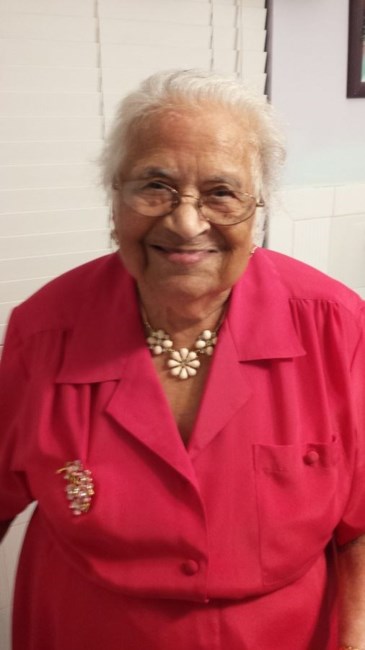
On the 13th day of May 1924, a baby girl was born to East Indian indentured servants at Providence Pasture, East Bank of Demerara, Guyana in what was then British Guiana. She was the last of 5 children - three boys and 2 girls. She was named Ramdulari, which means beloved of Lord Rama, a Hindu deity. It was common in those days to give your child a Christian name. So, she was named, Irene. Her father, Bidessar, sailed from Calcutta, India, in 1898 on a converted slave ship named Mersey, bounded for British Guiana and other Caribbean countries. The British brought him and others as indentured servants to do back breaking work in the British Sugar industry. Her mother, Bhophia, came the same way and for the same reason in 1892 on another converted slave ship named, Brenda. Her parents were married in British Guiana and worked on sugar plantations at Diamond and Providence estates.
When my mom was about 3 years old, her mother died. Two years later, at 5, her father died. Her three brothers, who were also working in the sugar estates at that time, had to take care of her. They lived in a lougie, which is a long, wooden structure consisting of attached ground floor apartments; each about 150 to 200 sq. ft. Her brothers would depart around 4 or 5 am for work and leave her home. Neighbors, whose work shifts were later, would give her milk and whatever they can afford.
When she was about 8 years and older she would wonder of to the nearby estate compound, especially in the afternoons, to look for her brothers to get food. Often, people who were lurking nearby would take her to the estate compound. The estates at that time prepared a single meal for workers, invariably smashed, salted cod fish with rice. There were many times when there was no fish, so she had to eat salt and rice. I would often teased her about this. When she cooked something I did not like, which is not that often, I would tell her that the food tasted like salt and rice.
When she was about 12 years, she went to live with her elder sister, who was married and had several children. She helped with the household chores and baby-sit some of the children. In the afternoons, she would accompany one of her nephews to sell cooking oil for her sister. The highest education she received was up to 2nd standard, which allowed to just read and write.
At around 18 years old, she married my father, Rajkumar, and moved to Windsor Forest, West Coast Demerara. Thereafter, she became the mother of 7 children. The eldest is my sister, Shivranie known as Shirley, followed by me, the eldest son, Muniram also known as Roy then Latchman also known as Krishna; Deodat also known as Vishnu, Tulsidai also known as Rita; Sew Kumar also known as Rohan and Premchand also known as Prem. Like most people in Windsor Forest, we were poor, hard working people but our house was rich in love and commitment to family.
As the eldest son, I have a long list of memories. Some of there were life changing moments. I will share one of these moments with you. My father and his brother had a few acres of rice land. It is customary for many rice farming parents at that time to get able bodied person to help out in the fields. So, when I was about 9 years old, I started to go the rice fields to work for a few days at tilling the land for planting and at reaping the paddy. I had to skip school on those days. Although the work was back breaking, I was happy to do so because I did not particularly liked school and was just doing Okay but not particularly well. One the tasks assigned to me when I was 10 years old was to fetch buckets of water from a nearby canal and take them to the laborers in the field working in the hot tropical sun and giving them a cupful at a time. One of the laborers was my mother, who was cutting the paddy. When I arrived to her area, I noticed that she was bleeding from the nose. I told her that she was bleeding and she stooped down, took the ends of her petticoat and whipped the blood off. I gave her the water and noticed that the blood was still dripping. I felt sorry for her and offered to take over her work. At that age, I was not good at using a grass knife, so the offer was not good enough. I was striken by grief knowing that I could not help my mother. I went to my father, who was also doing his task and told him about my mother. Of course, I exaggerated her bleeding knowing that if I spoke the truth there would be no significant effort to help. He went to her and told her to sit under a tree. I resolve on that day that I do not want my mother to work in the fields again. The only option open was to get a good education. So, when I went back to school I decided that I should put a lot of effort to do well. I doubt that I would have been the person I am without that incident. Thank you my mother.
When we lived in Guyana, my mother never told me that she loved me. This is also true for my siblings. In her generation, they do not utter the word love. They showed you love, they make you feel love. Her love was unconditional, unpretentious and unspoken. She transferred that deep inner love to each of us in so many ways that our mother became our goddess. Her love was shared not only with my siblings and I, but with everyone who comes in contact with her. One of her signatures is as soon as she greets you, she will offer you food saying "you nah go eat some food; me cook chicken curry". Everyone in the family knows that she has no equal in cooking chicken curry.
In 1983, my parents and my youngest brother immigrated to Canada and stayed with me for a few years. Then when I moved to New York, they moved to Florida. Over the last 30 years, and especially during the last 10 years when my mother developed some health issues, my two younger brothers, Rohan and Prem dedicated their lives to her. They received help from their wives, Penny and Nirmala, and the rest of us. We thank my two brothers and their wives for their mammoth efforts. Several times, they mount 24 hours vigil responding to her every turn, groans and needs. A few times, doctors gave up on her but she bounced right back to life. However, on Jan 30, 2019, she failed.
Our family are Hindus. One of the stanzas in a Hindu chant is "Jananam Sukhadam - Maranam Karunam". The English translation is "Birth is pleasure; death is a great compassion" if it happens to be at the right time. My mom's right time is dictated by her soul and her karma just like the rest of us. We have no control. All my family can hope for is that her soul achieved Moksha - the soul's liberation from Samsara - the cycle of birth and death.
Show your support
Add a Memory
Share Obituary
Get Reminders
Services
SHARE OBITUARYSHARE
- GET REMINDERS
v.1.18.0