OBITUARY
Bernard E. Martin
30 October, 1923 – 24 January, 2018
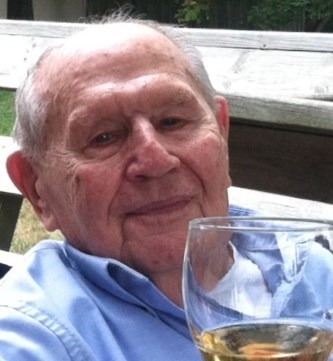
BERNARD E. “Bernie” MARTIN, 94, of Kansas City, MO, died January 24, 2018. Rosary will be at 9 a.m., Visitation at 9:30, and Mass of Christian Burial at 11 a.m. Saturday, February 3 at St. Regis Catholic Church; Burial at Mt. Olivet Catholic Cemetery, KCMO. In lieu of flowers make donations to Catholic Charities of Kansas City-St Joseph, 4001 Blue Pkwy, Suite 250, KCMO 64130 or Kansas City Hospice Foundation, 1500 Meadow Lake Pkwy, Suite 200, KCMO 64114.
Bernie was born October 30, 1923 in Blackwater, MO to Paul Telch Martin and Rosa (Bernardel) Martin. He grew up in Kansas City, MO, speaking only Italian until he went to kindergarten. Bernie attended Boone School, and graduated from Ruskin High School in 1942. Soon after, he was drafted into the Army and served in the 8th Armored Division in a reconnaissance armored car unit, often operating behind enemy lines. He fought in the Battle of the Bulge, where he was wounded in action and was awarded the Purple Heart. After the war, he returned to Kansas City, working and going to business school at night. He worked for Flour Mills of America, auditing local grain elevators across Kansas, a job that forever deepened his love and knowledge of rural Kansas. In his spare time, he loved to camp, fish, canoe, and shoot movies and photographs. He was hired by Ewing Kaufman to be the first buyer for Marion Laboratories, eventually becoming the company’s first purchasing manager. Asked once how he hoped his coworkers saw him, he said, “As an honest person.”
Bernie met the love of his life, Mildred Lickteig, through the Catholic Adult Social Club, and they were married in 1958 and raised three children, Ann, Dan, and Lisa. Bernie and Millie both devoted extraordinary time and attention to their children. Bernie was Scoutmaster of Troop 98, and he worked with his daughters during their years showing horses. He was a member of St. Matthew the Apostle and St. John Frances Regis Catholic Churches. He served on the St. Regis Parish Council and Finance Committee, and wrote the first history of St. Regis Parish, chronicling its first 25 years. Bernie retired from Marion Laboratories in 1983 and started to grow grapes and make wine, eventually expanding his vineyard to an acre. For nearly 30 years, he cultivated his vineyard, which, during harvest, became the center of activity for grandchildren, family, and friends. He belonged to Cellarmasters of Kansas City, and for much of that time was a teacher and mentor to other winemakers. His wines and champagne won numerous awards in Missouri, often in direct competition with commercial winemakers. In his later years, Bernie moved with his wife, Millie, to Villa Ventura. He died peacefully at home at the age of 94. He was preceded in death by his parents and his brother Angelo Martin. He is survived by his beloved wife Millie, their three children, Ann Zack (Mark Zack), Dan Martin, and Lisa Smith (Kam Smith), and nine grandchildren, Justin, Joey, John, Phil, Elizabeth, Rachel, Bryan, Eric, and Caroline.
********************************************************************************************
(Here is an essay written about Bernie Martin)
Grape Harvest
by Daniel J. Martin
from North Dakota Quarterly 1997
Around here, you can't always rely on the four seasons to name the time of year. A separate, shorter season inserts itself into the tail end of summer and overlaps into the most sanguine bit of fall, when the sumac stands red against the green of the late-turning trees and shrubs. The season is not exactly grape harvest, but it is the time when harvest occupies the mind, from the day my father begins to cover the vines with nets to protect the grapes from the birds until the day when fermentation has slowed to an undetectable crawl, a span of about six to eight weeks. During the weeks of summer leading up to harvest, our neighbors' walnut tree drops green walnuts onto the tin roof of their barn, loud, hollow clunks marking some sort of fundamental time with first a speeding up and then a gradual slowing of this arboreal drumbeat. If you did not know what the noise was, you might think someone walked out to that barn every hour or two and hit it with a stick. The end of the drumming, or maybe the day I notice the end, roughly coincides with a few other events that together say, "Harvest." The swallows vacate the barn, the orioles and robins take a ravenous interest in the ripening grapes, planting the fall garden takes on a certain urgency, and the grape vines, sagging with the weight of their fruit, dangle a cluster here and there within the reach of toddlers.
When my twin sons, John and Phillip, were just over two years old and Joey was almost six, we managed to join my father in his vineyard more than ever before. Over the years, I have visited Dad's realm of grapes and wine, always passing through, always the tourist, rushing back to my own endeavors. But with the help of Joey, John, and Phillip, I got a little more involved that season. They loved going outside and would follow Grandpa around all day if they could. John and Phillip would jump around and chatter excitedly whenever they saw Grandpa or Grandma out the window or whenever we decided to walk up to Grandma and Grandpa's for a visit. Neither Phillip nor John could pronounce "Grandpa," but they agreed to use the same mispronunciation, and it came out something like "Bocka." It sounded enough like Bacchus that I didn't bother to correct them and even took to saying Bocka myself, now and then. Though he's never been much of a reveler, my dad is unquestionably our local deity of grapes and wine. He tends about an acre of vines and makes all the wine the family needs. He had made wine for a long time, but when he retired, growing grapes and making wine blossomed into a full-time avocation. Some people retire and play golf, Dad has said, and he grows grapes. Those who know him understand the significance of that comparison. A neat and antiseptic world without weeds where numbers of people play a game and keep score does not fit my father. He thrives in an earthier place where solitude is the norm and where the order he works to maintain is continually buffeted by the surrounding wildness birds, weeds, raccoons, bees, rain, and drought. Even when he worked as a purchasing manager at a pharmaceutical company and wore a suit every day, he nourished his earthier side. I can still hear the hard thuds of his dress shoes on the kitchen floor when he came home, followed moments later by the softer footfalls of his boots taking him outside to work before dinner, as if he had swapped wing tips for earthen feet. Now that Dad has been retired for over ten years, it's easy to think that grape growing is all he ever wanted to do. In the vineyard, the human order and the wild continually negotiate their balance, and Dad's place in the middle of that, I am certain, is meditative and spiritual. He would, of course, say it's not.
Picking grapes and fermenting them into wine completes seven or eight months of attentive grape growing. Work on the vines begins when winter shows signs of relenting, when Dad catches up on the indoor work of bottling, racking, and testing. Feeling bottled up himself toward the end of winter, my father always talks anxiously about getting outside. As the cold begins to break in late February and early March, he heads out to begin a month or two of pruning. It is hard to prune back a grape vine as far as you should, for to do so you must place a good deal of faith in the vine and its ability to grow down the trellis wire. The French-American hybrid vines in Dad's vineyard grow with the same vigor as the wild grapes that grow around here. His wine grapes descend from the long domesticated varieties of Europe on the one hand and from native American grapes on the other. Their coming together began with an accident.
Around 1875, the American grape root louse, Phylloxera vastatrix, entered Europe on some American vines, and then this tiny aphid-like creature proceeded to gnaw away at the soft roots of the European vines and within twenty years and nearly destroyed the vineyards of France and central Europe. It had harmed or killed virtually every last vine in Europe. Unlike the European vines, the native American vines had a natural resistance to the root louse. Viticulturists experimented desperately, both hybridizing and grafting, in hopes of transferring the American vines' resistance to the European vines. The European grape growers finally solved the problem by grafting the European varieties onto the native American root stalks, and even today all the classic grape varieties of Europe, such as Chardonnay and Cabernet Sauvignon, grow on American roots.
Although grafting turned out to be the solution for the traditional wine regions of Europe, hybridizing ended up helping grape growers in the harsh climates of northern Europe and America. The fervor to hybridize a resistant vine produced dozens of combinations of American and European vines. Many hybrids not only resisted the root louse but also survived very cold winters, something neither the European vines nor the grafted vines could do. The American genes offered vigor, but they tended to deliver acidic, strong, almost wild flavors and a very dark color. The European genes, though not very resistant to cold or disease, offered improved palatability. In areas with severe winters like the ones we have here in Missouri, wine makers now grow the French-American hybrids, the best compromise. But the bolder wine and the rampant growth of these vines will always reveal their wild lineage. So even after pruning his hybrids, Dad normally goes back later in the spring to put a check on that vigor by "cluster thinning," pinching off clusters of newly-formed grapes no bigger than mustard seeds or peppercorns. A grape grower curbs the number of clusters a vine produces because with wine grapes, quantity reduces quality. Viticulturists agree on this; too many grapes on the vine will mean poorer wine.
Spring and summer mean tying up the new growth onto the trellis. Dad trains his vines on what is called a Geneva double curtain, side by side wires about two feet apart, held up by a pole and a cross arm looking like a capital T. The wires run through the ends of the T and resemble rows of telephone lines you see along railroad tracks. There is a certain beauty in those straight and dignified rows ruffled by the unruly growth of the vines. By holding a broad layer of foliage about five and a half feet off the ground, the double curtain lays the canopy out like a blanket to gather up sun, and with the wires at eye-level, the grapes are relatively easy for an adult to pick. Since there are no low wires, a person of my height can cut across the rows by stooping slightly. A person of John or Phillip's size can tear through with abandon. Under this arrangement, the vineyard was a good place that summer for toddlers to make mischief and then have a fair chance to get away. While I ran bent over after them, drooping vines slapping at my face and shoulders, they trotted off happily unobstructed, gaining several more yards of freedom than they would have out in the open. I approached John to tell him he needed his diaper changed, but this meant stopping his play, so he bolted and ran off, laughing like an imp. With the vineyard canopy on his side, he eluded me for a few extra seconds, meaningful victorious seconds, a successful challenge to authority. Even after I caught him, he wriggled with laughter and dropped his feet out from underneath him, elated by the struggle, pleased with himself, no doubt, at having used the trellis to his advantage. My father looked for other kinds of mischief during the summer, watching for signs of insect damage, phylloxera leaf galls, downy mildew, powdery mildew, and black rot, and sprayed for these as sparingly as he could. Near the end of summer, looking toward harvest, he began to net the vines to keep the birds from eating all his grapes.
The enmity between birds and grape growers in tradition and depth of feeling reaches archetypal proportions. It's like those cartoons that depend upon an ongoing and ritualistic feud, day after day, year after year, combatants turning to the most dubious tricks and contraptions, desperate but at the mercy, not of each other, but of this unresolvable plot. I first witnessed this legendary, bird-against-human battle while visiting a small vineyard in Ohio. As I walked up the hill toward the grapes with my mother and father, we kept hearing this loud report like a gunshot every three minutes or so. Bewildered at first, we later found that the owner had rigged up a machine that slammed together a pair of two-by-fours at regular intervals, to scare off birds.
Modern grape growers go to great lengths to fight birds. In a pile of my father's old magazines I stumbled upon an article in Wine East called "Bird Control in the Vineyard." The article offers the grape grower a remarkable bag of tricks, a whole variety of gizmos designed to keep the birds away from the grapes. If you were a grape grower you could use visual devices such as streamers, flash tape, spinners, aluminum pie tins, plastic owls, hawks and snakes, and scare-eye balloons, or noise devices like propane cannons, single-shot or double-shot cannons, rotating triple-shot cannons, taped distress calls, pistols, exploding pellets, whistlers, screechers, bangers, crackers, and wailers, not to mention the electric bird fence, and various pyrotechnic devices. You might mix the visual and the noise devices as the experts recommend and go for the Razzo Triplex, "a vertically mounted cannon that combines the triple-shot scaring effect with wildly flapping projectiles that are launched up a 20-foot mast." My personal favorite is the Scary Man Fall-Guy, "an inflatable, bright orange mannequin that shoots up rapidly from 14 inches to 5 « feet in height and thrashes about to the accompaniment of a siren. At night a light inside Scary Man illuminates, creating an eerie orange glow." Scary Man takes the scarecrow concept to new and zany heights. I can't help but conjure up this image of Wile E. Coyote digging into a box labeled ACME BIRD SCARER in yet one more episode in his eternal battle.
Before he got sophisticated about it, my father tried to scare birds years ago with pie tins and a plastic owl. The only creatures the owl fooled were dogs, who just barked, and people, who would catch it out of the corner of their eye, stop and take a long look to assure themselves that it was, OK, just a decoy. In order to work at all, these visual scare devices have to be moved around. That owl used to startle me when I found it in a new spot. The illusion convinced me just enough that I could imagine this owl moving itself around, as if it had a devious personality of its own behind those plastic eyes, but mainly I considered its movement as evidence of industry, Dad at his sneaky work, Wile E. Coyote style.
Yet my father loved birds before he ever grew grapes, and wishes the birds no harm. He and the birds simply compete honestly for grapes. In recent years he has taken the time and effort to cover the whole vineyard with netting, rolling out 12-foot-wide nets up to 270 feet long down the rows, and pinning them together side by side, to form a broad cover over all the vines. Joey, John, and Phillip were excited at the prospect of helping Bocka, so we tried to put nets up with him. I helped stretch the net and hook it to the next as Dad pushed it up over the vines using one of his many inventions, a bamboo pole with an old tennis ball stuck on the end. Using this tool he handled the nets without the end of the pole getting snagged on the monofilament netting. The twins stuck around at first, eating grapes and pealing strips of bark off the vines. Halfway through one row, however, I stopped to find John, who had wandered off. After another half of a row, I had to chase both John and Phillip out of the barn where they hunted for clippers and hatchets to play with. Before long, I had to go back inside to change diapers. I got the feeling that, with kids to look after, I was maybe more hindrance than help. But Dad tolerated us for the company, and he claimed it went faster with our help.
The netting kept all but the most insistent birds away. A few always found the holes in the netting and managed to get in but not back out. So, rather than the antagonist, Dad had become the bird savior, walking down to the vineyard every morning to check for trapped birds. Some mornings the boys and I wandered into the vineyard before Bocka. The twins, somewhat bewildered and concerned for the trapped birds, pointed at them and gave me a worried look. But Joey found bird saving to be great fun. We opened the net at one end, then walked around to the other end, got inside the net, and by walking back toward the opening, we shooed the birds toward the door to freedom. We freed blue jays, robins, and even red-bellied woodpeckers, but by far the most persistent that year were the young northern orioles, who were always finding a way in.
We were out "helping" Dad check grapes for ripeness one day when I noticed an oriole caught in the net. The bird somehow had pinned herself on top of an end post with the net over her holding her snug. She had stopped struggling, convinced perhaps that struggle had only made matters worse. A wing and a beak poked through the small squares of the net; she looked hopelessly tangled, maybe hurt. I pointed her out to Dad, and we worked at getting her loose. We finally had to cut the net apart around her and, careful not to force her wing, took her out by hand. Everybody had to look at her. Joey held her in his hand and stroked her head. John, who never met a critter he wouldn't pick up, reached for her, and I helped him treat her gently. Phillip observed but did not insist on touching her. We put her in the grass, and she flew away without trouble. The twins waved good-bye.
Although birds are by far the most voracious of the grape eaters, other animals eat grapes as well. One day Dad saw signs of raccoons. He put out his Havahart trap, a wire box trap that does not hurt the animal, and he caught a raccoon and released it far away from his vineyard. And so the trapping operation went smoothly and peaceably as he caught another raccoon and then another until, to Dad's puzzlement and surprise, one morning he walked out to the trap, looked under the canopy, and lo and behold found that he had caught in his trap an unhappy and horribly frightened skunk. He had to get close enough to open the door to free the skunk, and he enlisted my help. I put on old clothes, just in case. We used the "skunk board" method that we had developed a few weeks before when Dad had trapped the animal that was eating our corn, which turned out to be a skunk. I saw that first skunk before he did, so I took the ornery pleasure of saying, "Guess what . . . you know that trap you set over by the corn? . . . There's a skunk in it." All Dad could say was, "You're kidding." That first time around, it took a while to find an effective skunk-release method.
"Maybe a long pole."
"No, don't skunks spray twenty feet or so?"
"I don't know." A lack of natural-history detail was hindering progress.
"Maybe," Dad said, "I could sneak up and throw this poncho over the cage so he won't see anything, and then I can open the door."
"I wouldn't risk it. It might scare him." And I added, "You would sure catch hell from Mom if you got sprayed by that skunk." Dad knew this.
"OK," he thought out loud, "I can ease up to him behind a piece of plywood, and you could watch from a distance and tell me what he's doing."
I am not proud to admit that I accepted the rear echelon position without protest and let Dad take all the risks, but it was, after all, his idea to put out the trap. So we got a board out of the barn, and Dad hid behind it and began to inch his way toward the skunk.
"What's he doing now," Dad asked me.
"He's watching the board." We didn't actually verify the skunk's gender; we just started calling him a "he" probably because the skunk was far too much of an animated presence to us to go by the term "it." Dad lifted the board and edged another couple of feet closer.
"Uh oh, he's turning his back to you. Slow down." Dad paused and looked over at me as I cowered behind a small tree. "Ok, he's settling down," I said, "Go ahead." Dad went another couple of feet. "Oh, he's raising his tail. Dad, I think he's going to spray." Fearless, Dad peaked over the top of board to see for himself. He waited the skunk out. Sneaking up some more, Dad finally got the board up against the trap and then allowed the skunk to get accustomed to it. After a couple of minutes, Dad peeked around the board and reached for the door latch on the trap. I was tense. Anything could happen. A yellow cartoon cloud of skunk spray could engulf my father, right before my eyes. But the skunk backed into the opposite corner and just waited as Dad unhooked the latch and opened the door. He left the board next to the trap and backed away quickly. The skunk saw the opportunity and took his leave right away, across a vineyard row, under the fence, and into the brush. The release of the second skunk went more smoothly except that this one spent half the day sleeping in the open trap before leaving.
When the grapes were ripe enough for the birds and the coons and the skunks, they were almost ripe enough for wine. Maybe two or three weeks passed between the time the birds came after them and the time when they would make good wine. Dad didn't rely on birds or guesswork to determine ripeness, however. From the middle of August onward, he checked the grapes frequently. The boys and I went out under the nets hunting for Dad one day, and we found him, hidden in the foliage, looking up at the blank, blue sky through what appeared to be a spyglass. "What doing, Bocka?" Phillip asked. There was no explaining this to a two-year-old, so we all had to have a look. He wasn't looking through a spyglass at all, but he was peering into an instrument called a refractometer. It surely looked like a little spyglass. Only, instead of a large round lens at the outward end, the refractometer had a wedged-shaped end. On the flat surface of the wedge was a glass table about the size of a microscope slide with a hinged cover of the same shape. Testing another cluster, Dad pinched a grape and dripped juice onto the table; with a practiced flick of his finger he flipped the cover on top of it so that the table and cover were sandwiched together like two slides with a film of liquid between them. He looked through the eyepiece and offered the refractometer to me. Inside I saw a circle; the bottom half was a deep blue and the top was white. The dividing line between the two colors cut across a vertical gauge from zero to thirty and told us the number of Brix in the juice. Brix are units of soluble solids, and in grape juice that essentially means sugar. At twenty Brix, the juice is sweet enough to make wine. The twins wanted the refractometer to be a spy glass, but Joey challenged himself to see what he was supposed to see, calling out his reading to check whether it matched his grandpa's.
While all this scientific stuff went on, we also took readings from our mouths. Dad was practiced at this as well. I held the refractometer while he squeezed some juice onto it. As I looked into it, he popped the rest of the grape into his mouth, pondered a second, and said, "Sixteen." "Close," I said, "Seventeen." "That's pretty good. Another week and these should be ready," he predicted, with an optimistic nod.
Other signs pointed the same direction. The barn swallows had left with the recent cool snap, overnight low of fifty-four degrees. If I were a swallow, I guess I would have hit the road too. For a couple of weeks I had been expecting their departure, almost, I suppose, in an effort to prepare myself for the loss. While you can attract quite a few birds with different bird feeders, swallows, dedicated insectivores, get their own food. All you can do is offer a barn, and beyond that, you can't buy a swallow's company. The swallows who had chosen our barn had been an important part of the vineyard all summer. I couldn't go out there without seeing fifteen to twenty of them either flitting around above the vines, devouring insects, or darting in and out of the barn. Occasionally one or two rested on a trellis wire, showing their pale orange breasts and steel blue shoulders and head. On a wire their posture seemed quite refined, and with light breast sharply defined against dark head and wings, they appeared to wear tuxedos. Like magicians, they dressed with utter formality but then launched into the most uproarious shenanigans, seeming to defy laws the rest of us must live with. In the summer it was not easy to go out to the vineyard and strike a sullen mood. The swallows wouldn't allow it. After they left, the nighthawks took over the evening sky, making the swallows' absence both more noticeable and more tolerable. The days meandered toward harvest, and the grapes continued to ripen. Before long we would hear the quiet banter of grape pickers.
With many more grapes than he needed, my father sold the earliest grapes to friends in his wine club, that is, a club of wine makers. When customers buy grapes from my father, they get more than grapes. They get to help pick the grapes side by side with my father and mother and sometimes with toddlers, a five-year-old, and their scrambling dad. They get to crush their grapes in the crusher-stemmer. After picking and crushing they usually have cheese and crusty bread and an earlier year's wine. As they talk over food and drink, they get to pick Dad's brain about how best to handle the grapes. And later they will get the results from his laboratory tests for sugar content, pH, and total acidity. It's a good deal and a good deal of fun. When I could, I hauled the kids out to pick grapes, eat grapes, socialize, and just generally inhibit progress. We went one day to pick with Anita and Glenn, who buy grapes from my father every year. Through the canopy of grape leaves, we talked about wine and food and children and everything else, sentences punctuated by clusters dropping into buckets, children grabbing at our legs, and by our own leapfrogging around each other to get to the unpicked vines. At one point, as we moved down the row picking and talking, Glenn asked if I made wine. I said that I just drink it, but if I wanted to make some wine, I'd have a good teacher. "The best," he said.
My father mentions from time to time how he wishes he had learned more about wine making from his father. My grandfather used to tell us about picking grapes "in the old country," northern Italy, on steep mountainsides with a basket strapped on his back. I remember him taking strips of old cloth and tying up the Concord vines that used to grow around here. A man of modest means, Grandpa actually had wine grapes shipped in from California one year, and he filled up two forty-gallon oak barrels with, we now speculate, Zinfandel. My father's interest dawned a little late for him to learn from Grandpa. So he has garnered most of his knowledge from picking people's brains at the wine supply store, exchanging ideas with wine-club members, going to conferences, and by reading studiously. He has acquired his skill by making a lot of wine and recording his work with scholarly care. His records are something to behold. Taken together with the resulting wine, they suggest that this craft is both science and art, Dad both enologist and wine maker. From time to time, I go down to the cellar with him to sample the unbottled wine. Surrounded by five-gallon carboys and stainless-steel kegs, we will work our way around, taking a little wine off the top of each container, with what is sometimes called a "wine thief," a glass tube about the size of a basting syringe. Dad pokes the wine thief into the container, lets it fill with wine, stoppers the top with a thumb to hold the wine in, holds the tube over a glass, and lets the wine run out by removing his thumb. He lifts the glass up to the light to note its color. He holds his hand over the glass and swirls the wine around, then takes a big whiff to see if the wine, as they say, has a good nose, or whether it has any off odors. He tries some and passes the glass to me. I do the same. We begin by tasting one at a time, but after a while we have three or four glasses out, trying to compare different batches. If we're not careful we lose track of which glass goes with which batch. We talk over our reactions, and, on our way upstairs, Dad tells me what steps he has put the wine through and speculates on what it might need before bottling.
After my conversation with Glenn through the canopy, I toyed with the idea of trying my hand at making wine. A few days later, I walked out of the vineyard with Dad, and he said that he was going to have more grapes than he first estimated. He said he might call up some fellow wine makers to see whether they would buy any. Somewhat tentatively, imagining the work I might be getting myself into, I said, "Maybe, I'll take a few and try to make some wine down in my basement." Dad paused a moment, "Aw, you don't want to mess with that. You've already got too much to do." True enough, I thought. Maybe another year. "Well, see if anybody else wants them," I said.
Days wore on, more pickers came and went, the vines were looking lighter as they gave up their fruit. Before long all the grapes would be gone. The weather vacillated between sunny, eighty-degree days and cloudy, cool ones. Nights often cooled down into the fifties. Some mornings, the sun lit up abandoned strands of spider filament like gold thread swinging in the breeze. The tall grass in the idle field north of the vineyard had turned a tawny brown, and a wide patch of goldenrod bloomed in the horse pasture to the west. Hedge balls, with their unreal yellow/green hue, dotted the Osage orange trees, the scattered remnants of old hedgerows. As the Osage orange leaves began to yellow, all the green around looked ready to drain right out of the trees. Common sunflower blossomed along the road, giant ragweed was everywhere, and tufts of bur marigold huddled around vineyard posts where the mower never got them. The air buzzed yellow with the singing of grasshoppers and the beating of dragonfly wings. Except for the purple of the New England asters and red of sumac, it was a yellow time of year.
On one of these yellow days, when only a few red grapes still hung on the vines, Dad off-handedly asked, "You still want to make some wine?" Surprised, I said, "Sure. Are there going to be enough grapes?" He said, "Yeah, about two hundred pounds of Chambourcin and maybe that many VN," short for Villard Noire. Now four hundred pounds of red grapes would make much more wine than I had in mind. I had thought I might attempt maybe a batch in a five-gallon jug or something, but Dad was offering enough grapes to make twenty to twenty-five gallons. I hoped this would turn out to be a joint project. We wanted cool grapes in order to start a slow fermentation, so we planned to pick them on the next cool day.
The day for picking turned out to be rainy and cold. After getting Joey off to school, I dressed John and Phillip, put jackets on them, and persuaded them to wear baseball caps to keep their heads dry and warm. Phillip insisted on wearing his hat backwards in the manner of college students; it struck me as too self-conscious a decision for him to make at two years of age, but already he had convictions about his image; he would not let me turn the hat around. He knew how to wear his hat. Fashion statements aside, we headed up toward my folks' house to see if Bocka was ready. He was putting his boots on and had a box of doughnuts on the table and coffee made. "Oh, doughnuts!" I said. Phillip and John saw them quickly and said, "Doughnuts! Doughnuts! Want doughnuts!" Dad asked, "You want to have them here or down at the barn?"
Important events in my family, even insignificant events, always involve food. Food has a symbolic and sacramental function. Even doughnuts. So, knowing the doughnuts would both taste better and mean more out by the grapes, I said, "Let's take them down there." I carried the coffee and milk, Dad carried the doughnuts, and John and Phillip seemed unusually attached to him. We stood inside the barn door just out of the drizzle, ate our Lamar's doughnuts, generally regarded as the best that can be had in these parts, and sipped coffee or milk, talking about how many grapes might be left on the vines and what sort of wine we might make.
In the barn we gathered up buckets and clippers for picking. I picked up my grandfather's clippers. They were old, and they had some heft. Two flat springs, like the leaf springs of an old truck, forced the handles apart after a cut. The clippers looked as if they had broken once and my grandfather had put the handles back together with a heavy nut and bolt, dinging up the threads to keep the nut from spinning off. Years of sharpening had left a gap between the blades.
After a few last sips of coffee, we headed out into the mist with buckets and clippers. Phillip and John trailed behind, but they marched on out, not bothered by the rain. Water hung on the leaves and the nets. As we picked, our arms got wet from reaching into the wet foliage. The rainwater and the bare steel of Grandpa's clippers chilled my fingers just enough to foreshadow winter amid so many other autumn signs. Sweat bees spun around every cluster. While we picked, the bees crowded onto the grapes so that we had to tap the cluster with the clippers to shake them off before snipping the stem with one hand and catching the cluster in the other. Some bees still hung on tight, working away inside the hollowed-out grape skins, each walled away inside its own sweet chamber, consumed by its own consuming, oblivious to the rest of the world. I looked at a bee and saw only a tail, which undulated, and its buried head no doubt moved to the same rhythm, hungry and tenacious, and utterly focused.
John and Phillip did not fear the bees. They were rambunctious and foolhardy. In fact their recklessness toward the bees was a little distressing. They fancied themselves as helpers, and they liked to move clusters from one bucket to another and back again. They stuck their hands into the buckets full of grapes and swirling bees without a thought. For the most part the bees ignored them, but a couple of stings apiece eventually taught the twins a little prudence. A sweat bee sting only itches after the initial pain, but when the twins got stung, work stopped for a while with a tearful attention to the injury. John eyed his wound with a worried look as I daubed it with a little antihistamine, and in time we got back to work until the next distraction and with toddlers, there were many. Maybe because of a short attention span or out of laziness, I like a good distraction now and then, a little diversion. I would never admit to being entertained by my tender little twins fighting, but the fact is they rough each other up regularly, and cultivating a sense of humor about their fighting (while, of course, encouraging peace and open communication) is, well, a good way to get through this violence without becoming emotionally battered myself. Twins fight. People who know young twins assure me of this. The ancients must have thought so too. The twins Romulus and Remus, after all, were sons of the warrior god Mars. They quarreled over where to build Rome, and even after they settled that fight, Remus, having to show Romulus how pitiful his wall was, jumped over it. That was the last straw, and Romulus killed his twin brother.
In the vineyard, the location of Rome was not at stake, nor was anyone's life; but my twins did little to refute the mythical wisdom. A fight broke out over a bucket. Phillip and John each insisted that the bucket was his, never mind the other five or six free, identical buckets surrounding them. Nope. This one's MINE! NO, MINE! They yelled back and forth as each pulled on one end of the handle. "OK, OK," I came in between them. I tried to ask questions, and talk sense, but all imposed solutions were temporary, and the bucket fight broke out again and again. I tried to remember that they felt their emotions as profoundly as I felt mine, even if their disagreement seemed simple to me. I found myself amused, but I took their concerns seriously. They took their roles seriously too. Phillip, for example, wanted to perform the step that came after taking the cluster off the vine. I never knew that dropping a cluster into the bucket was a separate step from picking the cluster until he made it clear to me that it was and that it was his job. I picked a bunch, handed it to Phillip, and he dropped it into the bucket. If I forgot and bypassed him he yelled, "No!" and reached in to take the offending bunch out and put it back in the bucket himself. So it slowed me down did I want efficiency or involvement? And naturally these toddlers stayed involved only so long, then hunted for other activities. The purple stains around their mouths suggested that eating grapes was among them. They reached up to pick the low-hanging grapes but did most of their eating from the buckets. Now and then they wandered off, and I had to go find them.
By the time we finished picking the grapes, the drizzle had stopped, and it was time to crush. The crush is the first transformative step, the beginning of wine really, when grapes become the "must" for wine. It's the celebrated step from days gone by the stomp, the step that always stands for the whole process. We didn't actually stomp the grapes with our feet although I have a feeling some little feet would have liked nothing better. What feisty Bacchanalian revelers the twins would be. Instead of stomping, we used a little Italian machine whose official name on the label, Pigiadiraspatrice, connected our work to the noble tradition. The crusher/stemmer gives the grapes an initial squeeze to break open the skins and then separates the stems from the grapes. Dad dumped a bucket into the hopper on top, and I turned the crank by hand to start the music, a medley, grapes snapping as they got crushed, the machine's hollow rumble, juice and grapes pouring. A pair of rollers pulled the grapes through and crushed them, the way old clothes dryers squeeze water out of a piece of cloth, and then paddles below the rollers slapped the clusters around, kicking the stems out to the side, and dropping grapes and juice out the bottom, then down the shoot into clean containers.
We made two kinds of wine. First, we made blush wine out of the free-run, the first clear juice to run off the crushed grapes. The cool weather and a slow-acting yeast would help to preserve the fruity, delicate flavors that a fast fermentation would hastily burn away. We put this first batch into glass containers. After we captured the free-run, we saved the juicy, leftover skins for the second batch, a full-bodied red, which was going to be large and needed a big container. We hauled out an oak barrel my grandfather once used and attempted to tighten it up to hold liquid. We banged the rings down snug and soaked the barrel with water so that it wouldn't leak between the cracks. When we first put a spigot into the bung and filled the barrel, water ran from every joint. In time, however, the staves swelled, and soon our oak barrel held water without losing a drop. We emptied the barrel, took it into the barn, and stood it upright on planks about three feet off the ground so that when it came time to let the wine out of the spigot, we would be able to slide our containers right under it.
Dad decided to try an experiment with the red wine, a trick he had never tried before. He decided not to crush the grapes! We left two hundred pounds of grapes completely uncrushed and whole. We were imitating the wine makers of Beaujolais, who sometimes make "nouveau" red wines using a method called maceration carbonique to ferment the wine actually inside the uncrushed grapes while the pulp and skins macerate in their own enzymes. The wine makers seal the whole clusters in an airtight container and surround them with carbon dioxide to keep the grapes from coming in contact with oxygen in the air, which would ruin the wine. The wine matures quickly and, reportedly, is almost immediately drinkable. But we would have to see about that. We had to make a big adjustment to the method. Working with my grandpa's old oak barrel rather than an air-tight stainless steel tank, we opted for a low-tech method of shunning oxygen. We just drowned the whole clusters in the skins and juice left over from our first batch. Then we covered the barrel with a cloth to keep out the bees and flies. Dad showed me a sheet of columned paper, which had his measurements of total acidity, pH, and sugar. He had me record the steps we just went through, and we added descriptions of the color and smell of the fermenting must. These notes, I began to understand, would be a useful record for future harvests.
All seemed to go well until a few days into fermentation, when our spigot developed a leak. While Dad hurried to the wine supply store to get a new one, I caught the dripping wine in a bucket. He came back with the new spigot, and then we had to make the change. The spigot was on a tapered shaft, wedged tightly into the bung near the base of the barrel, and at that moment the one-inch diameter bunghole had almost three hundred pounds of grapes and juice pushing on it. Dad and I stared at the spigot for a moment. John and Phillip and Joey gathered around like bees. They knew something was up, they smelled a crisis. Dad proceeded. With a hammer, he lightly tapped the old spigot around the shaft to loosen it from the barrel. Dark juice began to bead up around the shaft where it entered the barrel. Dad dropped the hammer and took the new spigot in his right hand and the old one in his left.
"Now stand back.,” he said.
He was poised to make the switch when I said, "Wait! . . I'll pull the old one," I offered, "while you put the new one in."
Dad said, "OK." So I grabbed hold of the leaky spigot as Dad held the new one against the side of the barrel, right next to the hole.
"Ready?" I asked.
"Yeah."
I gave a light tug, expecting a little juice to run out. As the spigot came loose, a purple jet shot two feet out of the hole, sideways, like a drunken geyser, soaking my arm to the elbow. The stream sprayed and splattered as Dad moved the new spigot into place, and then the gush stopped as quickly as it started.
"Boy, that shot out," I said and sampled the wine off my arm.
"Sure it did," as he took the hammer and pounded the spigot home.
In the days that followed, things calmed down. As the yeast worked, turning sugar to alcohol and carbon dioxide, we tracked the fermentation by measuring the sugar level each day to get a sense of how much sugar remained and how much had been consumed by the yeast. I went out to the barn each day to measure the Brix with a hydrometer, a calibrated glass tube that floats like a buoy in the juice. I drew off some wine, filled a narrow beaker with the fermenting juice, dropped the hydrometer into it, and waited for the bobbing to stop. I took the reading, poured the sample back into the barrel, and then recorded my reading on the columned paper, which, as it steadily became filled with notes also became spattered and stained with wine.
Two weeks after the start of fermentation, when the yeast had essentially exhausted its sugar supply and grew weak in the presence of more and more alcohol, fermentation ebbed to a trickle. We were having a spell of warm weather and had to cool the must with jugs of frozen water to keep in at a moderate temperature. It was time to get the wine off the skins.
Dad had to go out of town, but Joey, John, and Phillip joined me in removing the fermented wine from the skins. We drained the barrel by sliding a glass jug and funnel under the spigot and opening it up. Dark wine rushed out, the jug began to fill, and the stream churned up a layer of lavender foam on top of the wine. When the jug filled, the foam pushed out the top, and a couple of dead bees floated out with the foam. They must have died in a blissful stupor. I slid a second then a third jug under the spigot to drain the barrel. I got Joey involved by asking him to climb up to the top of the barrel, lean in, and pull out the jugs of ice. He loved that challenge and managed to keep from falling in and so avoided the bees' drunken fate. Meanwhile, Phillip found a job. He stood next to the spigot, held his finger under the stream, and then licked the wine off his finger. He had a regular motion going. John came over to look, and Phillip, anxious to share the forbidden fruit, put his hand behind John's back and pushed him up to the spigot. John poked his finger into the stream, tasted, and said, "Ah, good!" Phillip replied, "Um, good," nodding his head. They continued to take turns politely, showing an unprecedented level of cooperation. If they liked the wine, maybe our version of carbonic maceration worked. We left the wine in the barn and waited for cold weather, which would kill any remaining yeast and insure that fermentation would not accidentally start up again in the bottle later on.
After several weeks, when harvest had become a memory, we siphoned the clean wine off of the sediment, a process called "racking." After racking, we got ready to move the wine to Dad's cellar before the really cold weather froze it. I asked Dad if we should taste it. "Sure," he said. So I got a glass, poured a little wine in, held it up to the sunlight, swirled it around. It was a dark violet, the characteristic color of red wine made from French-American hybrid grapes. The hue of the wine in my glass recalled that marriage born of a crisis. I smelled it to get its nose, a whiff of tannin and grape and a tingle of acid. I took a sip, and though I tasted that familiar acerbic pinch characteristic of wine from hybrids, it was surprisingly smooth for such a young wine there were French fur trappers and Osage people stalking through this wine. Dad took the glass, tried some. I said, "It's good." Dad tasted it again and said, "That's real good." He paused, getting up the will to exaggerate, "That's ready to bottle right now." I took down his words on the columned paper.
As Joey, John, and Phillip and I hopped in Bocka's truck to haul the wine up to the cellar, the trees around us waved like loose bundles of sticks. The vineyard canopy had disappeared, leaving bare spidery vines clinging to the trellis wires. Dad would be out there again in just two or three months, cutting back that gangly wood, preparing the vines for another season, and then another, and I expect we'll join him.
Show your support
Add a Memory
Share Obituary
Get Reminders
Services
SHARE OBITUARYSHARE
- GET REMINDERS
v.1.18.0