
OBITUARY
Elma Porter Porter Hopkins
18 August, 1909 – 13 November, 2009
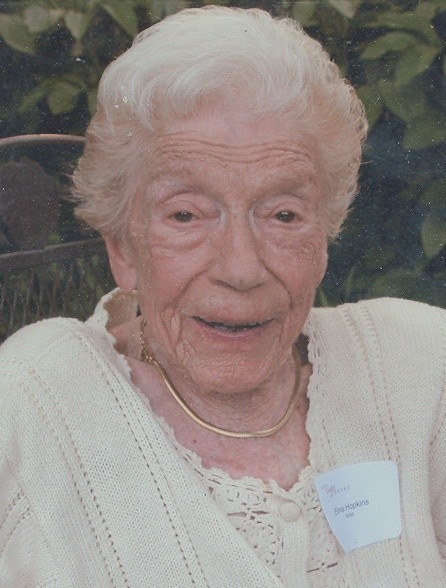
Elma Porter Hopkins, who died last week on November 13, 2009, was born over a century before on August 18, 1909, in the Plattsburg, Mo., home of her grandfather, a wounded Confederate veteran of the Civil War. Her affection for Plattsburg and her admiration for her grandfather and his cause were to endure throughout her life, the latter even as she welcomed the election of a president of Afro-American descent. Elma was valedictorian of the class of 1927 at Plattsburg High School and joined the Delta Delta Delta sorority at the University of Nebraska. After working in the Missouri Tax Office of Forest Smith, she began a long courtship with Glen Hopkins, whom she married in 1938. Their son Jim was born in 1941, and during the war, they were stationed with the Public Health Service in Pierre, S.D. Here she became skilled at hunting pheasants with a 410 shotgun, and devised a recipe for pheasant South Dakota style, which later appeared in the Kansas City Star. When her son left for college, Elma started to travel with Glen on a series of overseas consultations organized by the Department of State and the World Health Organization. The first was to Jordan, where she was able to visit the Holy Land and also to attend King Hussein's opulent birthday celebrations. Later consultations were held in Pakistan, India, Turkey, Iran and China. Elma combined these with trips to places not on the official itineraries, and she and Glen continued to travel long after his retirement. They did not stop until both were in their 90s, and Elma had been around the world three times. At the same time she also began painting, and this too became a lifelong passion. She started with tole painting and china decoration and moved on to pastels, oils, and finally to watercolors, in which she worked longest and most intensively. After studying painting for a number of years she began to teach, and held a succession of classes over three decades. For her teaching, Elma was made Program Volunteer of the Year for 1990 by the Southwestern District YMCA. She was Kansas City- Shawnee Mission Tri Delta of the Year for 1991, and in their Art Auction, was given both the Poseidon Award and the Grand Prize. At the time of her 98th birthday, her paintings were featured in the August/September 2007 issue of Social magazine. The article can be viewed at www.mem.com in the Biographical section and online condolences may also be written. In addition, Elma was a member of P.E.O. and the Eastern Star, a treasurer of the National League of Pen Women, a president of the Keramic Club and the L. Cosmo League; a regent of the Daughters of the American Revolution, and a member of the United Daughters of the Confederacy. As these engagements indicate, she had a great appetite for life and a great capacity to enjoy activity and contact with others. Also she was deeply religious and remained steeped in the faith of her Plattsburg childhood. She was an ardent member of the Country Club Christian Church, and every Sunday, even while traveling, sought to attend a service of worship. This too brought many friends, particularly among those who combined devotion with a love of living and a sense of fun. She is survived by her son Jim; her four granddaughters, Laura, Kate, Anna, and Amelia; her great granddaughter Ruby, and her great grandson Frank, all of whom attended the celebration of her 100th birthday. There will be a visitation from 2:00 to 3:00 p.m. on Saturday, November 21, at Mount Moriah and Freeman Funeral Home, 10507 Holmes Road, followed by a graveside ceremony at 3:00 p.m. at Mount Moriah Cemetery. A memorial service will then be held at 4:00 p.m. at the Country Club Christian Church at 61st and Ward Parkway. In lieu of flowers, donations may be sent for the Glen J. and Elma P. Hopkins Scholarship in Civil Engineering to the Office of the Treasurer, University Hall, Columbia, MO 65201. Arrangements under the direction of Mount Moriah & Freeman Funeral Home, Kansas City, MO.ELMA HOPKINS: THE ART OF A CENTURYExploring the Extraordinary Life and Art of Elma HopkinsBy Jennifer BrownStepping into Elma Hopkins’ living room is a little like stepping back through time. The furniture is antique, ornate, and tidy, the room all but dominated by a large portrait of a younger, 1950s-era Elma, painted by a friend. Closer inspection turns up a staggering array of exotic-looking whatnots and elaborate paintings-landscapes in oils, lavender florals in watercolor, delicately-feathered birds on china-all Elma Hopkins originals.The artist meets you in the entry-way, a broad smile on her face. “I have three of everything,” she says, as she grabs your arm and leads you on a tour of the house. “When I taught, I would paint the picture first. Then I would demonstrate it for my class. Then I would demonstrate it again. So I have three of everything.” The prospect is awe-inspiring. Three of everything painted in any artist’s lifetime would be. But three of a lifetime of paintings when the artist is nearly a century old is something else altogether.“I was born August 18, 1909,” Elma says as she settles close in a comfy chair. “In Plattsburg, Missouri. I”ll be 98 years old this year.” (Fun Fact: Elma was valedictorian of her class at Plattsburg High School in 1927.) Imagine living in a time when many Kansas City families still relied on outhouses. When major streets were unpaved. When beloved grandfathers were Civil War veterans. When clothing was still handmade. “My mother handmade all of my clothes,” Elma explains. “Because my grandmother thought store bought clothes, which there weren’t many of, weren’t good enough. And my grandfather, James Porter, was a Civil War veteran.”In fact, Elma’s grandfather, James A. Porter, married Bettie Gill, whose mother was Tabitha Watkins. Tabitha was a sister of Waltus Watkins, who built Watkins Mill in Lawson, Missouri in the 1860s. (Fun Fact: Watkins Mill is America’s only surviving woolen mill.) “We used to have our family reunions at Watkins Mill,” Elma says, “and we’d go up and turn on the mill, and ran it as it was run in the 1860s to make wool uniforms for Civil War soldiers.” A conversation with Elma is nothing short of fascinating, as she seems to have not only lived 98 years, but 98 extraordinary ones at that. (Fun Fact: Although Elma is diabetic, Elma’s guests rave about her homemade citrus candies and cinnamon rolls.)Elma’s late husband, Glen, whom she affectionately calls “Hoppy,” was a Colonel in the United States Public Health Service, and then was later appointed as Deputy City Manager in Kansas City. “Hoppy was a kind man and loving husband,” she says. “He was quite handsome and very bashful.” Glen’s work with the U.S. Public Health Service took him, and Elma, to destinations the world over. “I’ve been around the world three times,” she says. “I had a most marvelous time.” Elma’s “marvelous time” included attending King Hussein’s birthday party in the Kingdom of Jordan in 1959. It also included visiting the old city of Petra; shopping for pearls in Hong Kong; riding a “bullet train” in Japan; touring Nairobi in a Volkswagen minibus; and catching an Elvis Presley double-feature in New Zealand. Bangkok, Calcutta, Tehran, Athens, Zurich, Curacao, Guadalajara, Bulgaria. . .you name it, Elma’s been there. And she has the mementos to prove it-toothpick holders, statuettes, china plates, bowls, teacups—and Elma remembers where she got each and every one of them. Some of the most intriguing, such as a clothes brush with “1909” printed on it, originated very close to home.“That’s a clothes brush from the Priests of Pallas Parade in Kansas City in 1909,” Elma explains. “That’s the year Glen’s uncle was King of the parade.” Priests of Pallas was Kansas City’s answer to New Orleans’ Mardi Gras Parade, and was a week-long festival held annually from 1887-1912, and then revived for a short time in the early 1920s.Other keepsakes are from far-flung places such as Egypt, India, China, Iran, France, Russia, and England.“This was hand-painted in Russia,” she says, holding a small box, “And with a single-bristled brush. And this one,” she says, picking up another knick knack, “was hand painted in Iran. That’s bone that it’s painted on. Isn’t it beautiful?”Yes, but the real beauty found in Elma’s house lies in her own art, which decorates the rooms freely. “That’s an oil,” she’ll say, proudly pointing to a landscape. “That one won prizes and earned $450 at an auction.” There are acrylics and watercolors, too, and elegantly-painted china dishes and vases.“China painting is the hardest medium,” she says, but admits it’s still her favorite. “I’ve done china painting, and I’ve taught it. I love to teach.” (Fun Fact: Elma’s father called her “Flits,” because of the way she flitted about.)And then there are the glass eggs – hand-painted with flowers, animals, little scenes that must have required a keen eye, a steady hand, and tons of patience to accomplish. “I used to paint a dozen eggs a week for a gift shop,” she says, pulling some down from the shelf to show them off. “The hardest thing in the world to paint,” she says, holding up an egg with a cat no bigger than a thumbprint painted on it, “was getting his eyes just right.”Like most women starting families in the 1940s, Elma had devoted her life to her family-supporting Glen in his career, and mothering their one son, Jim, a Southwest High student who went to Harvard, and later to the University of Cambridge, on scholarship. “After Jim graduated high school (in 1959),” Elma says, “I thought, What am I going to do with all my time? He’s my whole life.” She recalled some painting she’d done during her younger years as a student a the University of Nebraska. “I was crazy about painting,” she said. So she decided that with her nest empty, it was a good time to pursue her passion. “That’s when I took up painting.” “I started with tole painting,” she says, holding up an umbrella stand and a wastepaper basket as examples. (Did you know? Tole painting, popular in the late 1800’s, is elaborate painting on metal ware, such as lampshades or trays.) “And then I moved on to oil painting. And then water-color. And then china painting. I took classes in someone’s garage, or in a backyard, or in somebody’s home, or wherever they were.”And though she spent hours crafting pansies and yellow flowers on china, she made time for a little whimsy in her art, as well. Her son Jim recalls, smiling, “She started out painting toilet seats. She had decorated toilet seats and you’d lift the lid and it would say, “Goody,goody, Papa’s home!”Don’t make the mistake that age has slowed Elma down any, nor that her days of creating art are over. This is one incredibly busy lady.“Jim wants me to come live in England,” she says, “but I belong to so many organizations, I can’t.”She’s an 79-year member of Delta Delta Delta; an active member of P.E.O., a philanthropic organization; a member of the prestigious National League of American Pen Women, where she was Treasurer for more than 20 years; member and past president of the L. Cosmo League; President of the Ceramics Club; and Eastern Star.She’s also a past Regent of the Kansas City chapter of The Daughters of the American Revolution (DAR), where has a long, exciting history. Returning to the states after a 1976 trip to London, she stopped in Washington, D.C., to present a lithograph of the famous Order Number 11 painting for the Missouri Room at the DAR National Headquarters. Order Number 11, painted by Missouri artist and politician, George Caleb Bingham, is a portrayal of General Thomas Ewing’s brutish treatment of Missouri civilians during the Civil War.Later, in 1995, Elma was commissioned by the DAR National Board to paint a picture of the President General’s project as a Christmas gift for her. The President General was Darla “Deanie” Kemper.Organizations aside, Elma has a definite plans for the future. “I want to get back to china painting,” she says, holding a detailed vase that took her more than a month to complete. She adds that she is also currently still teaching art, via correspondence, and is looking forward to August, when she’ll renew her driver’s license for another two years.And this 98-year old firecracker, who jokingly calls a 90-year old woman, “a young chick,” absolutely glitters as she tells a story about a doctor who recently, upon reading MRI results, told her she has a “pretty brain.” He went on to explain that the left side is pretty, but the right side, most commonly considered the “artistic center” of the brain, is even prettier.“I thought that was the funniest thing I’ve ever heard,” she says, laughing. “My brain is pretty!”And that – beauty - is the one thing that hasn’t changed over the decades in Elma Hopkins’ life. Beauty in art is as front and center in her life as ever it was. As she shows off a hooked rug hanging on the wall, or a pastel drawing by her mother at Ward-Belmont many decades ago, nothing is ever more apparent. “You can see the fuzz on the peaches,” she chirps, still proud and awestruck over her mother’s accomplishment. “She had to redo it so many times.”One can only imagine a woman dressed in homemade clothing in a house surrounded by unpaved roads, never having heard of a dishwasher or the Internet, a paintbrush in hand, trying vainly to pass on the sense of beauty she found in the fuzz on a peach. Compare that to the vibrant woman in a crisp red shirt wanting, in her ninth decade of life, to get back to portraying that same beauty in the dainty feather on a bird’s wing on a fragile china plate. In that light, actually, not much has changed at all.“If anyone had a perfect life,” Elma says, grinning, “I’ve had it.”
Show your support
Add a Memory
Share Obituary
Get Reminders
Services
SHARE OBITUARYSHARE
- GET REMINDERS
v.1.17.0