
OBITUARY
Marie "Bill" Heilker
May 29, 1933 – April 3, 2026
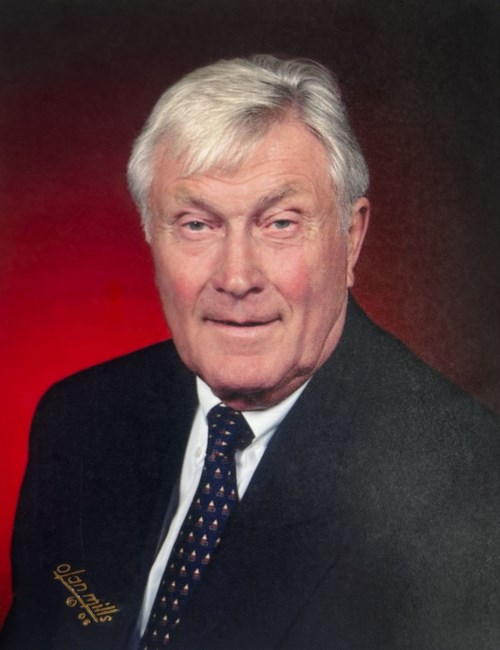
May 29, 1933, Schiedam, Holland — April 3, 2026, Lee's Summit, Missouri
Marie "Bill" Heilker died peacefully on April 3rd, 2026 — Good Friday — at John Knox Village, at three o'clock in the afternoon. For a man of Catholic faith, the symmetry of this was not lost on those who loved him. The same hour. The same surrender into something larger. His wife, Diana, was with him, and his stepdaughter Michelle, and his stepbrother Jim. He was not alone. He was held. Those who had known Bill for any length of time knew what he would say when he left you. He said it every time, to everyone, without exception — pressed into your hand like a small and serious gift, stenciled on the placard at his door. Keep smiling.
He said it to strangers. He said it to neighbors at John Knox Village. He said it to the children and grandchildren of the people he loved, every single time, without fail. You could set your watch to it — except that a watch implies obligation, and Bill's keep smiling was the opposite of that. It was a benediction. He meant it the way a musician means the last note of a phrase: not as an ending but as an instruction for what to carry forward.
Bill was born on May 29, 1933, in Schiedam, Holland, the youngest child of Johan Frederik Heilker and Marie Petronella Van Aken — both Schiedam-born, both already fifty years old when their youngest arrived. His father was a music conductor and horn player. Bill grew up inside music the way you grow up inside a language — not learning it so much as breathing it, the intervals and the feeling of them becoming part of the body's own rhythm before you have words for any of it.
Schiedam was also one of the great jenever-distilling cities of the Netherlands, and Bill carried both of these inheritances — the music and the gin — with him across every border he would later cross. At the holidays he made this literal: a glass of jenever, juniper-sharp and warming; a plate of oliebollen, the golden fried dough of Dutch New Year, dusted in powdered sugar, tasting of somewhere specific and far away. He gave these things with the same instinct he gave everything: here, this is good, I want you to have it.
He was also a boy who grew up fast. During the war, the Heilker family hid Jewish families in their factory while Bill's older brothers concealed themselves nearby, hunted by the Germans for forced labor. When Nazi soldiers came to the door, it fell to young Bill — the youngest, the one they hadn't come for — to look them in the eye and tell them his brothers were already working in the factories in Germany. He said it so that they believed him. Some lessons about dignity and courage arrive before you are old enough to name them.
After the war, the family's fortunes changed. The Jewish families they had sheltered gave Bill's father the means to purchase a large stock of cigars — tobacco being desperately scarce in postwar Holland — and the family began, at last, to find stability. Bill threw himself into sport: soccer, tennis, field hockey. He started playing field hockey at twelve and would not stop until he was sixty-two. He finished high school at sixteen, completed his degree at the University of Rotterdam in three years, and came away with a love of mathematics and languages and a lifelong impatience with anything that kept him from doing real work in the world.
At twenty-four, he immigrated to Canada, where he lived for eight years. Then came a decade in Phoenix, where he built a career in banking and threw himself into the life of his adopted community — organizing the March of Dimes Marchathon for Maricopa County, helping raise funds for families affected by birth defects, always finding the place where his labor could be of use to someone who needed it. Eventually, Kansas City called. He could not have known yet what was waiting for him there.
Music, it turned out, had one more thing to give him. A friend who sang alongside Diana in the choir had been sitting next to Bill at the Kansas City Symphony for years. She thought they should meet. They had lunch at André's, the Swiss confiserie on Main Street with white tablecloths and the peculiar midwestern light of a place where things begin. By the time lunch was over, something had already been set in motion that neither of them would stop. Bill fell in love with Diana with a completeness that was as beautiful for their families to celebrate as it was to witness. There was an early moment, before they married, when Diana was in the hospital and the doctors were working and Bill stood in that corridor and said to her family, quietly: I want them to take good care of her, because if something happens to her I don't know what I'll do. I love her.
There was no performance in it. It was simply true, and he said it the way a Dutchman states a fact about the physical world. It was clear then that this man had given himself over to loving Diana completely. And that she was safe in that. They married. They traveled the world together. They drove west from Kansas City through the Rockies and into the desert. They went to Holland, where Bill was from, and to Belgium, where Diana's family had its roots — two people walking backward together through their own histories, finding that the distance between those histories was no distance at all.
When Bill came to watch Diana’s son play music, he would find Hermon, the trumpet player in the band, and something would kindle in him. You could see it. The horn reaching across all that ocean and all those years, landing in him like a key turning in a lock that had been waiting. He loved music the way people love the histories that have shaped them so deeply they can no longer see the shape — they only feel the pull.
What Bill understood — what he perhaps always knew, in the way some people know things without having been taught them — is that dignity is not a condition. It is an act. It is something you do for another person, with your hands, with your presence, with your willingness to show up and say: your life has value and I will demonstrate that with my labor.
When Bill and Diana moved to John Knox Village, he did not slow down. He swam daily. He walked the grounds. And he noticed that another man was struggling — working to adapt his body to swimming and exercise, trying to reclaim something of his own vitality against the arguments of age. Bill started working with him. Not as a trainer. Not as an authority. As a teammate in the labor — the same way he had been a teammate on Dutch soccer fields and field hockey pitches for fifty years. Two men converting effort into more days and the specific dignity of a body still capable of trying.
This is the thread. Follow it back and you find it everywhere in Bill. The work was always an act of love. The love always expressed itself as work. He could not separate them — could not imagine why you would want to.
After he died, his hospice nurse bathed Bill's body before the funeral home came. The hands doing work give the mind a way through. This is not metaphor. This is physiology. This is why the three women went to the tomb. This is why, in our oldest stories, the body is washed and anointed and wrapped — not only for the dead, but for the living who do the washing. The nurse who bathed Bill had cared for him in his final days. In that last act of labor — warm water, careful hands, the body of a man he had tended — he was doing what Bill had done his whole life. He was converting his love into work. He was giving dignity. He was processing grief through the oldest available technology: the body, moving with intention, in service of another human life.
In The Time of Our Singing, Richard Powers writes about music as the one place where the dead and the living can occupy the same measure, where a theme stated by one generation is answered by the next, across years, across loss, across the impossible ocean between the living and the gone. Bill's father played horn in Holland. Bill found Diana in Kansas City — led there, in the end, by music, by a choir friend and a symphony seat and a lunch that changed everything — and in her a life that answered a melody in him that had resonated since childhood. A harmony he had carried across an ocean without knowing yet what it was for. The family who loved him heard keep smiling so many times it became part of their interior music — a theme they will carry and, one day, without knowing why, pass on. The young ones among them, still becoming who they are, carry it in whatever form their lives take — as the people they are, wholly and exactly themselves, which is precisely what Bill would have wanted. A theme stated. Then carried. With patience, with variation, with love. Keep smiling, Bill.
Bill was preceded in death by his parents, Johan Frederik and Marie Petronella Heilker (Van Aken), six siblings, and his beloved daughter Debbora "Debbie" Ann McFadden of Parkville, Missouri.
He is survived by his wife Diana; his grandchildren Scott and Aly McFadden; his stepchildren Michelle Clark and John Evans; and a loving extended family.
A Visitation will be held on Friday, April 24th, 2026, from 10-11:00 A.M. with a Memorial service to follow at 11:00 A.M. and a reception to follow the service at Our Lady of the Presentation,130 NW Murray Road, Lee's Summit, MO 64081. In lieu of flowers, the family is asking donations to be made to “Hospice by John Knox in care of John Knox Village Foundation,” 400 NW Murray Road, Lee’s Summit, MO 64081.
Show your support
Add a Memory
Share Obituary
Get Reminders
DONATIONS
John Knox Village Foundation400 NW Murray Road, Lee's Summit, MO 64081
Services
SHARE OBITUARYSHARE
- GET REMINDERS
v.1.18.0