
OBITUARY
James Hubert Conley
24 March, 1922 – 15 September, 2017
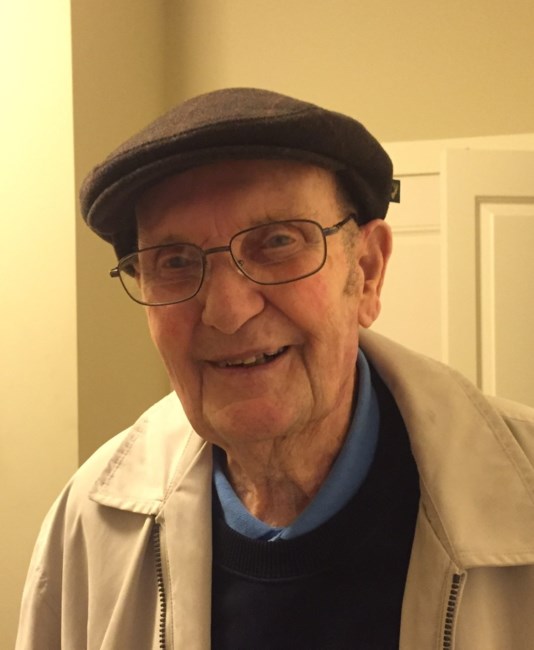
Memoirs of Jim Conley: I do not have previous memories prior to age five, as is the case with most people. However, I do remember my Mother, and since we lost her at my age nine, I try to retain memories of her between my ages five & nine. One of my first memories was not a good one for me. We had just moved to a new location in Lindsay, Ontario - Glenelg St. - a few blocks from downtown and every address was few blocks from downtown, as a small town of 7000 people at the time. Anyway, she had cleaned me up, dressed me in the usual sailor suit of the times and left me on my own on the front veranda, while she finalized her preparations for going shopping. I noticed some guys working on the corner down the street and curious, I wandered down and promptly fell in the sewer they were cleaning out, up to my armpits in shit at age five, not a good start. Anyway these guys delivered me home. I really don’t recall my reception there, not likely good. I should mention here that being born in a small town and growing up there during the 20’s & 30’s was a considerable blessing in itself. Dad was in the painting and decorating business and had an excellent reputation. He had clients who had the money, required his services and who referred his name to their friends i.e. Leslie Frost & Lional Frost -Lawyers. Leslie later became premier of the Ontario, a good one. When you think of the Depression Times, when it was most difficult to get any job, it is commendable that all during that period Dad was able to hire two good men and keep them fully employed, in addition, he lost mother at my age nine and Jack age three, and managed to bring us up without a great deal of help. A far better man than me, McGee. I will come back to Dad later but here I need to fill in those years of memories of my mother between my ages five and nine. Mother’s family was large. She was the youngest of five sisters and three brothers. In those days families did not scatter too much, although in this case one sister Lothe lived in California and two brothers, Albert and Sid lived out west, Winnipeg and Vanderhoof BC respectively. The brothers were station agents for the railroad. The sisters were school teachers and nurses. The rest of the family lived within an area of around 120 miles distance and Lindsay was central to this area. Accordingly, we had more family gatherings at our house. When my grandfather retired he travelled and stayed for various terms at each of his family members homes. He had a railway pass since the railway was his occupation. When Grandfather stayed with us he always gave me a “shinplaster” A shinplaster was paper money worth 25 cents about a 4th the size of the dollar. I should have saved those, of course because they would no doubt have been real collectables today. But you know me. I haven’t really saved anything except my life an few times. Come to think about it that was important since it has resulted in me having a wonderful wife, family, the most important asset. Getting back to Mother these are a couple of incidents I remember prior to age nine. We lived about 1/2 block from my first school, so naturally, I went home for lunch. So did Dad. Anyway, I came home one day and mother said she needed a couple of things from Babcock's Store and she wanted me to run down and get them, before Dad got home for lunch. Our backyard backed on the English Church and the church was surrounded by a six foot steel fence with the usual barbs on the top. I'd been over that fence dozens of times, no problem and it was a short cut to the store, so naturally I took it. No difficulty going, but coming back I was climbing the fence with the packages and my foot slipped out of the slot. I reached for the top to stop the fall and my hand landed on one of the barbs. I dropped the packages, then had to climb back up, get my hand free from the barb and finish the climb over. I had my first scar. When I arrived at the house, Dad was home, when he saw the hand and the bleeding he got the doctor on the phone, Dr. Shier and told him the story. Doctors made house calls in those days and he arrived shortly. He said I needed stitches and started preparing. Dad held my wrist over the corner of the table and the Doctor stitched it up. I guess once you get the first one you start a trend because I had more on the same hand not long after. As you know, I'm so handy with anything related to tools or knives. I think it's called "stupidity syndrome." Aunt Clara Mom's sister lived two doors away. I'm over there and she gives an apple. No sweat if I eat it normally, but I decided to cut it in half while holding it in my hand. That knife went through that apple like it wasn't there and continued on into my hand. Second scar and stitches. The third is vague in memory as to how, but I did manage to stick a knife into my wrist, small scar still showing.I have mentioned Aunt Clara living two doors away, married to Uncle Fred Bicknell. She was a terrible cook, even her chocolate pudding was an "ugh” She was however a really nice person. She had three boys. I guess you would describe them as unusual. They never played sports, Run Sheep Run, Cowboys and Indians etc etc as our usual gang did. Their father Fred could be described as a "hippy" of the thirties, a really bad time the be one, since a provider for the family was extremely important. There were no backups for poverty, welfare was $10.00 per week. There was certainly more admirable qualities to Fred, but he just did not relate to making a living in the usual ways. I recall one day when Aunt Clara called Mom and told her that she did not have a scrap of food in the house and could my Dad put Fred to work for a few days to get some money for groceries. So Mom told dad and he went over and told Fred to be ready for some real work. At 7 the next day Dad went over and Fred was still in bed. However, Dad prevailed and got Fred working. Now the good side of Fred. We kids loved this guy. Whenever something new in kid's interests came along Fred was first in line to provide "our Gang" with the best, i.e. the best slingshots, the best bows and arrows, the best kites and the best fishing rods. Fred played the violin and well actually taught it. He tried one time to enlist me, but that wasn't my thing. Fred made his own violins, he spent many hours doing so. Later in life he made instruments for the Toronto Symphony. Fred also led the town band in the oval at the park. Those were his kind of things. His view of life was somewhat different from that needed at the time.Then my mother died and life changed for us, and undoubtedly a terrible shock for Dad. The family came through when possible, like during summer vacations. It gave Dad some breathing room to have Jack and I spend time at relatives during the summers, often at Aunt Hazel's and Uncle Frank's at Ansom Ont. at Aunt Mabel's and Uncle Roy's or at Aunt Mabel's in London. However, there were also the greater periods of time on or own at home. At first a family friend, an older lady, Mrs. Tait moved in and took over household chores, a nice lady but it was understandably a chore for her and she had to give it up. In those days it really was not difficult to get housekeeping. Help for room and board alone, there were few other jobs for women. Dad did make a mistake in hiring the next housekeeper from Toronto. I did not get along with her from day one. She was extremely bossy, a drinker and smoked. Dad had a difficult time getting rid of her. After that my older cousin May Woodley came over and prepared meals etc. She was a nice person, the only Woodley I really liked.I look back on my years 9 to age 14 as being my Tom Sawyer - Huckleberry Finn days, I had complete freedom of movement and my Dad's trust that I was getting in no trouble. There was no allowance in those days. I had my chores, unpaid, but I needed spending money as did my friends, Don and Gord Tolmie, Frank O’Leary and a few others who I cannot dream up the names of at the moment. We all went to the Saturday movie matinee and needed some gum and candy money. So we had our various little enterprises. I had two paper routes, sold the Star weekly on the weekends, learned early that not all people were honest in paying their dues. In our wandering around town we became early day recyclers. When we came upon an old tire we never passed it by because that was a nickel at the junk collectors. When World War 11 broke these yards paid off big time. If we saw anything metal we picked it up and our collective gathering during the week sometimes paid for our weekend movie together. Our neighbor on Glenelg was Mr. & Mrs. Campbell, they had a double lot with a large barn behind the house. They rented the barn to firms delivering bread, milk. etc. These firms kept their horses there. Mr. Campbell was head of a food supply company, a good job. Mrs. Campbell had extensive gardens and she was our life saver when we ran short of funds. We worked on her lawn and gardens in exchange for our movie money. Mrs. Campbell's daughter was the town librarian and she got me started on reading, introducing a life time of enjoyment.There was so much happening in those years. I'll try to relate incidents as they occur to me. Dad fit into my life so closely in those days. We did seem to have an understanding. I never even thought of letting him down and I think he knew it because he gave me uncommon liberties. Dad never ever gave me money. When I needed a haircut, he'd say get you hair cut tomorrow morning, Saturday. I never really liked to hear anything that would spoil my Saturday plans. So, I'd get up early and try to be first in line at the barbers. Dad would pay the barber on his way downtown Saturday night. Other times he would say you need a new pair of pants, or a new shirt, go see Dick Butler at Eaton's in the morning. Dick Butler ran the men's and boy's dept. Everybody in town knew him and he knew everyone's financial circumstances and outfitted accordingly. Again, this could be an infringement on my Saturday time, so I'd try to get to Eaton's on opening and get on the "wait bench" in the top 5 or so. Again, Dad would call in at Eaton's and pay the tab. One time my rush backfired big time. Gord and Don Tolmie and myself bicycled down to Eaton's. We had some rush plans after. I got outfitted in new trousers and since we were in a hurry I did not change back to my old clothes. On the way home we started racing. I was on the inside and when we turned a corner they cut me off and I hit the curb and made a nice full out sprawl on a cinder driveway and lost plenty of skin on my hands and arms. But more important also took both knees out of my new pants. Dad was not too happy about that one.Incidentally, I should tell you about those cinders. When they talk about the cinder track in those days it really was a cinder track. In high school we raced on a cinder track and woe and behold if you tripped. In the winter people burned blue coal but coal would burn out over the evening and then you would need to start a new fire in the morning, a real pain. To avoid this, on going to bed, people would lay a pail of coke on top and this coke would eventually burn down to cinders which were then used to cover driveways. The real trick was to put a layer of soft coal on top of the coke. This soft coal would melt over the coke and seal the coke fire underneath. Then in the morning all you needed to do was break the seal and restart your fire with more coal. A toasty house all night. When we gathered to go play hockey on a Saturday our destination was one of out of town pond's, via the railroad tracks. We took with us a shovel, our hockey gear, material to start a fire and a pail. The tenders on the trains were always overloaded and as a result large chunks of soft coal fell off and were ours for the taking. Our Father's did not overlook freebies.As boys in the same circumstances, needy most of the time, we did not overlook times when we could earn a dime. We were all into fishing and the Scugog River provided the perfect means. Tourists going over the road bridge could not resist stopping because it just had that look. The bridge of course was not the ideal fishing spot but we did not enlighten the tourists. We just sold them our extra dew worms, caught the night before and then proceeded to our favorite fishing holes. I t was somewhat uplifting to be able to provide the provisions for a family meal. Incidentally the railway bridge over the river was the site of one of our initiation exercise to join our group. We knew the approximate times of the trains. The idea was to crawl out on the girders under the tracks to the middle of the bridge, then when the train was passing over hang of for dear life. It was noisy and seemed to go on forever. One time one kid fell off into the river, but was rescued by swimmers below. While I'm into fishing, I'll related another of our money makers. Keep in mind we are talking Depression, people were really poor. In early spring the river is running fast and high over the locks and splashing about knee high over the canoe slide. The fish are running, suckers, carp and catfish. So we got our pails went down to the locks and took turns standing on the canoe slide because the water was freezing cold. We dropped our hands into the water and waited for a fish to hit. They came fast and furious and we grabbed and threw the fish up to the waiting pails. When we got a pail full we sold the pail full for 10 cents. A good bargain. We had people lined up to buy. It was a cold hard day. The big payoff was to catch a carp. If we did and it happened one of the guys would put the carp in a full pail of water and rush up the street to the Rabbi. If the fish was still alive we got 25 cents. We did pay our dues. I don't believe kids today have any idea the lengths we would go to earn and we did earn that dime.During those early years besides being somewhat addicted to listening to Amos and Andy at seven each evening and listening to Fibber Magee and Molly, Dad and rarely missed the Friday night fights and in particular the Sugar Ray Robinson fights. Some of these fights lasted less than 2 minutes and Sugar Ray was getting huge pay out of $25,000. I remember one evening remarking that I wouldn't mind taking a beating for 2 minutes for $25,000. That was unbelievable money in the thirties. How times change. Anyway, Dad and I would start sparring and Dad started teaching me to box. In the beginning it was bare fists and a times both of us had split lips and sore ribs, but we enjoyed our workouts. I didn't realize at the time how much it paid off big for me later when I needed to prove something about myself. As I go along I realize I may need to go back and forth to relate some incidents. I'm now age 13, at school during recess we are as usual playing "two in" softball with two people at bat. At all times one player must run the bases and get home to be able to continue at bat. If you don't everyone moves up two positions and the "out" players starts over in the field. It is difficult to maintain your position at bat because you really need at least a double to ensure that your partner has a chance of driving you home. My friend at school is playing first base. The hitter is Jack Babcock, a guy who has joined forces with the supposed "bully" crowd. Jack hits a grounder and is called out at first, Jack refuses to accept the verdict, walks up and hits my friend a nasty one in the eye as he is reaching for the ball to continue play. Just then the bell rings. I cannot let it go and remark to Jack that he hit my friend a dirty blow. Jack immediately challenges me to a fight after school. The game is on. We go to class and are called to the principle's office. The principle, Elvidge does his thing and warns us not to fight on school grounds after school. However, the whole school is aware of the pending fight and when the bell rings everyone drifts toward the high school football field which adjoins our school grounds. Jack wants to earn his brownie points with his fellow bully crowd and I am committed. Keep in mind fighting in those days was one on one only and no hitting when down. My supporters were behind me, Jack's behind him. It's crunch time and Jack rushes in swinging from left field and right field, wide open to a block and a straight punch. He didn't have a clue. I simply blocked those wide swings and belted his nose and eyes with a straight rights and lefts as I had been taught. Jack kept trying, but finally he could hardly see and his nose was a mess. His friends decided he'd had enough and called the fight. I guess I confounded everyone's expectations. My self esteem jumped upward. When I got home after school Dad knew about the fight. I don't recall him saying anything about it. He just tapped me on the back of the head and gave me his quiet smile of approval. Surprisingly the next day both Jack and my friend turned up in class and looking terrible with those black eyes. Jack and I were immediately called to the principle's office. Elvidge gave us the required reprimand and then said that he felt that the result of the fight was proper and that if we shook hands the affair was over.There are a couple of other incidents I should mention about ways of making some money. All of us were on the lookout and sometimes you got lucky. Just being in the right place at the right time. I was down at the railway station one evening around 7 o'clock and saw this guy loading empty milk cans from his wagon into a box car. Then he loaded up his wagon with full milk cans from the box car. I asked if he needed any help and my timing was perfect since he had just lost his helper. So, I started doing the run with him each evening between the creamery and the railway station and the pay was above average. Those milk cans were heavy. Another chance Job I got was on Friday evenings. I don't even know to this day if Dad was aware of what I was doing and I did get home rather late at times. However, as previously mentioned I had Dad's trust and that was all that mattered. In my wanderings I had found out that there were illegal fights being held in a warehouse and they were popular with the betters. Anyway, I asked the guy in charge if he had any jobs and surprisingly he did want someone to clean up all the garbage left on the seats and floor. At the end of the fights, the job paid $5.00, big time money. Also, I got to see some good fights, real down and dirty and sometimes a little cruel when someone got in over his head. When I think about it now, I realize that I could have caused some big-time trouble if the police had raided and I was picked up.I should relate another story or two about Dad. As mentioned previously Dad employed two men full time all during the depression. One of these gentlemen was an alcoholic, Staff Teatro. However, when Staff was sober there was no better worker in town and he was the most pleasant person to work with. Constantly telling stories and singing ditties. When I eventually got to work with him it was a ball. Because of staff's sometime difficulty in passing a bar Dad always drove over to Staff's home on the other side of the bridge and gave Staff's wife the paycheck for the week. I believe there were three small children and Dad wanted to be sure that essentials were taken care of first. In those days everyone worked for 5 1/2 days. I remember that Dad was really annoyed with Staff one Saturday morning. He went over to site to check on Staff at noon and found that Staff had left a wall half completed and the paint can and brush still on the ladder. Dad had to spend the rest of Saturday completing the job. One time when Staff was in the cups he came to our door at supper time and pleaded with Dad to give him a shilling. He always talked in English money. Dad refused of course because he would never encourage drinking. However, he invited Staff to join us for dinner. That evening Dad had cooked a dish of macaroni. Staff decided to come in, sat at the end of the table, he pulled the whole dish of macaroni in front of him and poured vinegar all over it. Jack and I were about to complain but Dad quietly put his fingers over his lips and shook his head. That meal sobered Staff sufficiently to get back on track. There were times when Staff disappeared so long and his wife would ask for Dad's help in finding him. Guess who knew where all the bootleggers were, yours truly, and so I was the one who went on the search. I found him at times too, then Dad corralled him and took him home.I haven't mentioned my education. I was not really a good student. I guess I had too much going on and I seemed to have a tendency to get in some hot water daily. However, I did have my moments. I recall one instance that occurred basically because one girl annoyed me to no end. By assuming that she was tops in the class in total marks at the end of each month, she was half way to the front of the class to accept her reward before her name was announced. I guess I must have a mean streak, because I made it my goal to beat her and I buckled down and studied. At the end of the month the teacher stood up to announce the winner and as usual our gal was already on her way to the front when my name was called as the winner. I guess the shock was too much for her because she continued right out of the room, crying. I had accomplished my goal but at the time I was not committed to punish myself by constant studying and neglecting y other various interests. When I look back I realize that I really did have too may irons in the fire and that I neglected my school work because of them. At one point I got interested in collecting and trading hockey cards. There were only six teams then and I managed to collect cards on everyone of the players. That collection would probably be worth some dollars today, but the cards somehow disappeared during the war. Another of my real interests was stamp collecting. I joined a stamp club and spent hours collecting, buying and trading. I had a good collection too but over the years gave many of them away. Before I leave my young days, I should not leave the impression that our group of guys always went to the movie so Saturday. Often times the movies did not appeal to us and we made other plans. Quite often we would hike out of town to the woods we liked. We had some great times running around in there and the farmer did not mind us being there because we did no damage and lit no fires. Part of that woods was a maple stand that the farmer tapped in the spring to make maple syrup. Our group never drank from the streams. We did know of a couple of spring outlets and took a drink from those if needed. However, on one occasion a new boy who had joined us did take a drink from a stream unknown to us and got typhoid fever. It caused a bit of a panic on the street and we were all checked out. There is one winter in particular that I remember because we had an ice storm, before any snow. Everywhere was covered in ice and the weather stayed cold for some time. We skated right from our door to any place we wanted to go. The river froze solid and we skated for miles on the greatest ice ever. On one occasion I went to play hockey at an outdoor rink. It was at the bottom of a steep hill and the hillside was glare ice. You could chicken out and slide down on your backside, but my companion and I decided to skate down. He took a fall and broke his collar bone. The ice rink in town was about two blocks from our house. It was not equipped for making artificial ice, so it was done the hard way. The guy who made the ice lived three doors down on Glenelg and when he had a problem he called me and asked if I would get the gang together and come down to the rink to skate the bumps off. We loved that call and had a great time playing hockey indoors on a real rink. Of course we had to also make those fast stops to take the lumps off, part of the deal.I haven't mentioned my brother Jack. Jack was only 3 years old when mother died and because of our age difference he was not part of our gang. However, when he got older he and I got into board games, crokinole was one and we had some great times competing in our games. Dad would sometimes have to shut us down and get us off to bed. I'm not certain when Jack got "shingles" but that was a shocker for us all. Aunt Hazel and Uncle Frank were tremendous help in those days. I seem to be in a memory void for a lot of it. I haven't mentioned sports in much detail, frankly I was fairly mediocre, just enthusiastic and wiling. In hockey I would have had to go in full training and instruction to get even junior status and I was simply not that interested in pursuing it that strongly. It was mostly a good outlet for exercise. I remember playing with two guys, named English and Connelly who were on the NHL interest list and thinking they were in a different world altogether. I believe both got killed in the war. A lot of real talent lost. Softball, I certainly liked playing but I was always a late swinger and when I got a hit it was usually a Texas leaguer into short right field. After the war I played in the Insurance league in Toronto and made just such a hit, and drove in the winning run in one game. A big surprise moment for both me and my fellow teammates. Tennis, I learned to play tennis on one of my visits to London. London had play grounds in various locations and the nearest one to my Aunt and Uncle was Mclean Park. I wandered down there on day and went into the club room and introduced myself to the chap in charge. So he says what would you like to do and I said I'd like to learn to play tennis. He grabbed a couple of racquets and some balls and said come with me. He introduced me to a game I really liked and did become quite proficient at. When I returned home I mentioned my interest to Dad and he bought me my first racquet and a really good one at the time. He probably spent some bucks he could have used for something else. Table tennis was in its early stages when I was introduced to it. As far as I knew no one had their own table at the time. The guy who ran the United Cigar Store on Kent St. converted his back room to a table tennis court. Our little gang got interested and paid the required 15 cents each for 1/2-hour time. We didn't waste our time right from the start. I played left handed which confused my opponents. I got quite good at this game and later held the camp championship for three months at Aylmer, Ontario. Then an Australian came along and took the championship. He was just better. Things I tried once, Catcher for baseball, the batter came up and instead of swinging normally from the shoulder the swung straight back, caught me on the forehead, no mask in those days. Goalie in Hockey, our goalie got injured and I volunteered, no pads and the first guy came in shot high, caught me on the eyebrow with the puck. Those eyebrow wounds really bleed, end of my goalie career. Golf, I took up golf late with Neil Brown in Vancouver and it was the game I loved most. I was never "good" but I was competitive and I have had some exceptional moments. To be "good" you need some early years training, Both Bill and Robbie are better golfers. I have been a member of the Kelowna Golf and Country Club since the early 70 's and have enjoyed every moment of my membership. My best game at KG &C was a 75 a most unusual day for me. I have a good memory for good golf shots, both my own and those made by other golfers in my foursome. I have birdied every hole, except number 10, lucky to get a par there. I have eagled 4 holes, the old course # 9, old # 7, old #6, new course #2. The strange thing is I had those eagles during tournaments, good timing. Another fond memory is the 20 years or so I went to Spokane for a week in May each year with Walt Moore, Tommy Lloyd, and Ed Turner. Good golf courses and I had a real great week each year, lots of fun. Pool, a game I enjoyed most of my life started early, probably unknown by Dad. It was a great way to spend time during the service years.Religion, Dad was very close to the church and In the years prior to the war I attended Church and Sunday School on a regular basis. I do believe in a higher power. However, I not a big fan of structured religion. There is just too much hypocrisy and some religions have allowed unbelievable abuses. There are some good churches. However, I have my own principles and rely on those to guide how I live and treat others.Going back to the early teen years I was not yet old enough to work for Dad and I got a job in Druary's grocery store. That was an experience, and one I really enjoyed. There wasn't much money in it. My first day, a Saturday, I worked from 7 a.m. to 12 p.m. and received the princely sum of $1.50 and I lost the $1.50 on the way home. I was a little upset and went to Dad's bedroom, woke him up and told him my story. Dad didn't say a word, just got up, got dressed and then said, tell me exactly how you came home. We got the flashlight and followed the exact route, but no luck. Dad did not replace the hard-earned funds. It was an early lesson. If your careless you pay the price. It took a few such lessons for it to sink in. There is absolutely no relationship in the operation of stores today as compared to the stores of the 1930's. Packaging was almost unheard of. Most of the produce came in from the surrounding farmers on a barter basis. I was not prepared for this on my first Saturday and spent a great deal of my time filing orders on the spot. Even then I was thinking there had to be an easier way. At the time I was only working Saturdays. Later on, I worked every day during the summer holidays. Anyway the second weekend on the Friday evening I went down to the store and Mr. Druary was there working on the books and I suggested that maybe I could get some things packaged for the Saturday rush. He agreed and I worked for several hours, no pay, just trying make my next day easier. I cut up a layer of cheese in 1/2 lb. 1 lb. and 2 lb. slabs, packaged sugar in different amounts, packaged raisins, dates, flour, potatoes and all kinds of things. It really was a time saver on Saturday. Saturday evening in Lindsay was different, although I would imagine was much the same in most small towns in those days. The main Street, Kent was wide, angle parking on both sides and a good two lanes down the middle. A lot of the local people with cars would drive down early, park their car and then go back home for supper. Later on they would walk downtown and when they got tired of shopping or just walking, slip into their car and watch for acquaintances to stop and converse. Then the farmers would come into town and drop into the grocery store, to do their bartering with eggs, potatoes, butter, cabbages etc. They wouldn't grocery shop then. They'd go to the early 7 o'clock movie and after back to the store to do their shopping. A real pain in the butt for me. I'm tired and now I just know that someone is going to want 100 lb. of white sugar and worse a 100 lbs of brown sugar, which is more difficult to carry since they don't bend. There were no carts in those days and we didn't even have a wagon. I remember one Saturday in particular where the farmer was parked a good long block away and I did just that, carry both bags of sugar to the car, one at a time of course. My name wasn't Tarzan and I wasn't his strong cousin either. It is unbelievable how slow changes were made and continued to be slow until after the war years, more about that later.Druary had a son named Harold, a few years older than me and he did the deliveries in a car. He seemed to be continually eating or drinking and I'm sure cost his dad more in produce than his wages. A cookie here a chocolate bar there and continual Coke, in later years Harold developed "coke" poisoning and it cost him health wise. I always joined Harold on his last delivery, Saturday night. Each store was assigned a number of welfare recipients as customers, welfare was $10.00 per week. Those assigned to Druary's store were lucky because Druary had a soft spot and he arranged with his welfare customers to deliver their weekly order on the last delivery Saturday. Keep in mind that vegetables were not sized for cost. A cabbage the size of a football or larger went for the same price as one 1/4 it's size, 10 cents for every size, same for turnips etc. So Druary would sort out the large sizes earlier in the day and save these for the welfare orders. Also, there was perishable foods which wouldn't be saleable on Monday, strawberries, raspberries. In those days bananas came on the stock and hung up in the store on the stalk. On Saturday night I would clean off the stock. One Saturday while doing that I saw the biggest spider I had ever seen. He jumped off and traveled, I never did catch him. Those bananas went into the welfare orders, the berries, the bananas etc. all went in the orders free of charge. Nice guy our Mr. Druary. Delivery of those welfare orders was not a pleasant job, sometimes. My first time in one of those houses I had both hands full and almost gagged from the smell. I was careful after that to keep one hand free to cover my nose. It is hard to imagine the conditions people had to endure. By and large I did enjoy my days working at a grocery store. I should mention one incident early on when Druary did not know me that well. One of his best customers who lived close by came in one day and I waited on her. Later in the day she phoned in and said that I had given her change for a $10 instead of a $20 bill. Since the extra $10 did not show in the till, I was under some scrutiny for a while. Thankfully, the lady called later in the day and said she had made a mistake and that I had given her the correct change. People were both honest and most important in this case, absolutely sure of just how much money they had. Before I leave my grocery days I will mention one incident. Druary had bought a new car, small but brand new. Harold was anxious to see how fast it would go. One day I went with him in the car and we drove out of town about 2 miles and turned around. Harold said you watch the speedometer and I'll hit the gas. That speedometer was clicking on the end and the car was shaking big time, when Harold let off. It's kind of a teenage thing, I guess and we survived the experience. I don't think Harold ever told his Dad at the time, I don't recall ever mentioning it to anyone either. I guess we scared ourselves a little and maybe acknowledged some stupidity.I was now old enough to start helping Dad and he could use it because he was fairly busy. My first job was connected to a contract he had with a new subdivision being built, the doors windows, base boards, cupboards and frames were all being built at a workshop a couple of blocks away from home. It was run by a couple of carpenters who were friends of Dad. So Dad dropped me off there to prime coat all the doors, windows etc. ready to be transported to the job site. I admit these guys were busy but when you walked in there you were almost knee high in sawdust. They never took time to clean up or maybe it wasn't their thing. Anyway, I had to have some clean space, so I got out the broom and cleared a space in one corner and got started. Eventually, I caught up to them on the finished product so I spent my spare time cleaning up the whole place. They never had it so clean and I think it really helped them get more done. The job seemed endless and I was fairly fed up with the repetition, kind of brain numbing and I had my first thoughts about not wanting to be a painter for the rest of my life. There is another side to Dad I never appreciated at the time. He was busy, worked hard all day and still had to come home and prepare bids on future contracts in the evening. Some of those contracts were government and they were slow to pay. As a result we lived tight to a budget because Dad always paid his ongoing obligations first, ie wages, supplies etc. I remember one time he got the contract to paint all the Shell stations in Victoria County. Another time he had the contract to paint a number of cottages at the Lake. We lived in one of the cottages. The first morning Dad built a scaffold about waist high along one side of the cottage, gave me a gallon of paint and a brush and said that side was mine. He had hardly cleared the corner of the cottage when I knocked the gallon of paint off the scaffold. Dad came back, looked at the mess and then said, "I see you are working for free today" and I did too. Again I was reminded that there was a penalty for carelessness. Where I came in handy for Dad because I was light and had no fear of heights was at the top of double ladders painting these high dormers etc. on those old three-story houses. I would paint as far as I could reach and then give the ladder a little tug off where it rested so I could paint where it had sat. Sometimes the ladder moved more than I had intended and reminded me that it was a long way down. The landing could be nasty. No way could I do that now. A six-foot ladder is a challenge. I suppose there are a lot more memories I could relate and maybe I will write down some of these as they occur.But now we are approaching 1939 and the war is in the air. Guys my age are getting the fever even though under age. For a generation who have for the most part never travelled further than perhaps 80 miles from home, the thought of traveling hundreds and thousand of miles overseas was a mind-boggling adventure. Not much thought about some danger involved, that was the other guys worry. It's the same today. When war was declared, our town changed fairly quickly. The armories which had been mothballed since the First World War was reopened and good jobs announced. I forget the wages offered but they were way above the going range. Just prior to things opening up it was quite noticeable that serious army recruiting was going on. All the fit young guys, without jobs and just hanging around started to disappear and the next thing we know they are part of the First Division to go overseas. There is one incident that occurred in Lindsay that has always rankled me and I look back on it and wonder how such a shameful act could have occurred in our town. The most wonderful fruit and vegetable store was located on the corner of Kent and William St. and it was run by a long-time resident, Joe Lamancha. I think that was how it was spelt. He had a cart and pony and he used to load up the cart with his product and drive slowly up and down the various streets. People looked forward to seeing him come and made a point to go out and purchase something. He and his family were as good a Canadian citizen or better than most people in town. When Italy joined with Germany and some ugly and untrue rumors started, next thing we know some guy (probably the guy who started the rumors) opened up a competing business. The Lindsay people shamefully stopped dealing with Joe and drove him out of business. That still bothers me. We may not be as good as we think we are. Shame on you Lindsay. Good Japanese families got the same and worse treatment later.Now it's getting to my turn. I'm seeing a lot of my older friends joining up. One time Don Tolmie and I went to Toronto with his older brother Gord. Gord got into the para-troopers and fortunately Don and I were not accepted because we were underage. Don and I later joined the Air Force, my intentions when I joined was to get into aircrew. I had cut all civilian ties. My timing was really bad, since I had severe hay fever at the time and the Doctor turned me down for Aircrew. However, I was committed, so I joined up anyway with the intention of transferring to aircrew as soon as the opportunity came up. As a result I spent a few months in various admin jobs and got myself fairly fit in boot camp. At Aylmer I was assigned to the Control Tower to keep track of flying times. They flew Harvards. I was really looking forward to flying and found out if I carried a parachute in the tower with me I might get an opportunity. Some of the instructors really hated their job as flying instructors and wanted to get transferred to action. One of these was a guy named, Bitzy Grant. He had tried on several occasions to indicate his wish for action by shooting up the camp, so far it hadn't worked. I really don't know what was going on with him, but one day, sure enough, he asked if I would like to go up. I grabbed my parachute and we were on our way. Bitzy gave it the works that day right over the camp. Loop the loops, rolls, falling leaf (that’s a good one) and everything else he could think of. Surprisingly I never got sick. I was really enjoying it. However, when we got down Bitzy was suspended because he had taken up a plane that was termed U.S. Bitzy got what he wanted, Later I heard that he became an Ace Train-buster. I was not surprised. I don't know if he survived the war. He was in a tough racket. My chance for aircrew finally came. They were looking for a Air Gunners and Wireless operators and I quickly signed on. They sent the group of us to London to be tested first for wireless operators. Basically, we listened to wireless transmissions and recorded as to whether we could distinguish the difference between a Dit and a Dot. Some could not, but I did and was interviewed for wireless operator. However, when I learned that I would need to take a further six months course in wireless I turned down the "opportunity" because I wanted to see some action before the war was over. It was 1942. I was now committed to taking the Air Gunners course at Fingal Ont. (near St. Thomas). It was one thing to sign up but there were some hurdles to jump before being accepted. The first one was "air sickness", anyone can get air sick, but it is usually a one-time thing. One guy on the course got air sick every time he went up and was washed out. I got air sick the first day but there were contributing factors. I had a very tough first day. We were flying in Bolingbrokes, two engines, one turret and very little room. They took two gunners up at a time. The other gunner was in the turret first and I was crouched in the belly of the plane below the turret. He got sick and most of it came down on me. I then got sick too, and we had to land. However, we were shocked to find ourselves directed immediately to another plane. We never recovered from air sickness on the first flight and when we landed I was so weak that I had trouble getting into my top bunk. That was the end of my air sickness. When we were not flying we had study courses to complete. I had no trouble academically but as you know I do not excel mechanically. Thus there were a couple of hurdles for me to climb. Try putting a Browning machine gun breech-block together in the dark. I had to sneak down to the training centre at night to practice so I could keep up in the daytime performance. Same with wireless. We were required to send ten words per minute in case the wireless operators got injured. I passed but exercises later proved to be rather useless in operations anyway. I did okay in shooting, pressing a button fitted easily in my mechanical resume. Anyway, my log book indicates that I passed with a 70 grade and on the 9th of Oct. 1942 I was ready to move on.I am in my 90th year, one of those old guys who survived World War 2. Newspapers now report that there are less than 100,000 of us left. The rest of us are fading away rather quickly. I have no ambition to be the last man standing, or sitting, for that matter. I had better add my two cents worth to the memory file” NOW”, or it may too late. My first blessing each morning is just waking up.In the 1930’s our local news coverage reported on events taking place within an area of approximately 90 miles from where we lived. We were not bombarded by reports of disasters world wide, like now. (thank goodness) We did start getting disturbing accounts of Hitler’s rise to power in Germany. When the inevitable war was declared the young guys & gals of that era were more than ready for an adventure. Future job prospects in the “dirty thirties” did not look rosy. Most of us had never travelled much more than 80 miles from home and the prospect of traveling thousands of miles to other parts of the world was intoxicating. So we “innocents,” for the most part, signed up in the army, navy, and air force and with mistaken belief of youth(as now) that we were immune to disaster- “It was the other guy who was going to get it.” Many, a great many of those innocents died without having experienced a sexual encounter. We really did live in a different era - didn’t we?Let’s get on with telling you some of what I did and some of what happened to me during the war. Basically, I ended up training as an Air Gunner because the training period was short and I was itching to get into action. I wasn’t too smart when I was young, either. The classroom sessions of our training were like going back to school. Some skills we were taught proved useless in actual combat, like me taking Latin in school. Maybe I’ll get to use it when I reach age 100, you think? Reality set in when we started flying. Our top guy took a wrong turn on exiting his plane and walked into a moving prop - a fatal mistake. When I heard about this, my father’s instructions echoed in my mind, “stay focused, distractions can kill.” Another chap got airsick every time up and washed out. A small group decided they did not want to continue. I don’t know what happened to them, something not nice, I expect, like cleaning latrines for the duration. Two others decided to become instructors in Canada, they got the offer and took it. The rest of us graduated, were promoted to sergeants, and off we went to Halifax. There we boarded the Queen Elizabeth for the voyage to England. The ship’s troop complement represented all services including Americans, the English who had trained in Canada and of course Canadians. All categories of trained troops had been divided up and shipped out in different ships. Apparently, a full contingent of trained navigators had been shipped out on one vessel; that ship had been torpedoed and sunk with all hands lost. The powers that be decided never to repeat that costly mistake. Thus, our mixed passengers on the Queen. I must say that I enjoyed the voyage. The ocean was rough and even the Queen Liz gave us that constant up and down movement. Seasickness was the fate of a large number. I escaped that delight. The meals were excellent. They were the last good meals most of us would get until we returned to Canada in August 1945. There is one more incident I’d like to mention. Having no duties, I took the opportunity to do some exploring. The ship was fitted out as a troop carrier. Bunk beds, six to one room. In my travels around the ship I came upon the games room. The pool tables were still there but no pool equipment. The American troops had discovered the games room first and realized that the tables would make great “crap” tables. There was already a game in progress. While in Halifax we had all been paid, half in Canadian dollars and half in British pounds notes. No one seemed to be aware of the relative values of the currency, except those British troops, as soon became obvious. The Americans were in charge of the game and had placed an equal value on the Canadian and American dollar. We did not learn the true value of the British pound until we reached England. When players in the game ran out of Canadian or American dollars they began to throw their British pounds in the pot. The Americans who were in charge put value of the pound at $2.00 Canadian or American. The English troops who were watching the game realized the opportunity and every time a pound note landed on the table they reached in, plucked the pound note and replaced it with $2.00 Canadian or American dollar. Rules of the game, so no objection was made and we did not realize until we reached England that the big winners in the game were the English. Every-time one of the Brits reached in and made the exchange they made a profit of $2.67 since the pound note had a relative value of $4.67.We landed at Liverpool without incident although we changed course one evening, prompting a few remarks, but no facts. We disembarked and traveled to various destinations. The R.C.A.F. troops boarded a train and were off to Bournemouth on the south coast of England. The train trip was not memorable. We were given a sandwich which tasted like two pieces of pressed sawdust, covered by a thin paste of something. Bournemouth, was a huge troop deployment center. On arrival in the evening my first impression was the overall green tinge to the lights including the mess hall. Green lighting is not complementary to food. Bournemouth was awash in troops awaiting postings, after being processed through the necessary paperwork etc. The full contingent of new arrivals was scheduled for a meeting at a local theatre and I guess we all turned up, since the large theatre was full. After we were all seated the senior medical doctor for the R.C.A.F. or R.A.F. (I’m not sure) came out on the stage. His opening remarks were blunt and meant to grab our attention, He started “I don’t know why in hell I come out on this stage every time a new contingent hits town and deliver a speech no one pays attention to. I have given this same speech on numerous occasions and each time we still end up with 30% casualties. Once again then, this town is full of experienced girls. I’m being kind here by not using other descriptions. Nevertheless if you consort with these girls you will end up with the clap or worse.” The speech went on and on about the dire consequences of the various diseases that could be contracted and then he closed with if you become infected, we cannot process you for deployment to your new unit, until you are cured. I believe that I have been clear, but if there are questions I will answer them now. And no, I don’t know any of the girl’s names or where they live.” I have been asked that question before. Just stay away from the girls, please. Get processed quickly and leave town for your sake and ours.It seemed that you only got “processed” if you turned up at the processing center and became a “known” at Bournemouth. I chummed around with another Canadian, we were both interested in seeing London. Since no one seemed to be aware that we were around, or cared, we decided to go to London. We took the train and got a room in London, through the “Beaver Club.” First night we were in our room and guess what, an air raid. That was new for us. To us it seemed like all hell had broken loose. We tore down the stairs and there she was, our landlady, sitting quietly and knitting. She said, “Where are you going boys?” “Where is the air raid shelter we asked.” “No need for that” she said. Most of the noise is coming from the nearby anti aircraft guns”. “You're okay if you just stay inside.” “The enemy planes are nowhere near us.” We rather meekly returned to our room. Our landlady was typical of Londoners and I will always remember her calmness. When we returned to Bournemouth, after a couple of days, we realized that no one had missed us and we decided to start getting processed. Once we did start, it went rather quickly. Another aside here, we were bunked in a rather large estate home, probably donated for the duration, as many such were. In front of the place was a large pool, not deep, probably only knee deep. In October the water was “cool”. The driveway off the street wrapped around both sides of the pool and continued to the front entrance of the house. The pool presented no problem in the daytime. But at night, in the blackout you had better remember the pool. It provided some evening entertainment. We just sat on the steps at the entrance and watched the returning airmen make their approach. Most of the late returnees had been drinking or had a bad memory and the splashes into the pool were continuous, followed by some healthy swearing and finally the arrival of a thoroughly drenched and freezing airman. Some of the fun times are what I seem to remember the most. My friend and I attended the next processing session and learned that our posting had come through. It was a shocker. We were being sent to an R.A.F. station and attached to the R.A.F. There were some objections raised and ignored and off we went, all the way north to Lossiemouth, Scotland, for O.T.U. training and crewing up. The selected group heading north were mostly new people since it was made up of pilots, navigators, bomb aimers, wireless operators and gunners. In addition, our group would be joined in Lossiemouth by English crew members. I was a little upset by the posting to R.A.F. but as events unfolded I came to view the posting as a “Blessing”.So now in Dec 1942 I find myself in Lossiemouth, Scotland, which was not the ideal spot to be at anytime, let alone the winter months. There were no living quarters on the camp itself. Our tin huts were down the road about a mile or so towards town, with no amenities. We had to go to the camp to shave and shower etc. and when on call, be on camp and ready for duty by 7 A.M. - no transport. We were expected to walk. Try it on a cold frosty morning. That was just for starters. We had to survive until April. They called it toughening up. Some of it was “gross.” Our exercise and relief from duty was a soccer game on a frozen field in never washed soccer uniforms. I don’t know how many courses before ours wore those same outfits and experienced the unbelievable odor. Our initial course meeting was held in the camp briefing room. The room was full and a tough looking Scottish Squadron Leader entered and walked to the front. Someone had broken his nose and he deserved it. The first words out of his mouth were, “Take a look at the three people sitting beside you, to your right.” Only one of four will leave here to continue training. That has been the pattern set by previous courses.” He went on to relate, in general, what our training would entail. But his opening remarks have stuck with me for a lot years. I don’t believe our course fared any better than previous courses. Not all our casualties were killed. There were a number of accidents of one kind or another, due to inexperience, severe weather, or lack of attention to the rules. I will enlarge on a couple later. Previously, I mentioned that luck was a factor in survival. At times, it is difficult to discount that. Sometimes what looks like luck is just real life. I certainly thought it was bad luck to be attached to the R.A.F., but I later learned that it was the best thing that could have happened. The English pilots were older, more experienced and were accustomed to the poor weather and fog conditions. I think we all realized at this point that we had moved up from kid’s games and were now entering some serious reality. The O.T.U. course in Lossiemouth ran through late December 1942 and extended to the end of Feb 1943. During that period I completed my personal gunnery exercises, attended lectures, crewed up in January and flew as a crew member until the end of Feb. We flew in Wellington bombers (Wimpies) which had a crew of five. The Wellington was a good aircraft in it’s time but at the beginning of 1943 it was being used less and less as an operational craft and now more for training purposes. I have read some R.A.F. history and have realized that I was most fortunate to be starting my operational tour in 1943. The longevity of planes and people up to that time was discouraging, to say the least.I befriended another Canadian gunner at Lossiemouth. He was lodged in the same hut as me. In one of his off duty times he became acquainted with a Scottish lass, rather seriously, I might add, since he mentioned he planned to marry her. That was a distraction and it did cause a problem. In late December and early January we the gunners were scheduled for gunnery exercises in the air. These exercises involved 4 to 5 hrs. flying time each day for about 8 days. My friend, enamored by this Scottish lass attended a Scottish New Years party with her, not realizing that such parties go on and on for 3 or 4 days. Prior to crewing up no one identified you by name. You were just a body and if you answered to the name on the instructors list, that was good enough. When my friend did not turn up on Jan. 2. I checked his flight times with my own and found that I could do his flights, plus my own, if those same schedules were kept. So I simply signed in with his name, on his flights. It kept me busy, out of one plane, into the next. Same thing for the next two days, but I got it done and got away with it. My friend turned up on Jan 4th fully expecting to be charged A.W.O.L and it was a pleasant surprise for him to find, that I had covered his flying assignments. All he had to do now was to record the flight time in his logbook for certification and he was home free. Of course he had to record my performance scores too, but just maybe I did better than he would have, since I didn’t have a distraction.Lossiemouth, did not provide entertainment but there were occasions when we did provide our own. In the service it was important that you did not stand out as different. If you did, you became a target. I recall two incidents while in Lossiemouth. Anyone who was in the service and was different was usually viewed as one who could (and often did) get the rest of us in some trouble. Accordingly, we were usually looking for ways to “even out”. On arrival in Lossiemouth for crew-up and further training, we were billeted in small Nissen huts. These had no ablutions and were scattered around the countryside as far as two miles from the main camp. We were expected to make our ways to the camp to shave and appear on the parade square by 07:00. The winter months were cold and wet and it seemed to be dark most of the time. We had a fitness buff in our hut and he made the rest of us look bad. He didn’t smoke, didn’t drink, was in bed by nine and was the first up every morning. He ran everywhere. One night everyone in our hut was on night flying, except for him. When we arrived back at the hut around 02:00 he was peacefully asleep. I guess it struck most of us at the same time that here was our chance to even up. One of the guys changed Mr. Fitness' watch to six o’clock and then we all half undressed and pretended to be dressing. We then woke up our friend and suggested that he was unusually slow this morning. “Are you not feeling well?” we asked. Mr. Fitness checked his watch. In near-panic he jumped out of bed, dressed quickly, grabbed his bag and rushed off to camp. The rest of us then turned in for a very satisfying sleep.After crewing up in Lossiemouth, we were placed in huts along with our new mates so as to get to know each other, as quickly as possible. In our hut was another “different guy” an Aussie, who was a ‘dresser.’ He had had his uniforms all re-tailored to fit perfectly. His shirts and ties were all non-issue and he didn’t wear issue boots, when off duty. He easily succeeded in making the rest of us look somewhat scruffy. From our hut it was one direction to camp, the other down the road to the bus and the main road to town. Between our hut and the road was a rather wide ditch filled with slimy green water about waist deep. We crossed it on a couple of loose boards. One day we got an afternoon off. We spruced up in the main camp, then hurried back to our hut to don our best ‘blues’ for a trip to town. As usual our dresser was the last one to be ready since he had to be perfect. We set off without him and while crossing the ditch someone suggested that we remove the boards and when our dresser arrived pretend that we had all jumped the ditch as someone had made off with the boards. When he appeared, a few minutes later we suggested that he get cracking so that we didn’t miss the bus. It went off beautifully. The dresser backed up, took a run, slipped on the greasy edge of the ditch and made a very satisfying splash!Back to gunnery training, there were turrets lined up facing targets at the foot of the range. We had an English Flight Lieutenant instructor, who had already completed a tour of operations (a really nice guy). Before we started firing, he went over the rules, one of which was to always leave the turret with the guns facing the range and he added “never turn the turret so that the guns are facing other turrets, since there could be an unexpended cartridge in the magazine” So guess what, one guy did exactly what he was told not to do, one bullet was left, it fired, hit the turret next to it, chipped a piece of metal off the turret and that piece of metal entered the ear of the gunner sitting in the next turret. Exit another gunner who would take no further training, since that gunner, although not deceased was now deaf. Here’s where some injustice occurred, to my mind. The gunner who made the error received no punishment. The instructor, who did everything right, was taken off instruction and ordered back to combat operations for a second tour. Hopefully, he made it, but his chances were slim. Next step, crewing up, the pilots on the course picked their crew and I was very lucky to be recruited by an English pilot named Gibson. He was indeed a good pilot, who qualified for four engine bombers. This qualification was important, since those pilots who did not qualify had to continue flying the two engine Wellington in forthcoming combat. My friend’s pilot did not qualify for four engines and when our course completed training, his crew was transferred to a Wellington pre-op station in Yorkshire. More about that later.I spent the balance of January and February 1943 flying and completing the required gunnery exercises. Before I leave Lossiemouth, I will mention a couple of incidents. First a personal moment which became important to me because I really wanted to believe it. It happened at the right time in my life. If I dream at all, it is rare and I never remember the dream on waking. However, in Lossiemouth, I did have a dream, a very vivid one. In my dream I saw myself (after the war) walking across the corner of Albert St. and Kent St. in Lindsay, Ontario, in uniform. On waking, I remembered every moment of that dream. I actually did just that after the war to emphasize, in my mind, the reliance I had placed on that dream. I believe that dream fueled the thought that no matter what happened between now and the end of the war, I was going to survive. Not a bad feeling to carry around with you. There were a few occasions when it really helped. My beliefs were shaken on a few subsequent occasions. In one of our night cross country flights out of Lossiemouth, we apparently flew too low over Glasgow and found ourselves amid the barrage balloons. The noise emanating from the balloons were very disorienting, as was intended. It was a scary moment for us and we were lucky to emerge unharmed. On another occasion, in day light, we were coming in for a landing and I saw the plane behind us dive straight into the beach, with fatal results for all. Apparently, the pilot had turned on a dead engine, a no no. These kind of accidents and others did not help our course record. The Squadron Leader may have been right, but he sure picked a bad moment to forecast our futures. Our course did not set a new standard and we were now posted to a pre op status in Yorkshire. The group having pilots qualified for four engines went to Rufforth, Yorkshire to continue their pre op training (near York) The rest were posted to other locations in Yorkshire, including my friend. My log book tells me that we stopped flying in Lossiemouth on Feb 28/43 and we didn’t start flying again at Rufforth until Apr 13/43.In the meantime each crew member was scheduled for additional pre-op training and had to attend sessions acquainting us with the enemy on a more personal basis. We received lectures on what to do if we were obliged to bail out, particularly over the target. Naturally, the populace would not be friendly and if we were captured by them most likely would be hung from a lamp post. They had reports of that happening. If escape wasn’t in the cards they recommended that we try to give ourselves up to the German Home Guard, since this unit was made up of soldiers from the first war. The home guard would likely ensure that you reached a prison camp. We were to avoid the S.S. since there was every likelihood that they would assist the populace in the hanging. We were to try to get at least 40 miles from the target to have a chance to get picked up by the underground. They tested us on the escape plan. Although the night they arranged this “pleasantry” for us, we had no idea what was in store for us. We were told to dress in our battle-dress, leave our valuables in a sealed pouch and then get into one of the trucks standing by. The trucks had no windows. My truck filled up and we left camp. Each truck had an instructor in the back of the truck. Our instructor proceeded to tell us the plans for the evening. We were to travel 40 miles from camp and then be dropped singly around, a mile apart. I had gotten on the truck with an older English chap and when I heard the plan I said to him,” if you get off first, walk back, then I’ll get off next and walk forward. We will meet and the two of us will have a better chance of getting back to camp without getting picked up.” He thought that a good idea and we did just that. It could not have been a worse night. It was raining buckets. We were in the middle of the Yorkshire Moors, it was pitch dark and we had no idea which way to travel to get back to camp. We had been informed that we were on a simulated escape plan and that army units were on the lookout for us. Also, the whole area had been alerted to report us if we appeared in pubs etc. We were drowning in the rain, cold rain, since it was April. There was the temptation to give ourselves up. But, there was also the challenge. We were walking along side farm fields and noticed a tin hut in one of the fields. My companion said that farmers stored produce there and maybe this one was empty. It was and we crawled inside to get out of the rain. Relief from the rain was wonderful and gave us a chance to have a cigarette and make plans to get back. We decided our direction and returned to the road and started walking. Then we heard a motorcycle. We had very little time to hide, our only chance was to jump into the ditch. We jumped into about a foot of water. We couldn’t get much wetter, in any case. We had to repeat that maneuver several times during the evening. As I mentioned previously my friend from Lossiemouth had been posted to a Wellington squadron near York. I had gotten his address when his posting came in and he had my address at Rufforth. The previous night I had phoned him and made arrangements to meet in York later in the week. My companion and I were walking down the road when there was this terrific explosion, a plane crashing on the moors. It was too far away for us to get to but it was very likely that official parties had also seen the crash and would be en-route. After I got back to camp I went to York to meet my friend at the arranged time and he didn’t turn up. I phoned his station and learned that it was his plane that had crashed on the moors, no survivors. Getting back to our escape plan my partner and I were in the small group who got back to the camp without being caught, although we cheated a little. My partner had held back 10 shillings and the next morning we managed to catch a bus, which took us to within a mile of camp. We walked the rest of the way in. I don’t think I have ever spent a more miserable night.I haven’t mentioned much about the flying we have done as a crew. By the time I completed training and was ready to go to an operational squadron, I had flown around 125 hrs and enjoyed every minute of it. Before I leave Rufforth I must tell you about one “incident” which shook me considerably and is still a vivid memory. I have never used an alarm clock and have never been late for work or an appointment except once, at Rufforth. Our schedule was posted each day on D.R.O.’s (Daily Routine Orders) and we were expected to read those orders daily. No one was going to remind us. To save fuel and instructor time the training planes carried extra crew and several exercises were carried out on each flight, bombing runs, gunnery exercises, navigation runs etc. To ensure that the required activities were carried out, each designated crew member had a replacement standby in case someone did not turn up. Each takeoff time was shown on D.R.O. If your flight said 9:00 a.m. takeoff, that is precisely what occurred, not 8:59 or 9:01 a.m. One day I was listed for a 9:00 takeoff, as was my replacement. That plane was to carry 12 crew members. Then my worst nightmare happened, I overslept. I jumped out of bed, didn’t have time to shave, shower, or eat breakfast. I quickly donned my battle dress and ran to stores to pick up my flying gear, Mae West, parachute, electric flying suit, and the ran for the control tower. I was too late (9.01 a.m.) I saw my plane start it’s take off run. It reached about 800 ft and the wing fell off, the plane plunged to the ground killing all 12 crew members, including my replacement. I ran up the stairs of the control tower and asked if that was the 9:00 flight and they confirmed that it was. So many thoughts coursed through my mind, like I should be dead. My replacement is dead. Were my flying days over, would I face court martial? I have never had such a sinking feeling before or since. It took me awhile to settle down. I took off for the gunnery section and when I walked in, the gunnery leader’s first words were “your dead”. I replied that I should be and went on to explain what happened, much as I have written here. He said to leave it with him. I guess my record stood up because the powers that be, decided I should take my chances on an operational tour with the rest of my crew. I found out later that an investigation of the crash determined that the wrong wing bolts had been used. Also, that all Mark 5 Halifax’s were temporarily grounded and that 4 more planes had the wrong wing bolts, traced to a factory error.One thing I have learned in writing this memoir is that I have no memory for names and it is frustrating. Some names are recorded in my log book. I certainly regret not keeping a diary. We have completed training and are now en-route to our operational squadron, 102 squadron, Pocklington, Yorkshire, about 16 miles out of York. Our crew had done considerable flying together in training at Lossiemouth and Rufforth and as was intended have bonded. We each feel an obligation to cover the other’s back. My early participation with the crew is short term, which I will enlarge on shortly. The camp itself is located on a farm not far from the town of Pocklington and scattered widely since we are in range of bombing raids. The officers on our crew are in the officer’s sleeping quarters and the rest of us are together on a site for aircrew ranks. Sergeants, Flight Sergeants etc. Our quarters are definitely an upgrade from those we occupied during training and we are treated differently, due to our senior officer flying ranks, who brooked no interference from ground crew officers, who still liked to pull rank. More about that later. At this point in time, I did not experience this “tug of war”. My initial squadron experience was very limited. We left Rufforth on April 24th, 1943 and flew our first “air test” at Pocklington on Apr 27th. We flew the first operational trip on Apr 28 and as was usual an easy one (if there was such a thing) as a first time crew - mine laying. There must have been weather problems between Apr 28 to May 4 when we did our second trip to the Ruhr, Dortmund, Germany and we near “bought the biscuit” The attack on Dortmund was comparatively easy, the flack and search lights were new to us, but we did not experience any real problems. We came off the target expressing opinions like “piece of cake” “we can do 30 of these easy” and on and on with like remarks. We came down in height to around 10,000 feet as we approached the coast of Holland and suddenly we were hit with a blue search light which came right on to us and then numerous regular search lights which converged on the blue, heavy flak came up and we were suddenly in a spiral downward, twisting and turning. Finally, coming out of it without any real damage. The crew including me were a subdued bunch. At briefing later, we got lectured on the procedures that we had not followed. That was the end of my personal tour time for quite some time. I did not realize that, at the moment.We were not scheduled to fly on May 5th. We were preparing to visit “York” for the first time. I had picked up my gear for a shower and was headed for the shower room at the main camp when a call came over the “tannoy” that the Gibson crew was to report for an “air test”. When we reported, with our flying gear, we were missing our Engineer who had already left for town. However, we taxied out for take off and the navigator volunteered to assist with the throttles, the engineer’s regular duty. We started down the runway for take off and were at a fairly good speed when we suddenly veered right and headed for the control tower. I did not know this at the time, since I was in the turret facing away and hanging on for dear life. I was getting a rough ride. We did hit the tower. The plane was a write off. The tower would need considerable repairs. Someone yelled “fire” which was a word air crew never wanted to hear, since we had seen the results of fire on air crew. However, it did galvanize action, luckily the door of my turret had broken off and my seat belt a four or five inch web belt had also torn off, I expect from my strong thrust upwards. I only had to fall out backward and crawl along the fuselage to the side door, where our wireless operator grabbed me and pulled me out. Since we were at the control tower and the fire truck was stationed there, the plane was foamed up almost before stopping. There wasn’t any real risk of fire spreading. My troubles were just starting. When I fell out of the plane to the ground I tried to get up and couldn’t move. The ambulance crew arrived and that’s the last thing I remembered. I woke up in the York military Hospital, some 16 miles away. I guess someone had stuck me with a needle. When I woke up an nurse was cutting off my clothes. They were in bad shape. I went from there to the operating room. My first few days in hospital are sketchy. I was in a private room. There were two doctors attending and nurses coming in from time to time to adjust the iv and hit me with a shot of morphine for the pain. I still remember the relief those shots provided. I had broken vertebrae in my back. I didn’t end up in a body cast because I was swollen up like a pregnant lady. Next thing I know they are sticking a tube down through my nose to my stomach to clear a problem in my intestines. I recall waking up one night, thinking I was choking and pulling out the tube. The nurse wasn’t pleased, the tube wasn’t easy going down again in the middle of the night. I was sandbagged in bed and the Doctor warned me not to move or I might cut my spinal cord and never walk again. That scary thought was enough and for sure I didn’t move.Eventually my condition improved sufficiently and I was moved into the ward. I was the only Canadian and only air force in the hospital. The rest of the patients were English army. Some officials from the R.C.A.F. came in one day to visit and asked if I wanted to be moved to a Canadian hospital near London. I declined, since I wanted to go back to the 102 squadron and my old crew and so I remained under military authority until full recovery. The nurse in charge of the ward was named Sister Punch, which naturally drew the nickname “punchy”. No one could have been better placed for wartime duty. She was a gem and will be fondly remembered by a lot of patients in her care. As my condition improved other things began to happen. One day two older volunteer ladies stopped by my bed and suggested that a good way to pass time would be to do some needlepoint. Despite my mentioning that I did not think it was my thing they left me the material to start the project. I managed to complete about a quarter inch and then spilt a “wee drop” (as the Scottish would say) of coffee on the work in progress. When the ladies returned to check, I had told them (untruthfully) that I had an accident. They offered to leave me new supplies, but I believe they might have gathered that I was not a good student. Another thing happened which made me very popular in the ward. By regulations in effect at the time the Canadian charities were not allowed to distribute Canadian “goodies” example, cigarettes, chocolate bars to the English hospitals. However, since I was Canadian and in an English hospital the charities assumed that they had the right to distribute their wares. When the visited me, they left boxes and boxes of Canadian cigarettes and chocolate bars etc. under my bed, with the unspoken assumption that I would arrange distribution to all the patients in the ward. As soon as the charity reps left I had “Punchy” arrange the distribution. There was plenty for everyone and all the patients looked forward to the next distribution. By the way, the quality of English cigarettes and chocolate during the war could be described as barely passable. Especially the chocolate. As my condition improved and I was allowed out of bed “Punchy” enlisted my help in distributing the medications in the ward each morning. Walking behind the cart and using it as a crutch I was able to walk the ward. I believe “Punchy” assessed my progress during this period and it came time to move on to the next stage, although I was still wheel chair bound.My move was to a military run operation on an “estate” in York. As previously mentioned the estates were donated to the services during the war. In any event this “Camp” was an interim stage for recuperating patients. New patients like myself, still depended on a wheel chair when out of bed. On the weekends the “Candy Stripers” turned up to volunteer in patient care. One young lady was assigned to push my wheelchair. The premises were wheelchair friendly in that there was a ramp (no sides) built to allow the wheelchair patients to reach the grounds in back of the estate. My young lady got to the top of the ramp and for some unknown reason let go of my chair and I was on my way down the ramp without control. The chair and I headed for the edge and went over. Luckily, I landed just right with no injury. I guess the young lady thought she had sent me on a death roll, because she started screaming and didn’t let up until she was assured that I was okay.It became time to move on and I received a posting to Blackpool, near Liverpool. The Army had “inherited” a number of hotels on the beach for the purpose of “rehabilitating” the wounded. This entailed a long and determined regimen of exercises administered by some pretty exacting instructors. I will always remember our introduction. I believe it was a set-up, in case we had any thoughts of complaining about the exercises. We entered a room leading to the gym proper and saw two instructors dealing with one soldier who was just reaching the stage where he could begin to walk again. The soldier would start with one instructor guiding him from one corner of the room towards the opposite corner, which he never reached, while we were watching, because his leg muscles would not yet allow him to walk a straight line. When he turned off line the other instructor took him back to the original corner, to start again. I don’t know how long this performance kept up but he was still at it when our group finished our exercises for the day. When I inquired about this soldier, who persisted every day for hours, I was told that he had been wounded when returning from Dunkirk in 1940. An enemy plane had shot up his boat and his leg muscles were completely torn up. It is now mid 1943 and he still has a long way to go. Any thought of complaining about my lot, left me. I believe that was the idea, when they had us watch this soldier and hear his story. Blackpool, is on the west coast of England and out of the war zone. It was a holiday resort except for rationing. There was a fair grounds still running with all the rides, in the evening. When we were free from duty and able to move around, it was a common sight to see girls line up in front of each of the hotels waiting for us to appear and join them for a night on the town. I did this one evening and our group headed for the fair grounds and the rides. It turned out to be my only venture there, since I made the mistake of getting on a ride which twisted and turned and caused some back strain which I was obligated to report. It set me back on my recovery. However, I did leave Blackpool completely fit and ready for “operations” again.It was now August 1943 and I found out that I still had to report for a “refresher” course at Leconfield, before I could go back to the squadron. The refresher course was not long, just 4 days, during which I flew gunnery exercises from a Whitley and a Boulton Paul Defiant. I had a vacation between Aug 4th and Aug 22 at which time I started flying again at Pocklington. This was my first official vacation in London. The first visit to London was two day only, from Bournemouth. This time I pre booked for the Australian Club. When I arrived in London it was raining steadily. I took the underground to the location of the club and it wasn’t there, just the shell. It had been bombed out the night before. So welcome to London in the rain. I took the underground back and found out the location of the Beaver Club. On checking there I learned that there were no rooms anywhere to their knowledge. I made my way back to King’s Cross station in the rain and was soaking wet on arrival. I sat on a bench. It was like sitting in a wind tunnel. I guess I was feeling sorry for myself and a guy came along and asked if he could be any help. I told him my story and he said he could get me a room for the night, his, provided he could have it back a 7 a.m. He explained that he was on night shift for the Salvation Army and slept there when he came off duty. I happily accepted his offer and everything worked out perfectly. I still have a soft spot for the Salvation Army. They always seem to be first in line when there is a need. I was able to get my own room the next day. It is difficult to distinguish one vacation from another. I had several vacations in London and although I did enjoy it I often regret not taking vacations in other areas, since there were always offers on file at the squadron. Like for example an invitation to a Scottish estate where hunting and fishing were available, in addition to other activities.After my vacation, I returned to the 102 squadron and began flying again on Aug.22/43. I was able to rejoin my old crew since one gunner had finished his tour. I did 6 more trips with Gibson and crew before they completed their tour. They had done 22 trips in my absence. Some of those 6 trips were as mid-upper gunner. My first trip back was to Berlin and it was memorable. So much for an easy restart. We had no unusual experiences en route. We were flying in the stream at 18,000 ft. which was the intended bombing height. Approaching the target we lost an engine. The Halifax could not maintain height with a full bomb load and we lost height fairly quickly. The pilot checked with us on the intercom and asked if we wanted to proceed. He heard no dissension, as a matter of fact, everyone was anxious to proceed since we were so close and would not likely get credit for a trip if we turned back. Also, we could become a target for night fighters, since we would be alone and easily tracked. We proceeded and crossed over the target at 12,500 ft. and dropped our bombs. The sky was lit up like daylight what with search lights and the flak-bursts above us. My impression was that the stream at 18,000 ft. was taking a beating and here we were at 12,500 having no apparent problems. We did not realize until we were in briefing later, that we were very lucky indeed that we did not get hit by bombs dropped by the stream from 18,000 ft. The pilot, Gibson was awarded a DF.C. At this point in time the sorties into Germany blend into a somewhat vague memory unless there was something unusual about the trip. The burst of flak, the searchlights, plane near us getting hit and going down, being alerted by Fido of an aircraft too close for comfort, the constant worry of night fighters were all common events. On a further trip with Gibson, I was flying mid-upper gunner. A fact well known by the family over the years is that things mechanical are a mystery to me and if they fail to operate as they should they are not likely to be fixed by me and more likely to receive a frustrated kick. Now a kick does not always work, but it does relieve stress and I continue to use it since it did once work at a most opportune moment. The early editions of the Halifax needed some very necessary changes and did receive them in later productions. We were flying in a Halifax Mark 2 on the bombing run over the target. The wireless op assisted the bomb aimer, in that when he said bombs away the wireless op, pressed the toggle on the tube holding the photo flash which when released enabled the taking of pictures of the bomb release and ground. The tube holding the photo flash was located inside the plane with the end of the tube extending to the outside. I am in the mid-upper turret just above the photo flash tube. The bomb aimer says bombs away, the wireless op presses the release and nothing happens. The photo flash is on a timer and will go off regardless and if it goes off inside, we a have a big problem. We could become crispy critters. The wireless op reports his problem to the skipper and the skipper tells me to give “Sandy “a hand. I drop down from the turret and Sandy is still pushing the release with no result. So I give the tube a kick and lo and behold it worked and the photo flash is on its way. But not very far because the timer ran out and the flash goes off just outside the plane. Sandy and I lost our night vision. But we were not on fire. It was quite some time before we regained our night vision. So now you know why I have faith in the kick. In the later version of the Halifax the photo flash was released by the bomb aimer when he pushed the button for bomb release. I expect we were not the only ones who had a photo flash difficulty.There were a couple of more incidents during my tenure with the “Gibson” crew. We completed an operation on Nuremberg and Aug,23/43. On our return to England we were informed that our air drome and many others were fogged in. We were diverted to an American station, what a pleasant side trip that was. It was a 24 hr. operation since all types of aircraft flew from there at all hours. When we landed and parked, a truck came out to get us and promptly damaged the prop on one engine, since he apparently was not familiar with the lower slung motor. This accident caused us some delay in getting back to our station since the American camp didn’t have a replacement prop. We had to get one sent down from our camp along with two mechanics to install it. In the meantime myself and the rest of the crew entered the 24 hr. mess hall and were greeted by a wonderful sight. Large stainless steel containers full of orange juice and grapefruit juice, something we had never before enjoyed while in England. We filed over to the serving counter, the supplies of food seemed endless, there were signs that said, “take as much as you want, and come back for more if you need to but don’t leave anything on your plate.” The garbage containers were empty. We loaded up with juices, eggs, bacon, and ate heartily. We were then escorted to living quarters, adjoining the mess hall. Our visit was most enjoyable and after repair of our craft returned to our station on Aug 29th, where we promptly crashed on landing. Like Yogi Berra would say “it was Deja vu all over again.” There were some differences, we were not taking off like the last time, we were landing but if felt like it to me in the rear turret because like before we veered off the runway and headed across the field towards the control tower. I don’t know whether our previous accident inspired some thought to protect the tower but there are now slit trenches between us and the tower. The trench stripped the undercarriage and we slid the rest of the way and stopped just short of the tower. No injuries this time around and in my case, most thankfully. The accident did of course involve another trip to the hospital where they checked us out for various things like sight, hearing and a possible physiological effect. The aircraft was another write off which pleased the Wing Commander, since he had now got rid of his oldest plane and would now receive the latest Mark Halifax replacement. I do not believe I have mentioned that we lost our then Wing Commander and crew on the operation following the operation to Berlin. They never returned from that operation. I have copies of the official photos taken when we returned from Berlin and pictures of the Wing Commander and his crew are in that file.I believe I took an unusual length of time to complete an operational tour. First operation - Apr 28/43- last operation July 7/44. For various reasons, my sojourn in hospital and recovery, being a “spare bod” (no official crew) , then a member of the Wing Commander’s crew (didn’t fly as frequently) as a result I did have spare time on the ground for other activities and I must confess that I did partake in many of these, not all bad, since it was a basic responsibility to keep fit for flying duty. In that regard I quite often spent time in the gym and among other things exercised, running. I became active in the boxing ring, I was not good, but I did have some basic knowledge, thanks to my father and was willing to mix it up. There is no better way to get real exercise than, going a few rounds in the ring. Anyway, I got interested. One night and after going three rounds with one guy, a chap from Australia asked if I would go another three with him. I agreed and he got the gloves on and climbed into the ring. The bell sounded, we touched gloves and from there on until the end of the round I never touched him and I hardly saw him. He came in quick, hit me 5 or 6 solid jabs and disappeared. At the end of the round I walked over to his corner and mentioned that he was way out of our class. He replied that he only wanted the exercise and would appreciate if I would continue for the three rounds and really try to hit him. I did and I didn’t hit him once. At the end of the fight, if you could call it that, he informed me that he was the lightweight champion of Australia. He also convinced me not to take up boxing for a living unless I was prepared to fully accept the obligations inherent. I believe that would apply to any endeavor if one was going to be successful in life. I had some other off duty interest. I liked pool and became fairly good at it. Also, I made a few bucks from the boys. One guy was unsuccessful in getting a win and kept doubling the bet. His losses had reached 8 pounds which was considerable in our world at the time and he wanted to again double the bet for our next game. I agreed but on the condition, that it was our last double and he would pay the amount owing, if he lost 16 pounds. The game drew some interest in the mess and we had an audience. It was a close game and he had his chance but sewered on the black ball and lost. My lucky streak continued. Another interest was poker. I was never that good but neither were my competitors and I held my own and at times made some money. On one occasion, I had only 2 pounds in my pocket when the squadron declared unexpected vacation time. I certainly could not go to London with 2 pounds in my pocket and fully expected to be spending vacation on camp. I went over to the mess and the usual poker game was on and there was an opening. I was thinking that I might as well be dead broke, as having only 2 quid, so I got in the game. It was just one of those nights. I drew good cards and just couldn’t lose. I walked away from the game when it ended, with a pocket full of cash and immediately set my sights on another vacation in London. It was most enjoyable too, since it was on found money. I never learned to play chess until years after the war, but I was always envious of those guys who settled into a quiet game, during those “nervy hours”, while awaiting the word for a “go” or “no” on a planned operation over Germany.During our off duty time there were excursions off camp when we as a group decided to visit a country pub which had been discovered and recommended. On those occasions we mounted our bicycles and took off. I must say that some of these evenings were most enjoyable. The English country folk were pleasant to be around and there was a subdued atmosphere. While some of the York pubs, which were noisy and crowded to the doors with various service people and where fights sometimes erupted. There was the common practice of flying crews to host their ground crew, unofficially of course, since officers were not supposed to mix with the “erks”. However the crews recognized the importance of having a good relationship with ground crew since they were dependent on them to have their craft in top working order and bomb loads to be loaded with care and precision. Although, the practice was not official, it was known to happen. At times, pilots arranged a party in a back room of a country pub. At these gatherings there were usually at least two crews hosting the ground crew and the parties were somewhat noisy. I recall one such party and in attendance was a crew member from our living quarters (not our crew) I’m not much good at remembering names, but I do remember the names, Willis and Watson who were memorable for being in constant trouble. Usually Willis and Watson were together, but on this occasion only Watson was present. The country pub was some distance from the camp and most of us took our bicycles. Watson became quite inebriated and started to sing ( a truly awful singing voice) But someone persuaded Watson that he had a better voice than Sinatra and thereafter we couldn’t shut him up. At the break up of the party I discovered Watson did not have a bicycle and he elected to ride on my handle bars. I wasn’t too sober myself and with him on the handlebars and singing loudly we weaved our way home. At the entrance I tried to turn right and Watson wanted to go left and we ended up in a heap in the ditch. The bicycle a write off, we left it there and walked to the mess hall which was still open, and guess who was the only attendant- Willis. Watson was extremely anxious to inform Willis how he had discovered that he had a better singing voice than Sinatra. He immediately broke into song to prove it. Willis didn’t dissuade him but after enduring the noise for some time he got up and left. He was also a member of our hut. When Watson and I reached the hut later it was in darkness, but this didn’t daunt Watson. He turned on the lights, climbed up on the stove and broke into song (the same awful voice) I prepared for bed. Predictably, the guys in the hut who were sleeping when Watson arrived were becoming annoyed and indicated dire consequences if he didn’t shut up. It didn’t have any effect on Watson’s enthusiastic bellowing and someone started throwing shoes. Watson became angry, grabbed his sten gun and went outside to open fire, a full clip. through the hut walls. Luckily, no one was still sitting up in bed, if so there would have been wounded or real casualties. The guys in the hut realized that the noise would bring the S.P.’s and some of them rushed outside and dragged Watson in and threw him in bed, clothes and all and covered him up with the admonishment to keep quiet for his own sake. The lights went out and sure enough we heard the S.P.’s arrive and wander around. Eventually, they left without discovering holes in the hut, in the dark. The holes were discovered the next day and no one admitted to the shooting. Since no one was injured, I don’t believe they tried too hard, since they were dealing with aircrew. However, this incident did have the police confiscate our ammunition. I had better explain why we all had sten guns in the first place. It had apparently become more than a rumor that Hitler and his buddies had plans to drop 50,000 trained paratroopers on the airfields around England with the intent to destroy as many aircraft and airfields as possible. It never happened, but if it had I do believe that the results could have been disastrous for us. The powers that be decided that the possibility of attack existed, had slit trenches added to aircraft sites, armed everyone with sten guns and a clip of 10 bullets. Some parties may have had more ammunition, but I believe aircrew only had one clip of 10, everyone was placed on a guard duty shift. Aircrew only had a 2 hr. shift, but others had a longer shift. I don’t recall anyone being excited and alert, more of an attitude of, are you serious!Before I leave my association with the Gibson crew, since they were nearing the end of their tour I might mention one incident. There were times when we had a briefing on a set target, but there were still details to clear up before the target was declared “on” or off. In any event crews were required to be ready for immediate take off if the operation became a “go”. On these occasions we as a crew trucked out to our aircraft site with all our gear and if we were still on delay, we all sprawled on the ground to await the word, one way or another. We didn’t put on our gear, parachute harness, mae west & helmets. We would do that when we got the “go”. The skipper (our pilot) was considered senior and we were going to have a “passenger,” a ground crew Group Captain C.O. of the station. Apparently, he had never flown before, at least on an operation and he was “antsy,” couldn’t relax and he started putting on his gear. Then we noticed he was making a serious error in doing so. We hesitated to correct a “senior” officer so one of us whispered to the skipper who hadn’t noticed him putting his mae west over his parachute harness, which could cause him considerable difficulty if he had to use his parachute. The Group Captain was wandering around and the skipper joined him and quietly informed him of the problem, which was corrected. However, the damage had been done. The “group” was now in the gossip stream, typical of the English and because his name was “Louis” he was thereafter known as “Clueless Lou”, out of his hearing of course. We did go on that trip and I must say that he was “a pain in the ass.” As soon as the early action started, the search lights, flak etc. he was constantly on the intercom with remarks like “I say” “what ho” “look at that.” Ordinarily conversation is limited and when we neared the target and on the bomb run the conversation was between navigator, bomb aimer, and the skipper, only. On this occasion our passenger was in high gear, with his “Jolly Good,” “I say Bloody Good Show,” “there goes another plane down, poor buggers,” “I say that was close,” referring to a flak burst. The skipper who was outranked, but strictly in command was finally obliged to tell him to “shut up,” so we could concentrate on what was really important at the moment. We didn’t take him on another operation. I don’t believe he was anxious to do so in any case.Before I leave Gibson and crew there was another operation where we lost an engine and fell behind the stream returning home. As a result we found ourselves alone and became a target for night flyers. We spotted the night flyer first and dove down to the thick cloud cover at 10,000 ft. and flew along the top of the clouds. It was like daylight above the clouds and anything black stood out and we could easily keep track of the fighter, so could the fighter keep track of us. When we, the gunners, saw the fighter turn towards us we reported to the skipper who promptly dove into the clouds where he changed course and after some time rose again to the top of the cloud bank. We continued playing hide and seek in this manner and when we rose out of the cloud and there was no sign of the fighter, we assumed that he was running out of fuel and could not continue the pursuit. I don’t believe any of the crew were happy about flying in cloud since it was flying blind and wide open for a head on collision, which was not unheard of, we referred to it as “pucker time.” In general I now find that it is difficult to distinguish one operation from another. They all had the same moments of search lights, flak bursts, planes being hit hard and going down, targets on fire. Newspaper reports the next day about 50 planes missing but they didn’t relate that the planes missing had at least 350 crew members, fate unknown. In addition to those missing planes there were the planes who did return, were badly shot up, had some crew member dead or wounded, badly burned or severely traumatized. There were planes that got back to England, but ran out of gas and crash landed. There were losses besides those reported in the news. Each crew had their stories and I heard a number of them while on the squadron. I too had my “experiences” but happily with no further injuries. I had been saddled with the nickname “lucky” since my missed flight while at Rufforth and I continued to be just that when I returned to the squadron after hospitalization and rehabilitation.I completed my tenure with the original crew of “Gibson” until they completed their tour and I became a “spare bod.” As related the squadron had lost its Wing Commander and crew on the operation following the night we had gone to Berlin Aug 23/43. Accordingly, the squadron needed a new C.O. and Wing Commander Marchbanks arrived. I flew with his crew 18 days after my last trip with Gibson and in my mind, was not a member of his crew. At this point, I was anxious to get on with completing my tour and as recorded by my log book I was not going to do this by flying with the Commanding officer. My first trip with Marchbanks was Oct 22/43, my second trip was Nov. 22/43 my third trip was Dec 28/43 and my fourth trip was on Feb.24/44. During that period from Oct to Feb. I did only one other operation with squadron leader Millson. This particular trip was memorable to me. Millson was on his “third” tour and he was a professional in all respects. You just knew right away why he was able to survive two tours and was on this third, a very unusual occurrence. I felt very comfortable on that trip. He referred to me by my name, right from the start and during the trip asked me to perform little rituals, maybe just to be certain I was with it, because the rear turret can be a lonely spot. In any case he kept me in touch. He’d call up and say, Jim just turn your turret a touch to the right and then he would claim the turret resistance had made the necessary slight correction in his course heading. Maybe it did, but at the same time I felt keyed in. When we got to some activity he said, Jim I’m going to dip the right wing, take a look underneath to see if we have company. Night fighters made a practice of coming up underneath and they had the ability to fire straight up. Then on another occasion, I noticed activity at about 7 o’clock which indicated night fighter activity at our height. I reported same to him and he immediately changed height. The whole trip was directed by a professional, most encouraging and I learned a lot. Millson’s constant companion on the squadron at the time was Squadron Leader Kilsby and I went on to do 13 trips with him. Perhaps I was being tested by Millson to see if I qualified for his friends crew. In any case, I enjoyed those trips with another professional. Incidentally Millson received some special recognition from the Germans. He was mentioned in particular by name by Lord Ha Ha on his radio broadcast with the remark that they knew he was flying on the operation that night and were prepared, indicating that they were going to get him. Lord Ha Ha even named the target. Now Lord Ha Ha was a “traitor” who spent the war years broadcasting from Berlin. He filled his broadcasts with remarks intended to discourage aircrew. He predicted dire consequences, claimed to know targets in advance and that the air would be filled with night fighters. We did not really take him seriously, thus the name Lord Ha Ha, However, I believe that he was indeed termed a traitor, faced trial after the war and was executed as such.I mentioned previously that my operation with Marchbanks were infrequent. He didn’t pick and choose. He had many other duties which did not allow him to take in some operations. As a result, I found myself with a lot of spare time and even though I was a member of the Wing Commander’s crew I classified myself as a “spare bod.” This resulted in some strange happenings. The gunner leader did not appear to have any contrary instruction and he was always looking for spare gunners, preferably volunteer. Anyway as usual I’m in the gunnery office early and talking with another “spare bod.” The gunnery leader comes over to us and says he needs two spares, both rear gunners. The gunnery leader explains that both crews are experienced. The other spare bod and I decide to flip a coin to determine which crew each of us would take. We did so. The other “spare bod” left and I’m still sitting there when gunnery leader again comes over and says he has a problem. A new Canadian crew has reported in and the pilot would like his rear gunner to get an operation under his belt before taking over with his own crew. Would I consider giving up my trip for the new gunner. I said sure and that’s the way it went. I guess my guardian angel was still on duty. The crew which the other “spare bod” took by the flip of a coin did not come back. The crew which I had originally took and gave up did get back, badly shot up. The rear gunner did not survive, apparently a cannon shell exploded in the turret with fatal and terrible results. And so my “luck” continues.“Spare bodding” did have some drawbacks. As I believe I mentioned previously the R.A. F. did not leave much to chance and “spares” attended regular briefings for operations. The spare reported for duty with full gear and remained on call until the last plane took off. I was spare one evening and was fully expecting to be released from duty. I did not have the usual excited anticipation or the adrenaline rush. At the last moment I get the call, the truck pulls up. I hop in with my gear and we are off to the plane site. The engines are running and the crew are awaiting my arrival. I jump on board and we head for the runway, since we are last off and we need to make up time. In the meantime I am getting settled in the turret and discover there is something sticky on one of the guns, later found out it was blood. This was my most uncomfortable trip, since I hadn’t expected to be going, I didn’t know the other crew members and I was wondering “why” I was there. We had a good trip, nothing unusual, but I was unusually tense. When I got back I learned that the “rear gunner” had let a breach block crush his hand. He had apparently lost his nerve, did not want to go and he took this way to avoid going. The break point differs from person to person, but in those days anyone “avoiding” an operation was classified L.M.F. (lack of moral fiber )and “disappeared” from the operational site immediately, so as not influence others. I still thought it was a harsh solution since in some cases they contributed to the problem because of their unbending rules. I can relate such a case. Some crews became very bonded and one night such a crew took off, had a very bad experience over the target which left two of these crew members badly injured. The other crew members attended to their injuries as much as possible on the return journey. But the injured did not survive the trip and this had a profound effect on some of the remaining crew members. The same crew with two spares were scheduled the very next night for an operation over Germany. They did take off, but some of the original crew revolted en route. The pilot was obliged to cancel and return to camp. The revolting crew members were classified L.M.F. and disappeared. Who is at fault here? There are times when some slack in rules could be beneficial. Everyone has rules and even the squadron commander “my skipper” in the following case had his orders which I am sure he regretted having to follow by the book. Marchbanks received his orders for the operation that evening, which were all up. This meant every plane and every crew were to be scheduled. One of our top pilots and a favorite of Marchbanks and scheduled for a promotion went to him and asked if he could be excused for personal reasons. Naturally, Marchbanks said no. Marchbanks was going himself and that meant me too. Anyway, we all went including the top pilot. We get back to camp, through briefing etc. and by the time we crawl in the sack it’s 3’oclock in the morning. We are hardly asleep when the “tannoy” goes off, informing loudly that all air crew are to report immediately to the briefing room. The immediate reaction to this announcement was “what the hell”, we just got back. We can’t be going on another trip. However, we all got out of bed and dutifully reported. The room was full and Marchbanks got up in front and said “I have a story to tell you. As you are aware, last nights operation was an all up. Yesterday, one pilot came to me and asked to be excused and I asked him why and he said he was distracted by an incident and I asked him to explain. He said that on his 20 or so trips, he had always had a small doll hanging in front of him in the cockpit, a good luck charm. This doll was made by his girlfriend and future wife to be and it was very special to him. Yesterday, he discovered that the doll was missing and he was so upset and distracted by this event he couldn’t concentrate on anything else and was asking to be excused. Personally I don’t believe in good luck charms and I couldn’t present that as an excuse to keep a crew and plane on the ground in an all up situation so I said No. You must make the flight. Now, let me tell you, I am extremely upset that this pilot and crew did not come back. I truly believe he was distracted. Now someone stole that doll and I want you to catch the son of a bitch, beat him up really good and then drag him in to my office for sentencing. We have lost a good pilot and crew and I feel responsible.” Speaking of dolls I should tell you about my doll. It’s a little embarrassing but could have been much worse if I had mentioned to the crew what happened. I don’t know why I was rushing a little on this particular evening but I guess I was and when I was putting my stuff in the turret, I temporarily put my coffee thermos in the gun well. After sorting things around I forgot about the coffee thermos. When I was in the rehab unit in York one of the candy stripers gave me a little doll made of wood pieces wired together forming arms and legs of a body and I hung this on my battle dress jacket when I was flying and never really gave it any significant thought. However, on this particular night I noticed one of the legs was missing. Stilclose burst of flak and I felt as if my leg were on fire. I imagined blood running down my leg. I was about to get on the intercom and tell the crew I had been hit when I noticed the coffee thermos had been crushed by the gun butt. Thank goodness, I noticed in time or I would have been the butt of some remarks forever after. When the hot coffee hit my leg, in my mind I connected the missing leg on my doll to a wound on my leg. How the mind does work sometimes. Other incidents come to mind each trip had its particular challenge, moments when you wonder if “luck” is enough, seeing a craft close by take a direct hit, only two of the seven man crew get out and then see the plane spiral down, at that moment it is difficult to suppress the thought when is it your turn. Maybe the next trip.I was again “spare bod.” We had two pilots, which was indeed fortunate. The one pilot was new experiencing his initial flight along with an experienced pilot, a big strong guy, luckily, and one whom I’d flown with before. Anyway, we were off on a mining trip and we had a mine in the bomb bay which was so large that the doors would not completely close. The drag would be a problem on take off. However, we did get airborne and at 900 ft and still over a built up area, we lost one engine. The experienced pilot took over, realized we were in serious trouble and broke radio silence with the shout Mayday, Mayday to alert ground forces of a possible crash. He then told us the crew to prepare to parachute. I quickly vacated the rear turret, grabbed my parachute, put it on and made my way forward. The escape door was open, the rest of the crew were there, except of course the pilots who had their hands full maintaining flight. But there was no one standing in the doorway to await the command to vacate. I guess everyone was hesitant to make the first move. I was not anxious to do so myself, but someone had to get the ball rolling, so I plugged into the intercom and stood in front of the door, ready, in case the vacate order came. It never did, the engine caught and we powered up and were off to the target of the night. I often wonder if even I the first one out would have landed safely from 900 ft. Another night to remember for a lifetime. While I’m on spare bodding I’ll record another “fun evening” I was actually still a member of the Winco’s crew. As mentioned before he didn’t go on operations enough for my liking, since I was now anxious to get my tour over. The Winco had never mentioned that he did not want me to spare. So I was surprised by my greeting on return one evening. I was sparing and we lost an engine on our return trip. We were way overdue getting back to the airfield and I guess they were wondering if we were to be on the missing list. We came into the circuit, got permission to land and just at that moment, two planes in the circuit one of ours and one from a nearby squadron, we later learned hit head on and crashed (everyone killed). We landed, trucked in to the briefing room and the Winco was still up and awaiting me. I got a very blistering greeting, partly because I was not supposed to spare, partly because he thought we were one of the planes which had hit head on until we appeared in the briefing room. The events I have described are possibly out of order since there was one incident I just now remembered when I was strictly a member of the Winco’s crew. When the crew first got together, he told us that if we ever had a problem, don’t bother to go through protocol (make an appointment, get escorted in etc.) just rap on the door and enter when you hear come in. I had occasion to avail myself of this privilege. I woke up one morning and realized I had the flu. So I made plans to get on the sick parade when it opened at 10:00 a.m. at the hospital. In the meantime I went down to the gunnery office to await sick call. I’m sitting there with another gunner when the door opens and a group captain looks in and and says you and you. I need you for a cross country flight today. I need to explain some R.A.F. war procedures before I continue this story. During the war R.A.F officers paid income tax unless they flew 25 hrs during the year. This of course presented no problem for active combat personnel. However, officers reaching the rank of Group Captain were no longer allowed to fly combat and were assigned administrative duties. So now they have a problem getting their 25 hrs flying in during the given year and to offset this they were given the privilege of attending a squadron during a quiet time and arrange the use of their planes for cross country trips over north Ireland for example. Usually these trips took 5 to 6 hrs each time, since the Group Captain wanted to get his required hours in as quickly as possible particularly if he had left the arrangement late in the year. So the situation was that these Group Captains wandered in from time to time and some acted like they were special and people like us where just there to serve. Like my particular party. Anyway I had the temerity to say before he closed the door again that I had the flu and was just awaiting the sick roll call at 10:00 a.m. and that I could not fly because my ears were plugged. So our guy the Group Captain starts the ball rolling on what happened next. Unbeknownst to me at the time the Group Captain walks down the hall to the adjutant’s office and informs him that I refused to fly and was going on sick parade. He didn’t think I had the flu. So the adjutant now makes his mistake and calls the doctor who is taking the morning sick parade and informs him that I will be appearing that I’m faking sickness and to pass me through without any attention. Then the doctor makes his mistake and does just that. It looks like I’m up the creek or whatever. At 10:00 I go down to the hospital, my turn comes and the doctor barely looks at me and says I’m okay for duty. I return to the gunnery office and then I think of the Winco’s offer. His office is right next to the adjutant’s. I knock on the door and walk in when he said, “Come in.” I told him my problem and the fireworks began. First, he calls the doctor, then the adjutant and requests both to appear in his office. When they arrive, he begins tearing strips. When he cooled down somewhat his final words were “when one of my boys says they have a problem, listen and don’t start another problem until you can prove otherwise.” I don’t know what the Winco said to the Group Captain but I believe he would have a hard time getting his 25 hrs. on our station.There is one other incident that I can relate at this time. Flying in the 1940’s meant you were subject to the elements. When you flew above 10.000 ft you needed an oxygen mask at all times and you needed a heated flying suit because it got cold like 30 below. The flying suits did at times present problems, like burnt feet from a short which you may not know about until too late, due in part to the tightness of the flying boot. The flying suits were in constant use by various people and suffered unusual wear. We did not have our own suits. I found that I could get the best deal by wearing suit # 13 since many of the crew members had their superstitions. That one never bothered me. However, one evening on an operation my flying suit gave up on the return journey from the target and I was obliged to sit without heat in 30 below temperatures for over an hour. When we landed I was cold and I mean really cold. My teeth were chattering and I could hardly wait to get to the debriefing room where hot coffee and rum awaited. The hot coffee and rum was a ritual following an operation. We entered the door of a side room, collected our coffee and a shot glass of rum, the real stuff. Ordinarily, I would do this and then retire to the table reserved for our crew’s debriefing. On this occasion however, I decided I needed more than one shot of rum. So when I got my shot I drank it quickly and then waited outside the door and as my compatriots passed, said to them, if you don’t want your shot of rum take it anyway and pour it in here, meaning my empty glass and this occurred. All of a sudden I was confronted by the group 4 Commander, Air Commodore Gus Walker, who said to me “do you have a problem” meaning I imagine that I had perhaps lost my nerve. I explained to him about the flying suit and the cold and he left me to my chore of collecting unwanted rum. The result of this incident was that the whole squadron received new flying suits just as soon as they could be delivered. I continued to request # 13 which always seemed to be available.There will be other “incidents” come to mind which happened during my flight sergeant days but now I enter my Officer rank period. I received my promotion on May 26/44. I was quite happy as a flight sergeant, but officer rank offered better food, better living quarters, bat man service better pay, nicer clothes and a host of other amenities. In the years after the war, my wife to be offered the opinion that this period “spoiled” me. Anyway, after equipping myself with the necessary clothing I walked over to the officer living quarters and entered my assigned room. My room mate was just leaving to attend a briefing. We introduced ourselves. He left and I never saw him again. He went “missing” that same evening. Not a good beginning. Strangely enough, I had the room to myself until the end of my “tour” I only had four more to go and I was then transferred to other stations for other duties. Of the four remaining operation three were with Marchbanks. However, two were daylight operations, low level, in support of the troops just landed in Normandy. Advances were held up in various locations and we were sent in to bomb the road blocks. I must say I found the “daylight and low level scary as the dickens. I could see everything and it wasn’t nice. A plane flying right beside us, I believe to be a Marauder, had one wing blown off and spiraled in from around 2000 ft. The trip to Caen left the place a pile of rubble and the ground troops moved on. And so my operational tour ended - 34 trips - in July /44 My log book indicated that I must have had some vacation time in August, then I did some flying in September with a F/L Pichel Juan in a Oxford, including a trip to Cambridge to represent the squadron at a funeral for one of our English Squadron members who had died from operational injuries. I was then transferred to Riccall, Yorkshire, another unit of Four Group, to instruct in fighter affiliation exercises with new crews. . I continued fighter affiliation exercises until the end of March 1945, At that time a group of English chaps had crewed up and asked me if I would like to join them as a rear gunner. I was certainly ready, because I was finding that the fighter affiliation was becoming wearing. I agreed to join them and I guess our names were sent to head quarters for approval. My future again took a turn. I receive instructions to appear at Air Commodore Gus Walker’s office (the Four Group Commander) the next morning at 10:00 a.m. I did so and he informed me that it was against regulations to send a Canadian on a second tour unless they had been home. He went on to offer that if he did approve, I would put him in the unenviable position of having to write the l not significant to me. Now we are over the target, flak is pretty heavy and I had some reason to raise the gun barrels. At the same moment there was a final letter to my family, if anything serious should occur to me. In any case he said, I have another job for you. I need someone to go over to the Free French station at Elvington (near York). I believe they are doing the necessary training exercises, but they are not sending me any reports. That’s now your job. You will be assigned a French interpreter. Good Luck. My stay in Elvington was short, since the war was now coming to an end. However, the stay was an eye opener. The squadron was made up of Degaulists and Vichyits with some of the Vichyits wearing iron crosses earned while fighting for the Germans. Before my arrival there had been a riot in the mess between the two factions and serious damage had been done to the mess. There was now a sign in front of the mess (No politics to be discussed beyond this point)There are many, many stories that I have not mentioned in this account. Most of the stories remaining have to do with my times off, vacations, the good times enjoyed in our mess parties and the general fellowship of the crews on the squadron. I feel truly blessed to have been a survivor. The records reveal that only one of every two Canadians who served in bomber command returned to Canada after the war. That’s the way it was.
* * * * * * * * * *
CONLEY: JIM . It is with great sadness we announce the passing of Jim Conley at the age of 95, Sept. 15 2017. He is survived by his daughter Terry, son Bill, daughter in law Jayne, two grandchildren, David and Robbie and a great granddaughter Jennifer. He was predeceased by his wife Joyce in 2009, his son Rick in 1979 and his only sibling Jack, in 2013. He was happily married to Joyce for 61 years and they were perfectly matched. They started with nothing and worked very hard to provide a good life for their children. We always came first. The same year Joyce died he was blessed with a great granddaughter, Jennifer. He made a strong connection with her. He taught her to crawl, play catch and juggle. He loved to read her stories. He always thought he had lived in the best of times even though he fought in World War 11. He moved to Kelowna in 1971 and retired in 1985. He had many good years golfing at the Kelowna Golf and Country Club. He loved to read and was a librarian to many people. His mind was sharp to the end. We would like to extend a special thank you to his doctors, Dr Mackle and Dr. Purdon. Also to the staff at KGH that looked after Dad with so much compassion. Jim lived at his home, which he loved, until the last four days. He went for breakfast at Milestones every Sat for over three years and never missed a one. They treated him well. He was grateful to many, Rhonda, Pam, Sandy, his doctors, his pharmacists and many more. He made friends wherever he went. He will be missed by many. He will be remembered for his great sense on humor, his generosity and his honesty and integrity. He will be reunited with the love of his life Joyce and all that preceded him. Maybe Dad will start a library in heaven. A Celebration of Life will be announced at a later date. Condolences may be sent to the family by visiting www.firstmemorialfuneralkelowna.com. Arrangements entrusted with First Memorial Funeral Services, Kelowna, BC 250-762-229
Dad had an unbelievable memory and wrote his memoirs regarding the war years and shared those with some friends. He also had written out his childhood memories that I have typed and included in his biography. Also, I would like to give details regarding his life after the war. He went back to school after the war, encouraged by Mom, and got his grade 13. He was hired by Excelsior Life that later became Aetna Life. He worked all his life for the same company, 38 years as a Branch Administrator. He met Joyce at a boarding house she lived at, in Toronto, his Dad was also boarding there. He married Joyce and started with Excelsior in 1948. They were transferred to Calgary, Windsor, Vancouver and then to Kelowna in 1971. He retired at 63 in 1985. He said at the time that it was probably a good thing to retire early because he only had a good five years left. He was wrong and golfed until about 85 years old. He held the attendance record for the most years playing consecutively in the Senior Tournament at the Kelowna Golf and Country Club. He loved his golf. Mom and Dad did some traveling but were really content to stay at home and enjoy their family and friends. They went to San Francisco for their 25th anniversary. They also went to Europe (Italy, Spain, France, Switzerland, Germany, England) Vegas, Florida and Hawaii. They went back to London Ontario to visit his brother Jack and wife Aunt Arla. They had a large family, sons John, Philip and Mark and daughters Margaret and Mary. They would go see the Blue Jays and visit the surrounding area. Mom, Dad and I also went to Ottawa and then rented a car and toured Nova Scotia, New Brunswick and PEI and had a wonderful time, friendly people, good food and unbelievable scenery i.e. Peggy's Cove, Cape Breton and the Bay of Fundy. After Mom's passing in 2009, Dad and I took the train to London and had a great experience. Dad was very social and met some interesting people from all over the world. Dad loved to read and went to all the Library Book Sales. His favorite was in Vernon. The first time we went he told me to clean out the trunk of the car. I told him that there was no way he was going to fill the trunk, he did. He had a list of people, their preferred authors, that he supplied books for. When we went to the sales his memory was so good that he would remember if he had the book at home or not, he had over a thousand at one time. Dad was always up to date with current affairs, he read the paper and watched the news everyday. He also wrote a number of letters to the editor. Dad donated on a regular basis to the Salvation Army. He was kind, honest, generous and upbeat. He had a really quick wit and was always fun to be around. Dad will be missed by many.
Terry
Show your support
Add a Memory
Share Obituary
Get Reminders
Services
SHARE OBITUARYSHARE
- GET REMINDERS
v.1.18.0