OBITUARY
Gustav "Gus" Adolf Binkle
3 February, 1935 – 9 August, 2026
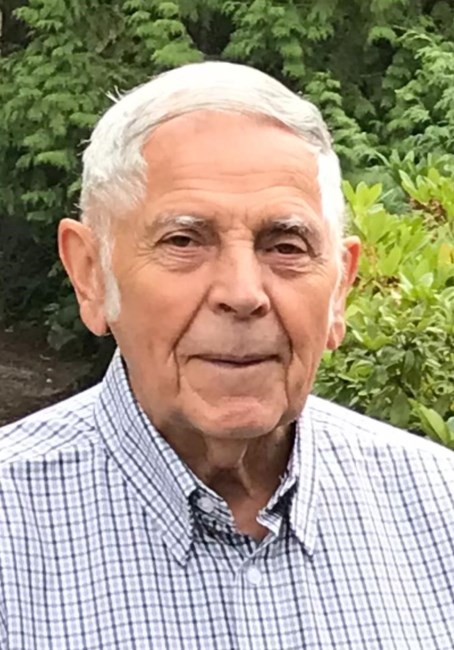
Gus was born in Germany on February 3rd, 1935. He married Ursula Norheimer on March 17th, 1956. The couple and their three children, Christine, Gus, and Karin, emigrated to Canada in 1965. Daughter Janet was born in Canada in 1966.
Gus was predeceased by his wife Ursula on February 24th, 2025. They were married for 69 years and had many adventures together.
In Canada, Gus and Ursula first resided in Maple Ridge. Gus was a volunteer firefighter while living in what was then called Haney. In 1974, Gus and Ursula bought property in McConnell Creek, Mission. They lived in their McConnell Creek home for more than 40 years. Gus enjoyed growing a huge vegetable garden and Ursula had flowers and shrubs of all kinds. They regularly invited family and friends for dinners and bonfires. Two family weddings were hosted on the property. Everyone was always welcome.
Gus was a millwright for most of his working years, employed at a sawmill in Pitt Meadows. After he retired, he spent a few years helping Ursula with her postal route, until she also retired.
They loved to travel and they toured throughout Europe and North America and visited Cuba and Rarotonga in the South Seas. They loved hiking and camping and, on summer weekends and vacation, could usually be found somewhere in the back country of BC. Gus loved his Jeep and four-wheeling, a fondness he seems to have passed on to many of the grandchildren. In their retirement years Gus and Ursula could be found on the water, fishing, canoeing and sailing. Children and grandchildren often were invited to join their adventures.
Both Gus and Ursula were very active members of the McConnell Creek community, donating many hours of volunteer service to the Hall and the community at large. They were active members of the Valley Power and Sail Squadron. Gus became an excellent sailor, teaching sailing and navigation courses to others.
Up until his death, Gus was a member of Mt. Calvary Lutheran Church in Mission. He and Ursula enjoyed weekly services, potluck lunches, and visiting with friends. The children of the congregation always had a special place in Gus’ heart. Gus was a supporter of many outreach projects, such as the Food bank and the Christmas Hamper Project.
For most of his life, Gus was blessed with excellent health. He was a firm believer in “staying in shape” and he could regularly be seen running his daily 10km along the roads and trails of McConnell Creek. He loved to swim and he swam almost every day of his life, both at the Mission Leisure Center and in rivers, lakes, and oceans. Cold water never was a deterrent! Gus was swimming laps in the pool well into his late eighties. To keep Ursula company, he also participated in fitness classes and walks around his neighborhood.
Gus was a lifelong learner, and he always seemed to have some new interest or project on the go. In addition to learning to sail and whitewater canoe, and fly fish, he also took up classes in French conversation. He and Ursula travelled to Montreal and Quebec City, and he was very pleased to be able to converse with the locals.
Gus enjoyed music of all varieties and both he and Ursula loved to dance. They danced together for almost seven decades! In his younger years, Gus sang tenor in a men’s choir.
Throughout his life, Gus enjoyed dogs. In his younger years, he trained dogs to search and track and he often assisted local police with new dog recruits. After Gus no longer had dogs of his own, he helped his grandchildren train their dogs on Fraser River trails.
During his years in Germany, Gus took flying lessons and had a pilot licence for small planes. He loved to be up in the clouds! Ursula was always nervous of him flying up there and Gus eventually limited his flying to helicopter rides with friends and commercial airline trips.
Gus was a skilled craftsman at working with wood. He made many items and has left behind three beautiful cedar strip canoes made for his family to enjoy. They are being put to good use by grandchildren and great-grandchildren.
Gus and Ursula’s last few years together were spent at Chartwell Cedarbrook Retirement Home in Mission. They made many friends there and participated in activities and social events. Gus enjoyed a good cup of coffee or Espresso, a nice glass of red wine, and good food. He had a fondness for sweets, especially Ursula’s homemade baking. At his last home in Maplewood House, he would still enjoy an extra helping of dessert and he would share chocolate and have coffee with visitors.
Gus kept in touch with friends and relatives all over the world. He used his computer and email to send pictures and jokes and to make plans to meet up again!
Gus will be missed by and lovingly remembered by a large extended family, including children, grandchildren and great-grandchildren. He passes on his love of the outdoors, his enjoyment of the “finer things in life’, and his zest for life. He always said that “every day was a beautiful day”.
One of the delights of Gus’ life was to be an Opa and Uropa. He supported his grandkids in all endeavors and he attended many concerts, lessons, and sporting events. No matter how early in the morning and on the coldest of days, he would be there cheering on the next generation.
We will all treasure these memories of a long and exuberant life, lived to the fullest. Survived by daughters Christine (Darrell) Paul, Karin Shank, and Janet (Brian) McNeil and son Gus Binkle. Gus was Opa to his grandchildren Jennifer (Tracy) Maddison, Teresa (Jeff) Malahoff, Alisha Binkle (Mark), Nathan Paul (Gabby), Aaron Paul (Stephanie), Emily von Hardenberg ( Derek),Ben Paul (Savannah), Nolan Paul (Hannah), Martin Shank, Wesley Shank (Kaitlyn), Darrell Shank (Shantelle), Trent McNeil (Sarah), and Kurt McNeil. At family gatherings, the great grandchildren were Uropa’s delight. Greatgrands are Jonathan Brines, Kevin and Derek Maddison, Alex Malahoff, Oliver, Ava, and Isaac von Hardenberg, William, Ivy, Everett, Everly, Brinley Paul, and Scarlett Shank and Payton McNeil.
Thankful for the blessing of a devoted father, Opa, and Uropa.
Forever in our hearts.
Thank you everyone for coming to honour Dad. He was a son and brother, a husband, father, grandfather, and great-grandfather. Most people knew him as Opa.
If parts of this service seem similar to Mom’s last year, it’s because when we preplanned the funerals, Dad answered every question by pointing to Mom and saying I will have whatever she is having! Mom wanted to die first, and Dad said he would be close behind her. Neither one wanted to live alone.
Dad was born in 1935 in the small village of Ensheim in Germany. He was the second son in what would eventually be a family of seven siblings. Dad was born into frightening political times. His little village was very close to the French border and political views divided families. A fascist government exerted control over its citizens; even amongst family members there were different allegiances. As one of the older children in his family, Dad was responsible for getting younger siblings into bomb shelters during air raids and he helped in many other ways. Survival was the name of the game.
Dad’s family, like Mom’s, was evacuated at various times during the war and they became refugees. While Mom was the baby in her large extended family, Dad was one of the older children in his. Despite the war, Mom usually felt secure and loved and taken care of. Dad’s war experience seemed to be one of turmoil and confusion, and having overwhelming responsibilities thrust upon him by circumstance. For a time, Dad and his mother and siblings lived as refugees in a church, and food was scarce.
Dad was deeply affected by his war experiences. He saw and experienced many things which he was reluctant to talk about. Although he shared very little with us, he occasionally talked about the day army tanks rolled through his town. Later, His uncle and godfather did not return from being a POW in Russian until 1957. During his thirties and forties, Dad struggled with depression, no doubt brought on by some of his childhood experiences. It took many years for him to be able to cope with some of his distressing memories of those times.
Dad started his formal work life in his early teens. The little town where he lived was then part of France, and there were shortages of food and many other things. Dad recalls meeting with his group of co-workers every morning to negotiate what wages would be for the day. Inflation was so high that it would have been foolish to work for yesterday’s wage.
Dad was thrilled when he finally obtained a bicycle to get to work. Cars were impossible to come by and there was no transit. Dad built his own bike by scouring the countryside for bike pieces until he had what he needed to make a bicycle for himself.
For a short time, Dad worked in Bavaria on a farm. He spoke fondly of this time. From his host family, he learned to love oatmeal porridge for breakfast and he had a bowlful most mornings throughout his life. Bavaria is where he learned to work with horses and where he learned his gardening skills. Dad loved his garden, using all organic methods long before it became popular to do so. He produced enough food to last through the winter. Mom would freeze and can everything as it was ready in the garden. We enjoyed a huge variety of vegetables. Dad could also make his own sausage.
Mom and dad met in 1954, in Bischmissheim Germany and were married in 1956. As a young couple, they first lived in a small apartment in the upstairs of the Binkle home and eventually moved into their own house just before my sister Karin was born. During the first years of their marriage, Dad finished his college degree. He was very proud of that because he completed it all at night school. It was difficult; he and Mom both worked all day and then he had school in the evenings. I was a baby then and I was a very fussy premature baby and kept them awake many nights. They told me that sometimes they had to put my crib into the bathroom and just let my cry, because they needed some sleep. Then at age one, I had polio, which made for many more sleepless nights and stressful days. Through it all, Dad kept going to school until he graduated. When you come downstairs for lunch, you will see Dad’s diploma on one of the tables. He displayed it wherever he called home.
As a child I was so fortunate to be able to travel throughout Europe with my parents. Mom and Dad both loved to meet new people and see places and have adventures. They loved the arts and culture of other societies.
I’m not sure why Dad wanted to come to Canada. I know he had also considered Australia. He wanted a land where he felt there was more opportunity. Perhaps he also wanted to leave some of his wartime memories behind. Germany had many daily reminders of those dark times. When I was a child, my Oma would often take me to the city on the bus. She wanted to spoil me and take me shopping. But what I remember most from those trips is the war veterans. Many of them, older by that time, with obvious injuries or missing limbs, and often begging or panhandling on the streets. I’m sure they had some government support, but I think many of them also suffered from mental health issues. I found this very upsetting and I wonder if Dad did too. Every family had those veterans who had been so sadly affected. After much discussion, Mom made the final decision, and we came to Canada.
We immigrated in 1965. Dad came several months before the rest of us followed. I have his immigration papers which state that he landed first in Montreal and that he was in good health and he had $15. He travelled on to Vancouver because he heard there was work there. He was able to find work in Maple Ridge, which was called Haney then, and he rented a small house and then sent for us.
Dad worked at a variety of odd jobs and soon realized that Canada was a big country with little transit. Our family would need a car. He and Mom found an old car at the auction. The car had been in a fire but the engine was still good. He and Mom together refurbished that car inside and out until it was good enough to use. I remember Mom sewing the headliner and finding old car seats somewhere and reupholstering them.
Life as immigrants was at first not easy. Jobs were hard to find if you didn’t speak English. Money was often scarce. But both Dad and Mom were never scared of hard work. One summer Dad worked out of town and all of us kids and Mom worked picking berries. Mom needed the money to make our current house more liveable and we children used our money for school supplies and new shoes for school.
For a time, Dad was self-employed working in construction. He had a small crew of helpers, and he would often hire men who were eligible for work passes from one of the penitentiaries in the area. Dad regularly brought these men to our home to have supper with us. They were always so grateful to have a good home cooked meal and Mom was an excellent hostess. Dad was a firm believer that everyone deserved a second chance.
Eventually Mom and Dad were able to find good jobs with decent salaries and they saved money to buy the 10 acres in McConnell Creek. The family first lived in the log cabin on the property, without running water or hydro. Within the first year, Dad dug a well by hand and started clearing the land. With help from family and friends, he built the beginning stages of what would become their long-time home.
As children grew up, left home, and married, Dad and Mom started to pursue their own hobbies and interests. Dad had a jeep and they loved to camp and fish and canoe in the back country. They often took grandchildren along.They travelled across Canada twice by car and once by train. They also travelled by car and plane into northern Canada, experiencing the land of the midnight sun. Everywhere they went, they had their trusty green tent. Both Mom and Dad retired in their early 60s.
Their home was always open to family and friends. Mom’s baking was legendary and both Mom and Dad were very good cooks. Dad made great soup! Every Saturday the big soup pot would sit on the stove all day and be ready in time for dinner. Pea soup, Lentil soup, Bean soup, chicken and rice soup with dumplings in the winter and fall, and in the spring and summer there would be green bean soup with potato pancakes or mushroom soup. Leftovers were sent home with children and grandchildren or frozen for later.
As the grandchildren grew, Opa was always teaching them skills. He taught some how to fly fish and how to tie the flies. He taught them to canoe and sail. They learned survival skills and how to live in the wilderness. He taught them to use chain saws and how to chop wood for the winter. Opa passed on his gardening know how.
Opa passed on less tangible skills too. He was a role model and his grandchildren learned how to work hard, and how to respect others and themselves. How to be kind and how to be mindful of those less fortunate. How to live with dignity and to be a responsible citizen of Canada and of our world. How to live respectfully on this Earth and to not take more than you need and to leave a place in better shape than you found it.
Many of the grandchildren lived with Opa and Oma for various lengths of time. They stayed in the house with Opa and Oma or lived in the small cabin next door. Opa and Oma’s house was a good place to be if you were going to school or relocating or looking for work or whatever else you needed.
My family has wonderful memories of canoeing and wilderness trips. We had many hiking adventures. Once the sailboat arrived, summers for our family were on the ocean. We swam and went fishing and would kayak to get oysters from the rocks for our dinner. Life was very good.
I was always up on deck with Dad, on the hottest days and through the stormiest seas. Not because I was the best sailor or deckhand. I always had to stay up on deck because I would get sea sick the moment I went down below. The rest of the crew could sit in the cabin and play cards and eat snacks, but I had to be outside. If the weather was stormy, I would help navigate and if the weather was hot and windless, we would motor along, listening to music. Classical, opera, or German folk songs or rock and roll, it was all an adventure. Dad loved to sing and he had a beautiful voice.
Dad and Mom travelled to the South Seas. They rented a Vespa while they were there and toured the islands. Dad used the opportunity of the warm ocean water to get his scuba diving licence, and he loved it. He was always telling me that the ocean was alive. It was a little chillier to dive on the BC coast, but no less spectacular.
We travelled to Cuba together. One of the highlights of the trip for Dad was that he had the opportunity to drive a horse and carriage through town. We had booked a carriage tour through one of the towns and, when the driver realized that Dad had horse experience, he moved over and handed the reins to Dad for the rest of the tour. Dad also loved the Cuban music and I think he and Mom spent almost every evening on the dance floor.
Throughout his life, Dad was particular. He liked things done right and he was an impeccable dresser. He always wanted to look good. He was even particular about Christmas decorations. Everything had to be just so. For years he and Mom would argue about the treetopper. Dad wanted a star and Mom wanted an angel. Our family always said it wasn’t really Christmas until we had the angel or the star fight. Eventually we had two trees, one in the living room with angel and one in the rec room with a star.
For as long as they were together, Dad was totally devoted to Mom. She was the love of his life. Every year he teased her and pretended to forget her birthday, but he never did. He also remembered their anniversary.
Dad was always in good physical health but Mom in her later years struggled with a heart and kidney condition, eventually needing a walker and then a wheelchair. Dad began to show signs of dementia. They sold their home and moved into the Chartwell Residence across the street from this church. They had some wonderful years in there, enjoying the social activities and good meals. The staff was wonderful. We continued our outings as long as we could.
Every Sunday we would go to church, then out for lunch and then some other activity, such as a drive or a walk in the park or a visit with family. Dad and Mom always loved being with family and they really enjoyed the new crop of great grandchildren. We went to craft fairs and to the opera at the movie theatre. We went to the mall and to the park. For as long as they lived, Dad and Mom never lost interest in life.
As Mom’s physical health declined, I would spend some time with Dad on his own. He always loved to walk, and we went along the river or to the park or to the Monastery. Dad tried to teach me German folk songs. Dad kept swimming well into his late eighties. His laps were slower, but he never forgot how to swim.
One of the blessings of Dad's dementia is that he never realized his memory was failing. When we were returning from a walk one day there was a poster in the elevator advertising a walk to raise funds for Alzheimer's. Dad read the poster, commented how very sad this disease was, said how fortunate he was to have escaped it, and suggested we go on the walk. We did just that.
Dad never lost his sense of humour, teasing the great grandchildren and joking with the staff at his residence. Once at a medical appointment, where we had to wait a long time, Dad had forgotten that I had brought them. I was sitting out of their sight in a crowded waiting room. He kept bugging Mom about when and how they were going to get home and she would tell him, but he would forget a few minutes later. Eventually she lost patience and told him that they would have to hitch hike. He was quiet for a few minutes and then he looked at her and said, “well that’s fine for me but what on Earth are you going to do when you’re in that wheel chair??”. We had so many funny moments.
As we are left with our memories, I take comfort in knowing that Dad is with Mom and those of us left behind are not alone. Dad firmly believed that In life and in death, and in life beyond death, that God is with us.
In the words of one of our favourite sailboat songs, written by Leon Dubinsky, and most famously performed by the Rankin family.
When the waves roll on, over the waters
And the ocean cries
We look to our sons and daughters
To explain our lives
As if a child could tell us why
That as sure as the sunrise,
As sure as the sea,
As sure as the wind in the trees
We rise again, in the faces of our children
We rise again, in the voices of our song
We rise again, in the waves out on the ocean
And then…. we rise again
Dad lived life in a big way. He said every day was beautiful and that we should embrace all of it. Dad loved a party and a good time. As his casket leaves the church today, we will hear the song we often sang on the sailboat. It’s about going home. We wish Dad godspeed as he sails home.
- Christine Paul
Show your support
Send Flowers
Add a Memory
Share Obituary
Get Reminders
PALLBEARERS
Aaron Paul
Benjamin Paul
Nolan Paul
Trent McNeil
Kurt McNeil
Wesley Shank
DONATIONS
Mount Calvary Lutheran Church32420 7th Avenue, Mission, BC
McConnell Creek Hall35483 Hartley Rd, Mission, BC
Past Services
Visitation
Funeral Service
Reception
- SEND FLOWERSSEND
FLOWERS SHARE OBITUARYSHARE
- GET REMINDERS
v.1.18.0