
OBITUARY
George Cooke White
August 16, 1935 – August 6, 2025
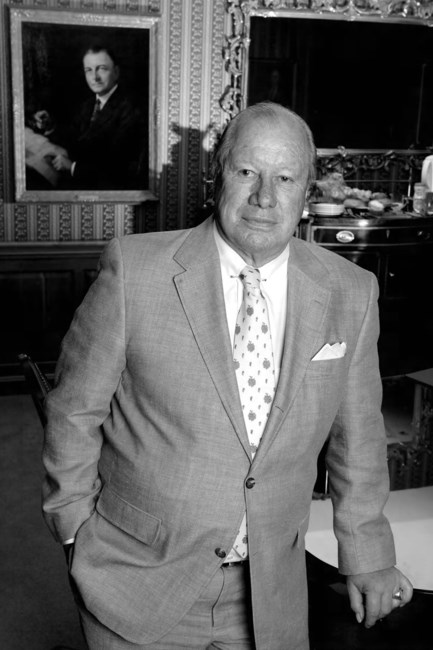
George C. White, founder of the Eugene O’Neill Theater Center, passed away peacefully at his home in Waterford, Connecticut, on Wednesday, August 6, 2025, with his loving wife Betsy by his side, ten days shy of his 90th birthday. For more than half a century, George forged a path for theater artists throughout the world. His contributions to the theater have influenced some of the greatest performers, writers, and directors of our time: August Wilson, John Guare, Lee Blessing, Lanford Wilson, Robert Redford, Edward Albee, Sam Shepard, Meryl Streep, Michael Douglas, Wendy Wasserstein, Christopher Durang, and John Patrick Shanley, among countless others, passed through the O’Neill, his classroom, or his rehearsal room.
The son of Nelson and Aida (Rovetti) White, George was born on August 16, 1935, and raised in Waterford, just down the road from the Hammond Estate where he would eventually establish the O’Neill in 1964. He earned a B.A. from Yale University and an M.F.A. from the Yale School of Drama, having also attended the University of Paris (Sorbonne) and studied at the Shakespeare Institute in Stratford-upon-Avon, England.
He began his career in theater at 19, managing the International Ballet Festival in Nervi, Italy and stage managing for the Imperial Azuma Kabuki Company’s 1955 World Tour. Inspired by his friendship with playwright Dale Wasserman, he began to envision a process by which theater artists could develop their work outside of the spotlight of Broadway and the established “tryout” process that existed at the time. His professional career includes 37 years as Founder and Chairman of the Eugene O’Neill Theater Center as well as a myriad of other accomplishments and endeavors.
George’s founding of the O’Neill is a piece of theater legend. Sailing past the old Hammond Estate, he vowed to save the property from being burned for firefighting practice by the Town of Waterford, instead transforming it into a site for theatrical innovation. He would go on to forge lifelong personal and professional partnerships that shaped the American Theater for decades: Lloyd Richards, who ran the O’Neill’s flagship program, the National Playwrights Conference, for 34 years as its first Artistic Director; Edith Oliver, the New Yorker theater and film critic who cemented the role of the dramaturg as the cornerstone of the O’Neill’s developmental processes; Paulette Haupt, whom he tapped to run the National Music Theater Conference, the world's first new musical development program; Jim and Jane Henson and Rufus and Margo Rose, who planted the seeds of puppetry at the O’Neill early in its history; and Robert Redford, for whom the O’Neill served as a model for what would later become The Sundance Institute.
Thanks to George’s leadership, the O’Neill was the recipient of numerous honors, among them two Tony Awards and the National Medal of Arts, which was awarded to the organization in 2014 by President Obama. George was the 2022 recipient of the O’Neill’s Monte Cristo Award, annually bestowed on an individual whose body of work has made an indelible impact on the arts.
In addition to his responsibilities at the O’Neill, George served as Co-Chairman of the Theater Management Program at the Yale School of Drama from 1978 to 1992. He regularly directed plays in such venues as the Actors Theater of St. Paul, the Guthrie Theater, the Hartman Theater, the Annenberg Center, and the Hedgerow Theater. He was the Founding Chairman of the Sundance Institute and served as a member of the Tony Awards Nominating Committee and a panelist for the Theater and Opera-Music Theater Programs of the National Endowment for the Arts. He was inducted into the Theater Hall of Fame in 2011. He served on a number of theater, art, and music-related boards across the country, including the National Arts Council, Metropolitan Opera Guild, Arts and Business Council, New Dramatists, Center for Inter-American Relations, International Theater Institute, Connecticut Commission on the Arts, American Soviet Theater Initiative, Camargo Foundation, and Save Venice. George also served as Executive Director of the Johnny Mercer Foundation.
George’s contributions to theater extended well beyond the borders of the United States. Beginning in 1972, he spearheaded cultural exchange efforts in countries such as the Soviet Union, the People’s Republic of China, Australia, and Brazil, as well as the Caribbean. In Beijing, he directed a production of Eugene O’Neill’s Anna Christie in 1984 and Meredith Wilson’s The Music Man in 1987. He lectured throughout the world on behalf of the U.S. Information Agency. His international accomplishments were recognized by being awarded the Royal Swedish Order of the Polar Star from King Carl Gustaf and the French Republic’s Chevalier des Artes et des Lettres.
George’s interests and passions outside of theater ran wide and deep, and he took great pleasure in sharing them with anyone and everyone — from Yale football and the New York Yankees to history, boating, fishing, and fencing; from wines across the world to Russian vodka, Jamaican rum, and single malt scotch; from music and art to poetry and an endless supply of jokes. George was a celebrated raconteur, who shared his stories gleefully, complete with comic accents and bad punchlines.
Even after his retirement from the O’Neill in 2000, he remained engaged and involved with organizations at home and abroad. He was a member of the U.S. Coast Guard Auxiliary, serving as a Flotilla Commander, a quartermaster of the watch for “America’s Tall Ship” Eagle, and National Auxiliary liaison for the Coast Guard Academy. He served on the boards of the Mystic Seaport, the Florence Academy of Art (Founding Chairman, 1999-2007), Mitchell College, and the Day Publishing Company. He was a member of Waterford’s Representative Town Meeting, the Ariston and Thames (New London), Century (New York), and Cosmos (Washington) clubs as well as the Bohemian Grove. He was a Knight Grand Ufficiale Dott. of the Orders of Saints Maurice & Lazarus and a member of the Chevaliers du Tastevin.
No account of George’s life would be complete without mention of the love of his life, Elizabeth (Betsy) Conant Darling, whom he met in Simsbury, Connecticut in 1955, and to whom he was married for 67 years. Betsy traveled the world with him, was his partner in building the O’Neill and enjoying most of the things he loved in life – opera, art, food, sailing – and shared his life with their family. In addition to Betsy, George is survived by his brother Nelson H. White; his three children and their spouses – George and Jennifer (Medby) White, Caleb and Elizabeth (Mank) White, and Juliette (Darling White) and Jeffrey Hyson; ten grandchildren – Darby, Eliza, Liam, Faith, Zoe, Sam, Troy, Olivia, Ellie, and Reilly; as well as nieces and nephews, great-nieces and nephews, and great-great nieces and nephews. He leaves behind an enduring legacy in the hearts of those who knew him, and in the spirits of those around the world touched by his remarkable cultural influence.
Relatives and friends are invited to calling hours on Tuesday, August 12 from 4:00 pm to 7:00 pm at Fulton-Theroux Funeral Services, 181 Ocean Avenue, New London; and to a memorial service on Wednesday, August 13 at 11:30 am at Evans Hall at Cummings Art Center, Connecticut College, 270 Mohegan Avenue Parkway, New London.
In lieu of flowers, donations can be made to the Eugene O’Neill Theater Center, the Lyman Allyn Museum, or the Mystic Seaport.
Show your support
Add a Memory
Share Obituary
Get Reminders
Services
SHARE OBITUARYSHARE
- GET REMINDERS
v.1.18.0