
OBITUARY
Laura Maioglio
March 17, 1932 – January 17, 2026
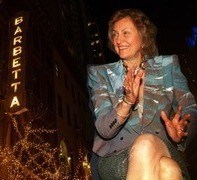
Laura Maioglio, the gracious and visionary proprietor of Barbetta Restaurant, New York City’s oldest Italian restaurant still owned by its founding family, passed away peacefully on January 17, 2026, at the age of 93. For over six decades, she presided over this historic establishment in the heart of the Theater District, transforming it into one of the most elegant and respected Italian restaurants in America while maintaining its authentic character and familial warmth.
Born and raised in New York City, Laura was the daughter of Sebastiano Maioglio, who founded Barbetta in 1906. She attended the prestigious Brearley School and went on to graduate magna cum laude from Bryn Mawr College with a degree in Art History. Her education continued at the University of Florence, where she spent a year immersed in Italian art and culture. Throughout her life, she maintained deep ties to her family’s ancestral home in Piemonte, Italy, spending extended periods at their 17th-century palazzo in Fubine Monferrato. These sojourns provided her with an intimate knowledge of Italian cuisine and wine, particularly the refined traditions of Piemonte, which would become the cornerstone of Barbetta’s culinary identity.
A Bold Vision for Italian Cuisine
When her father passed away in 1962, Laura faced an unexpected challenge. Sebastiano Maioglio had not envisioned his daughter running the restaurant and had arranged its sale to an outside party. Undeterred, the young Laura returned with an attorney and convinced the prospective buyer to halt the transaction. She assumed full ownership of Barbetta at a time when few women helmed major restaurants, and even fewer in New York’s competitive dining scene.
Laura’s vision was transformative. At a time when Italian restaurants in America were overwhelmingly seen as rustic establishments, she transformed Barbetta into the first truly elegant Italian restaurant in New York. Her 1962 redesign of the dining room, featuring 18th-century Piemontese antiques, created an atmosphere of refined sophistication that challenged and changed American perceptions of Italian dining. The centerpiece, a magnificent 18th-century chandelier from a palazzo in Turin that once belonged to Italy’s royal Savoy family, set the tone for the restaurant’s elegance.
Her culinary vision was equally transformative. Laura introduced Americans to the authentic, refined cuisine of Piemonte, presenting dishes that were both elegant and deeply rooted in tradition. Perhaps most notably, Barbetta became the first restaurant in America to consistently offer white truffle dishes during the autumn season. For many years, she maintained her own truffle hunters and truffle hounds in Piemonte to ensure a steady supply of this prized delicacy. By 1973, Barbetta had become so synonymous with white truffles that Bloomingdale’s invited the restaurant to host a truffle exhibition, where 500 portions of Fonduta con Tartufi were served to notable guests.
Laura also introduced other Piemontese specialties previously unknown to American diners, including Bagna Cauda, a convivial dish where guests gather around a table to dip fresh vegetables into a simmering pot of anchovy and olive oil sauce. Under her direction, Barbetta’s menu evolved to include both time-honored traditional dishes and innovative new creations, each bearing a notation of the year it was first served, a living timeline of the restaurant’s culinary evolution.
A Legacy of Beauty and Hospitality
In 1963, Laura designed and built Barbetta’s famous garden patio, at a time when outdoor dining in Manhattan was exceedingly rare. The verdant space, with its century-old trees and fragrant blooms of magnolia, wisteria, jasmine, oleander, and gardenia, became one of the city’s most sought-after dining destinations. The garden remains a beloved oasis in the bustling Theatre District, a testament to Laura’s vision of creating not just a restaurant, but an experience of beauty and tranquility.
Barbetta occupies four townhouses built between 1874 and 1881, which Laura’s father had purchased from the Astor family. Laura meticulously restored the second floors of these historic buildings, preserving the original Astor family dining rooms, library, and drawing rooms, each with its original fireplace and period details. These spaces became elegant venues for private events, accommodating gatherings from intimate dinners to receptions for up to 100 guests.
Laura’s dedication to Italian wine culture was equally pioneering. When she took over Barbetta in 1962, only one Barolo was imported to America, and Barbaresco and Gattinara were not available at all. For many years, Barbetta imported the only Barbaresco and Gattinara to be found in the United States. In the 1970s, the restaurant began importing Grignolino and Barbera from its own vineyards in Fubine Monferrato. Her efforts to promote the great wines of Piemonte earned Barbetta numerous accolades, including first prize from the Italian government in 1977 for Most Outstanding Italian Wine List, Wine Enthusiast’s Award of Ultimate Distinction in 2004, and Wine Spectator’s Best Award of Excellence annually from 1997 through 2010.
A Partnership in Science, Art, and Philanthropy
Laura’s personal life was marked by a remarkable partnership with Dr. Günter Blobel, a distinguished cell biologist whom she married. Dr. Blobel, who joined The Rockefeller University in 1968 and served as the John D. Rockefeller Jr. Professor, was awarded the 1999 unshared Nobel Prize in Physiology or Medicine for his groundbreaking discovery that proteins have intrinsic signals governing their transport and localization within cells. His work revolutionized our understanding of cellular function and had profound implications for diseases including cystic fibrosis, Alzheimer’s disease, and AIDS.
Laura and Günter shared a deep appreciation for art, culture, and the power of community. She encouraged his scientific work and never complained about the countless hours he spent in the laboratory. In his Nobel Prize autobiography, Dr. Blobel credited Laura with introducing him to many artistic pleasures while greatly encouraging his work. Barbetta became a gathering place for scientists, artists, and intellectuals, bridging the worlds of scientific inquiry and cultural refinement.
The couple’s commitment to The Rockefeller University community was profound and enduring. For decades, Laura hosted countless dinners at Barbetta for members of the university’s faculty celebrations, visiting scholars, and milestone events that brought together the scientific community in an atmosphere of warmth and elegance. Following Dr. Blobel’s Nobel Prize in 1999, Barbetta became the natural setting for celebratory gatherings, where the worlds of science and fine dining intersected. Laura and Günter were stalwart supporters of The Rockefeller University, embodying the institution’s spirit of intellectual excellence and collaborative inquiry.
Their shared commitment to cultural preservation was equally remarkable. Dr. Blobel, who had witnessed the bombing of Dresden as a child, founded Friends of Dresden, Inc., in 1994 to support the reconstruction of the city’s historic monuments. In 1999, he donated the entire sum of his Nobel Prize’s approximately $960,000 to support the rebuilding of Dresden’s Frauenkirche, a baroque Lutheran church, and the construction of a new synagogue to replace the one destroyed by the Nazis. A portion was also dedicated to restoring a baroque church in Fubine, Laura’s family’s ancestral home. This extraordinary act of generosity reflected the couple’s shared belief in preserving cultural heritage and healing historical wounds.
Dr. Blobel passed away on February 18, 2018, at the age of 81. Laura continued to oversee Barbetta, maintaining the standards of excellence and hospitality that had defined her life’s work.
Recognition and Enduring Legacy
Laura’s contributions to American culinary culture earned widespread recognition. Barbetta was designated a Locale Storico (Historic Establishment) by Italy’s prestigious Locali Storici d’Italia, becoming the first restaurant in America to receive this honor. The restaurant was inducted into the Distinguished Restaurants of North America Hall of Fame and received numerous awards, including four stars from the Mobil Guide and recognition as one of the Top Six Italian Restaurants in the United States by Esquire Magazine in 1997.
Beyond the accolades, Laura’s true legacy lies in the countless lives she touched through her hospitality. For over a century, Barbetta has been a place where celebrations were held, relationships were forged, and memories were made. Generations of New Yorkers marked life’s milestones within its walls - anniversaries, birthdays, post-theater dinners, and quiet romantic evenings. Broadway actors, scientists, artists, politicians, and visitors from around the world found in Barbetta a welcoming refuge, a place where excellent food, gracious service, and authentic warm elegance were found.
Laura approached her work with a profound sense of stewardship. She understood that Barbetta was not merely a business, but a living piece of cultural history - bridge between the Old World and the New, between tradition and innovation, between her father’s vision and her own. She preserved what was essential while continually evolving, ensuring that each generation could discover something new while honoring the past.
Her dedication and perfectionism extended to every detail: the careful selection of each antique piece that adorned the restaurant, the cultivation of her famous garden, the mentoring of her staff, and the personal attention she gave to ensuring every guest felt welcomed and valued. She believed that dining was not merely about sustenance, but about creating moments of beauty, connection, and joy.
Laura Maioglio will be deeply missed by the countless friends, colleagues, staff members, and patrons whose lives she enriched. She leaves behind not just a restaurant, but a legacy of how dedication to craft, respect for tradition, and commitment to excellence can create something truly timeless.
* * *
A Gathering & Visitation will be held at Frank E. Campbell - The Funeral Chapel, located at 1076 Madison Ave, New York, New York, 10028. The event is scheduled for January 20, 2026, from 3:00 pm to 7:00 pm.
Show your support
Add a Memory
Share Obituary
Get Reminders
Services
SHARE OBITUARYSHARE
- GET REMINDERS
v.1.18.0