
OBITUARY
Mrs. Latifa Menashi Toeg
1 July, 1918 – 1 November, 2010
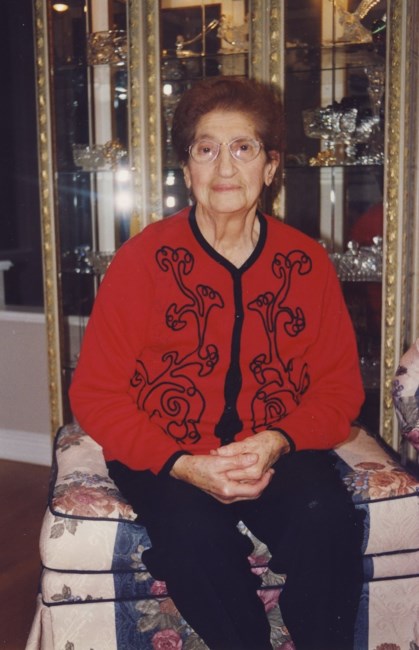
Born on July 1,1918 into a Jewish family in Baghdad, Iraq, Latifa discovered the Bahá’í Faith while being courted by her fiancé and later husband, Daood (David) Toeg, a successful merchant in the city. In English her name means “delicate” or “refined.”
Latifa grew up dissatisfied with the Jewish Faith. Not only was she discontented with the religion of her birth, but she became disillusioned by the exclusionary prejudices and hatred that prevailed among Jews, Christians and Muslims in her native city.
Her sincere heart was so distressed by this enmity that she found herself praying fervently that God would remove the prejudices that had built up the ancient walls of alienation among the religions. “Oh God!” Latifa would pray. “You are the Father of all. Why are your children fighting?” The moment Latifa heard about the Bahá’í Faith from her husband, and the principles of the “unity of mankind” and “the abolition of prejudice,” she found her heart’s desire and embraced it.
She married Mr. Toeg in 1942. The marriage was blessed with the birth of three fine sons, Jamal, Kamal and Jalal. Latifa was not lax in giving her children a Bahá’í upbringing. She spent her best efforts in raising them to become devoted servants of Bahá’u’lláh.
Depending upon the occasion, Latifa’s character could show quiet determination, strong will or courage. She became one of the first women in Iraq to obtain her driver’s licence, an action for which she was ridiculed and even spat on by a Muslim cleric who could not tolerate a liberated woman setting a bad example to other Iraqi women.
At the early days of her marriage her husband told her that Baha’u’llah wanted the Baha’i friends to chant Baha’i prayers the same way that the Qu’ran is being chanted. Therefore Latifa went on to learn how to chant professionally from a blind mullah who was appointed to chant the Qu’rán in certain mosques in Baghdad. The Muslim cleric visited Latifa at home, an action that raised eyebrows and questions in the Jewish neighbourhood where Muslims were very much disliked to be in that area. In the appropriate musical style, he taught her to chant most of the chapters in the Qu’rán.
On a family visit to Turkey, while she was expecting her third son, Jalal, she visited the famous Blue Mosque in Istanbul, built by Sultan Ahmet I in the early 17th century, so-called because of its interior blue tiles. When those in charge of the Mosque learned from Daood of her talent of chanting in Arabic, they pleaded with her to chant the Qur’án from the minaret. After some convincing—for this was an unusual request--she graciously accepted. Latifa’s chanting was enthusiastically received and some of the visitors to the mosque were moved to tears.
During her lifetime, she was often requested to chant Arabic Bahá’í prayers at meetings large and small: firesides, conventions and conferences. Anyone who ever heard Latifa chant can testify that her chanting brought the believers into the divine presence. A particularly memorable moment took place during the International Symposium on the Bahá’í Faith and Islam in March, 1984 at McGill University, Montreal, a symposium sponsored by the Canadian Association for Bahá’í Studies. To close the conference, her male counterpart, a Muslim, chanted the Qur’án while Latifa consecutively chanted the prayers of Bahá’u’lláh. It was an unforgettable experience for all those who were privileged to attend.
During the Ten Year Crusade (1953-1963), launched by the beloved Guardian, Latifa encouraged the family to pioneer to Kirkuk, capital of the province of Kurdistan in North-Eastern Iraq where they spent seven years (1956-1963). With the passing years, and the change of circumstances, the National Spiritual Assembly of the Bahá’ís of Iraq felt that the Bahá’í community in Baghdad needed the support and encouragement of the Toegs; it requested the return of the family of five to the capital.
During her years of service to the Faith in Iraq, Latifa attended with her husband many international conferences in the 1950’s including those of New Delhi, India, Stockholm, Sweden, Kampala, Uganda and Wilmette, Illinois in 1958. During the same year, she traveled with her husband on a world travel-teaching tour for an entire year. It was one of the highlights of their married life as Bahá’í travel-teachers.
In Iraq, Latifa served for many years at the local and national levels, on both assemblies and committees. She was the first woman who served on the National Spiritual Assembly of Iraq. She served for many years as a member of that institution, acting for some years as its treasurer.
When in those years some Western believers had the opportunity to visit Iraq and wanted to visit the house of Bahá’u’lláh in Baghdad, Latifa used to make the arrangements for the western women to wear the abbah to circumambulate the house of Baha’u’llah at night.
For many years the Toegs’ felt the desire to leave Iraq and settle abroad, but when they requested permission from the Guardian of the Faith, Shoghi Effendi, his reply was “your presence in Iraq is more essential and very much needed”.
But in 1970, the repressive measures of the Iraqi government compelled the Toegs to leave Iraq. After a stay of several months in Tehran, they settled in Canada early in 1971. At the request of the National Spiritual Assembly, the family pioneered to Hull, Quebec where they helped to re-establish the Local Spiritual Assembly which had fallen under strength.
Latifa served on the LSA of Hull for many years. The Toeg home at 92 boulevard Riel became well known throughout the Ottawa Valley for its dynamic weekly Friday night firesides. Together, Latifa, Daood and their sons made a wonderful team. They looked forward to the Friday meeting with expectation. Daood prepared his talks carefully if he were the speaker. About a dozen French Canadian believers became Bahá’ís during their firesides, most of whom have remained active and devoted believers.
Her beloved Daood passed away in Hull on February 1, 1974 after only three years of life in Canada. He had the honour of being buried at his pioneering post. His was also the distinction of being the first Bahá’í to be buried in Hull.
After her husband passed away, Latifa lived for two years in Hull with her son Jalal and his wife Doris until her son and daughter-in-law left for their pioneering post in Inuvik, North West Territories. From 1976, until the end of her life, Latifa lived with son Kamal and daughter-in-law, Francine, and their two sons, Hadi and Salim. The passing of her beloved son, Kamal, in January 2006 was a great blow but Latifa acquiesced to the will of God, accepting this great test with magnanimity.
Throughout her long life, Latifa served as a homefront pioneer in Ontario to various communities to help establish functioning LSA’s. The communities of Kanata, Rockland and Russell all benefited from her serene, steadfast presence and her firm determination to fulfill the teaching goals. For a one year period, she went north to Inuvik, NWT, as a short-term pioneer where she also served as Assistant to the late Auxiliary Board Member, Mr. Ron Parsons. In 1986 she attended the inauguration of the Bahá’í House of Worship (the Lotus Temple) in New Delhi, India.
For many years, and as long as her health permitted, the National Teaching Committee requested that Latifa travel teach in many communities in Canada, both large and small. That body considered her to be one of their star travel teachers. In a letter of October 31, 1978 the NTC called her “a precious resource” and assured the correspondents that “we know you will love having her with you.” The letter contained some delightful references to Latifa’s personal teaching style: “At firesides, deepening, or children’s classes she likes to tell stories of the history of the Faith and about Bahá’í family life, as well as encouraging the friends to teach. Her chanting of the prayers in Arabic stirs the depths of your being with its feeling and melody. She also sings in Arabic and brews delicious Turkish coffee!” The NTC asked that Latifa be given every consideration.
She also traveled to at least fifteen small, very isolated communities in Nunavut, Northwest Territories and the Yukon. While in Inuvik, NWT, she taught the faith to a young Inuvialuit woman who declared her faith in Bahá’u’lláh. She was expecting a child at the time, and when her daughter was born, she named her baby Latifa, in honour of her spiritual mother. Many of today’s believers became Bahá’ís because they met Latifa during her travels and she helped them to become enchanted with the beauty of Bahá’u’lláh’s Faith.
Latifa was very much loved by the Canadian Bahá’í friends for the stories she told about the early believers in Iraq and the Middle East. She loved to speak about the Central figures of the Faith and especially the Hands of the Cause of God. A good number of the Hands enjoyed the hospitality of her home in Baghdad and in Karkuk where they were frequent visitors as they passed through Iraq engaged in the teaching work.
For many years her husband Daood rendered valuable services to the Guardian in channeling communications between the Holy Land and the Iranian Bahá’í community at a time when there was no direct means of communication. In appreciation of this vital service, the Guardian sent approximately fifty letters of praise, thanks and encouragement, assuring Daood of his constant prayers and blessings. In one of the Guardian’s letters, he asked Daood to give his greetings to his three sons, “Jamal Effendi, Kamal Effendi and Jalal Effendi” and to Latifa, addressing her as “the Muqina (lady of certitude), your respected wife”.
* * * * * * * * * *
Toeg, Latifa
Latifa Toeg, in her 92nd year, was released peacefully at the Ottawa General Hospital with all her family members at her side on Monday November 1, 2010. Beloved wife of the late Daood Toeg. Dear mother of Jalal (Doris DeBassige) and Jamal (Nina Deloomy). She is predeceased by her son Kamal (Francine Sauvé). Cherished grandmother of Ben, David, Hadi, Salim, Neda and Justin. Latifa will forever be remembered as a most kind and generous person and will live on in the hearts of all who loved her. Friends may join us for visitation at the Racine Robert & Gauthier Funeral Home located at 180 Montréal Road, Ottawa, Ontario (Phone: 613-241-3680) on Thursday November 4, from 10 a.m., followed by a Memorial Service at 11 a.m. in the Funeral Home Chapel. Reception to follow on premise. A graveside service will be held the same day at 3:30 p.m. at the Our Lady of the Miraculous Medal Cemetery in Russell. In remembrance, donations to the Ottawa Kidney Foundation would be appreciated.
Show your support
Add a Memory
Share Obituary
Get Reminders
Services
SHARE OBITUARYSHARE
- GET REMINDERS
v.1.18.0