
OBITUARY
Hermann P. Jacobi
16 June, 1920 – 1 June, 2010
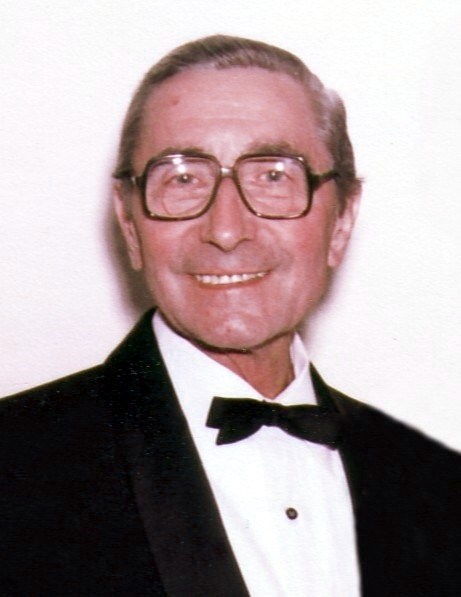
1920-2010 by James Abell, FAIA 480.642.1665
The Arizona construction and building design industry will never see another individual like Hermann P. Jacobi. He was a local legend, a cornerstone of the DWL architectural firm, and his design ideas and vision propelled dozens of landmark buildings into civic prominence and Arizona history. He started as an architectural employee of Weaver-Drover Architects in 1949 in Fred Weaver's garage (later, DWL Architects) and for more than 40 years, Mr. Jacobi put his special imprint on churches, university buildings, hospitals, and commercial buildings throughout the Valley of the Sun.
Born in Darmstadt, Germany in June of 1920, Hermann was drafted into Hitler's Panzer Tank division in WWII and drove a tractor-towing tank to rescue disabled tanks. He would often joke that he drove the only tank without a gun! After the war, Jacobi met his wife, Friedel in Frankfurt and they were soon married. In 1949, he was able to immigrate to the USA with a sponsorship from a cousin who had married an American GI and had moved to Clifton-Morenci, AZ.
Traveling on choppy seas for 13 days on the USS Veendam, Hermann recalls "Early in the morning we felt the ship moving and went on deck to see where we were in the harbor. There was nothing but fog all around us and the sound of fog horns all over. Then somebody said "look over there..."; reaching out of the fog we saw the arm of the Statue of Liberty, reaching through the fog like a welcoming hand and promise... An unbeliveable and emotional scene. Many of us had tears in our eyes." He always remembered that glorious sight and his long journey across America by train. Arriving in the Morenci, AZ area, he was soon taken into Phoenix by a local parson who introduced the 29 year old Jacobi to United States District Judge Karl Muecke, a friend of architect Fred Weaver. Jacobi was hired as a draftsman, and soon, architect Dick Drover became a partner. Within a few years, Hermann Jacobi was named to Associate status in the firm.
With his technical training in Germany, Hermann was known as a top draftsman of the most organized and fastidious manner. He had worked for the City of Frankfurt before arriving in Phoenix. In the early years, he often played pivotal roles in major building design concepts. Large segments of the design of the 1966 Phoenix Air Terminal number 2 (a joint venture between Weaver & Drover and Lescher & Mahony) are credited to Jacobi, along with the 1964 ASU Hayden Library. The signature “circle-square” motif used for the 1967 ASU Cady Mall paving and mall were Jacobi's innovation, as is the ASU Cady Fountain, the virtual center of the campus.
Jacobi was a major organizing force behind the 1976 Maryvale Samaritan Hospital (where his daughter, Maureen, would later work), he was manager-in-charge for the 1978 Good Samaritan Hospital patient tower and ancillary building construction documents, and was the designer for the ASU Wells Fargo Arena, formerly known as the ASU Activity Center, working with ASU basketball coach, Ned Wulk. Both Jacobi and Wulk were both prisoners-of-war on different sides in the waning days of WWII, and were held captive not far from each other late in 1945.
“I always tried to sneak a little stained glass into every project I did in those early years,” noted Jacobi. “I remember Walter Bimson of the Valley National Bank complained about one branch bank I designed around 1962; he told me I should save it for my next church!” The artistry of Jacobi's stained glass is evident on the first two stories of ASU's Hayden Library, and Jacobi was particularly proud of The Arizona Industrial Commission Building from the early 1980's that featured a mural by the famed NASA space artist, Robert McCall. Jacobi is featured as one of the characters in this illustrative mural of the recent history of Arizona.
Hermann was a legend at DWL Architects, tutoring dozens of employees over 4 decades on his approach to construction documents and architectural practice. Later, many of these went on to gain local prominence as architects under their own name such as Paul Winslow, FAIA, George Christensen, FAIA, and James Abell, FAIA. Hermann Jacobi was proud to have become an American. He was thrilled with the opportunities afforded an immigrant to design and build a new, modern Arizona. He loved the firm of DWL Architects and visited often after his retirement. He was proud of Phoenix as a modern progressive town open to new architecture and ideas. He was a demanding technician, a dedicated leader, an imaginative building designer, and a planner extraordinaire.
Few individuals have so deeply touched the construction and development of modern Arizona for the second half of the Twentieth century. His landmark structures will continue to radiate color, artistry, lofty interiors, and symphonies of pattern and texture for decades to come.
Show your support
Add a Memory
Share Obituary
Get Reminders
Services
SHARE OBITUARYSHARE
- GET REMINDERS
v.1.18.0