OBITUARY
Mary Stewart
13 September, 1919 – 5 December, 2020
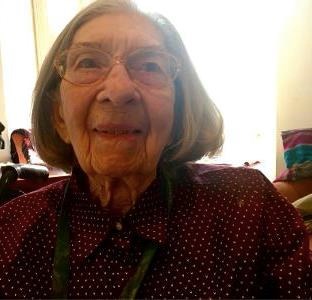
where she relocated from Pittsburgh nine years ago in order to be closer to her daughters.
She was born Mary Kathryn Nicely, in 1919, to Roy Washington Nicely and Abigail Slater Nicely
in Ligonier, PA. In that year, women in the United States finally got the vote, the global Spanish
flu epidemic loosened its hold, and Mary came into the world in a cabin on a farm that had
been in the family for over a century. Her parents’ families, the Nicelys and the Slaters, were
among the original settlers in the Ligonier Valley, and figured in that area’s history. Her
grandfather, Samuel Slater, a farmer and local magistrate, drove a wagonload of potatoes over
the hills to help feed the survivors of the Johnstown flood. There were violent conflicts with
native Americans: two Slater girls were scalped and left for dead; one Nicely boy was
abducted, and ultimately chose to stay with his adoptive Senaca family. And of course there
are the tales of “The Murderin’ Nicely Brothers,” documented in a local ballad.
Mary’s descriptions of her childhood on the farm now feel like something out of historical
fiction: taking half a potato to school for her lunch, the treat of an orange in her stocking for
Christmas, constant hard work, but always balanced by much pleasure in her day to day life
with family, friends, and in school. Mary remembered helping her mother, Abbie, (who at the
age of 16 left in her own home to work as a teacher in a one room mountain school), bake
bread and pies to feed their family and their boarders, who were workers at a nearby oil well,
and she also helped care for the farm animals, and readied produce to take to sell door to door.
At the age of 18, after graduating Pitcairn High School, where she loved English class the best,
Mary took the bus into Pittsburgh, by herself, and enrolled in Presbyterian Hospital’s nursing
school. Mary was the first in her family to leave home for school, and she became head nurse
on a surgical ward at Presbyterian Hospital in Pittsburgh, promoted immediately into that role
when she was hired out of school. Some of her patients there were soldiers, returning home
from the Second World War, and The PIttsburgh Press did an article featuring Mary, as she
greeted a soldier who came to visit the floor: her brother, Jack Nicely, who flew rescue
missions for the navy over the South Pacific. Mary’s brother Floyd sailed with the Merchant
Marines, notably the arm of American forces that had the most fatalities in the war, and her
sister, Virginia, followed her into nursing. Like many families of the time, the Nicelys and
Slaters, who for generations rarely strayed from their rural community, suddenly had all of their
children scattered throughout Pennsylvania, the country, and the world.
In her role as head nurse, Mary put her own job on the line when she advocated strongly for a
friend from nursing school, a young African American woman, who despite being a top student
in their class, had been unable to get a job. Her advocacy, along with that young woman’s
talented nursing skills, resulted in Presbyterian Hospital hiring their first black nurse. Mary
described how after their shift would end, all of the nursing students would walk down that
steep, Pittsburgh hill, and would go together to get a Coke at a luncheonette. She would
always ask her African American friend to join them, but she would always refuse. Mary said it
was not until years later that she fully understood that her valued, hardworking colleague would
not have been served at the counter.
It was in her job that that Mary met a young intern, William D. (Bill) Stewart, whom she noticed
was actually better at diagnosis than most of the experienced physicians, but, also, she liked
the way he walked. Bill was the son of Scotch-Irish immigrants, whose father worked as a
chauffeur on one of the North Side mansions, (now a building that is part of Pittsburgh
Community College campus) where he and his brothers grew up in the carriage house. Mary
and Bill started dating, and were married in 1946, in the minister’s study at First Presbyterian
Church.
As soon as he completed his medical training, Bill was drafted into the Army, and was
stationed at an army hospital in El Paso, Texas; Mary accompanied him there. Both recalled
those years nostalgically, living away from Western PA for the only time in their lives, and
becoming lifelong friends with young people from all over the country. Their oldest daughter,
Patricia, was born in Texas.
After his discharge, Mary and Bill returned to Pittsburgh. Bill completed his residency training,
worked at St. Margaret’s hospital, and then Mercy Hospital, where he spent most of his career,
becoming Chief of Staff and eventually being named to the Board of Directors. Mary stayed
home with the couple’s four children, one of whom was severely disabled. The family lived in
Allison Park for twenty-five years.
After their children left home, Mary and Bill moved back into the city and lived in Shadyside for
over twenty years. Mary worked as a docent at Carnegie Museum, they traveled, attended the
symphony, socialized with dear friends, and celebrated 50 years of being married, and very
much in love. Mary and Bill were one of those lucky couples who were also best friends.
Mary was a gourmet cook— her daughters joked about the “wall of Gourmets” in their
basement— her collection of Gourmet magazines dating back to the 1960s, organized into
binders with indexes, and taking up an entire wall of shelves. She was also one of the original
“local ingredient” chefs, always finding the one family farm still nestled somewhere in their
developing suburb, where she would befriend the farmer, and purchase wonderful, fresh
produce for her family, at a time when most Americans saw frozen or canned vegetables as
more “advanced.”
At Carnegie Museum, Mary was happy to be surrounded by art and natural history. She loved
old movies, often out movie trivia-ing her film professor son-in-law, and was, most of all, an
adventurous reader of contemporary literature. In her waning years, when she no longer had
the focus to read a novel, she would read, and often recite, poetry, some of which she
remembered from her school days. She frequently quoted these lines from “Thanatopsis,” by
William Cullen Bryant:
So live, that when thy summons comes to join
The innumerable caravan, that moves
To that mysterious realm, where each shall take
His chamber in the silent halls of death,
Thou go not, like the quarry-slave at night,
Scourged to his dungeon, but sustained and soothed
By an unfaltering trust, approach thy grave,
Like one who wraps the drapery of his couch
About him, and lies down to pleasant dreams.
Mary was much loved, and her graciousness, kindness and mischievous humor were treasured
by many, including her aide and friend of recent years, Laura Muldrow of Philadelphia, and, of
course, by her family: daughter, Patricia Stewart (Edward R. Sargent), and grandson Samuel
Stewart Sargent of Philadelphia, and daughter Constance Stewart (M. George Stevenson) and
grandson Frederick Dalzell Stevenson of Hastings-on-Hudson, New York. She was
predeceased by her loving husband, William Dalzell Stewart, daughter, Rebecca A. Stewart,
(Michael E. Murphy) of Cambridge, Massachusetts, and son, William D. Stewart Jr., of
Pittsburgh. Mary Stewart will be much missed, but we are privileged to have spent time in her
presence, and to have shared in her remarkable life, which surpassed a century. Mary was
happy to vote against Donald Trump, whose crassness and callousness were anathema to her,
and whose ineptitude in handling the pandemic made her last months at times lonely,
frightening and confusing. As a western Pennsylvanian, Mary had been a life-long Republican,
but left the party to support President Barack Obama, whom she felt more represented the
values she grew up with, and that she and Bill pursued in their life together. She never returned
to the Republican Party.
In lieu of flowers, please make donations to the Pittsburgh Community Food Bank, or to
Pittsburgh Mercy Intellectual Disabilities Services. Memorial services will be held at the First
Presbyterian Church of Pittsburgh early next year, when people can gather more safely.
Show your support
Add a Memory
Share Obituary
Get Reminders
Services
SHARE OBITUARYSHARE
- GET REMINDERS
v.1.18.0