
OBITUARY
Louise Katherine Auernheimer
22 September, 1933 – 20 March, 2025
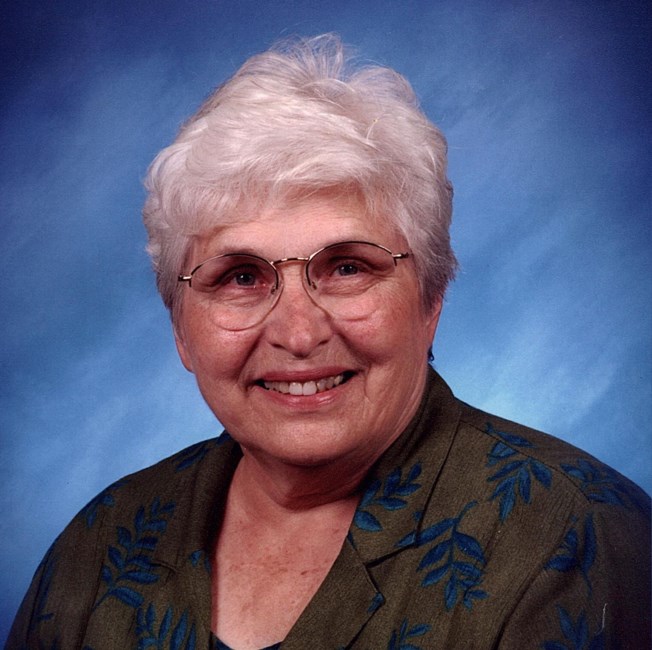
Louise Katherine Fast was born to Henry and Katherine Fast on 22 September 1933, on their farm near Mountain Lake, Minnesota. She was one of twin daughters, joining her sister Lois. Louise graduated with the Mountain Lake High School Class of 1951 and married Clayton Auernheimer on 30 December 1953 at Bethel Mennonite Church in Mountain Lake.
Louise was a lifelong learner, continuing her education with classes at Mankato Business College (1951), Bethel College (1952-1953), Reedley College (1975-1977), and California State University extension (1977-1978). She earned a California Community College credential in Office Services and Related Technologies.
From 1951 to 1954, Louise worked at the General Conference Mennonite Church headquarters in Newton, Kansas, followed by secretarial work at St. Francis Hospital in Wichita. After relocating to Reedley, she was secretary to the high school principal from 1955 to 1958. In May 1963, Louise began her service as secretary for the First Mennonite Church, a role she held until February 1996. During this time, she prepared over 1,600 church bulletins and assisted nine pastors, nine interim pastors, and 20 summer interns.
In August 1977, Louise began teaching part-time at Reedley College (Kings River Community College) until her retirement.
As church secretary, Louise was known for her attention to detail, organizing the church’s records, and keeping the congregation connected. She was also the congregation’s correspondent to the Mennonite Weekly Review for many years and served on the boards of Sierra View Retirement Homes and the Sierra View Homes Auxiliary until 2024.
Louise’s love for nature was shared with her husband Clayton. Together, they cultivated a passion for plants and flowers, particularly orchids, which brought beauty and joy into their home.
Louise is survived by her son Brent, daughter JoLynne (Brad Blake), grandchildren Sara and Zachary, sister Eldoris Peak, and many relatives and friends who will remember her fondly.
In lieu of flowers, memorial donations may be made to the Sierra View Homes Retirement Community (https://sierraview.org), Mennonite Central Committee (https://mcc.org), or a charity of your choice.
"...and what does the Lord require of you but to do justice, and to love kindness and to walk humbly with your God."
FOR THE LOVE OF ORCHIDS
I grew up on a farm in Southern Minnesota where you would find fields of corn, soybeans, grain and large gardens. My world involved milking cows, feeding chickens, gathering eggs, and picking potato beatles, never seeing or taking care of an orchid plant. I remember reading that Minnesota's state flower was the moccasin, the pink and white showy queen's lady slipper--a cypripedium.
After Clay and I were married, he received his notice from the draft board to report for his two-year I-W service. Desiring to use his degree in Botany, Biology and Chemistry, as well as his intense interest in the medical field, he requested to fulfill this obligation in a hospital setting. Thus, both of us began working at Wichita's St. Francis Hospital, Clay in the Histopathogy Department and me in the lab office. Returning to Reedley in October 1955, Clay introduced me to his first orchid plant he had received for performing yard work during his high school days. I didn't realize that through the years this also included numerous different sized greenhouses--the last one being a 15 x 30 foot building. was in for a rapid "101 Course on Orchid Culture." The vocabulary in our home soon included words such as: Cattleyas, Cymbidiums, Cypripediums, Phalaenopsis, Oncidium, Epidendron and many others. Learning to pronounce their botanical names was an impossibility for me.
Orchids can be found growing everywhere from the frozen tundra of Alaska to the farthest tip of South America and the hottest deserts of Africa. Following a conference Clay attended, he joined Marden and Marianna Habegger on an orchid hunt in Jamaica. Orchids grow in soil, on trees, tree ferns, fence posts and along streams. Plants, through hybridization, come in all sizes and hues. Clay and I found "rain orchids," a delicate small plant with green blossoms, growing and blooming along the penstocks near Camp Keola.
Each orchid blossom has a specific time of the day or night when its fragrance attracts moths, bees, and birds for pollination. One of several methods of germinating an orchid plant is to scatter the powder-like seeds over the surface of a sterile agar in a sterile flask. It takes an eternity for the etty-bitty seeds to establish themselves as individual plants. At the time Clay passed away, two flasks each containing a different cloned variety of plantlets, almost ready to be planted into their individual tiny pots, were waiting for his attention. Planting these tiny orchid plantlets now became my responsibility. Orchid plants bloom once a year and take from three to eight years to grow from seedling to full bloom. After this long wait my children and I were honored to see their first blossoms--each plant proudly displaying God's perfect and pure form and color. The thrill of seeing these first blooms was an awesome joy--beyond description
Clay presented me with a beautiful lavender Cattleya when Brent was born. I take pride in that this plant survived and was part of the last group of plants that left the greenhouse. I will always remember Clay bringing in a new array of blooming orchid plants each Sunday morning to grace my kitchen window. These were also enjoyed by many persons driving past our home. I remember a nurse on her way to her night shift at the hospital one evening stopping by at 11 p.m.
I know Brent and JoLynne, when very young and on short weekend trips, became extremely bored and exasperated when daddy was engrossed in his love for visiting botanical gardens and orchid houses. I confess I also became weary of the long waits. However, our love and joy for God's nature and environment were truly enhanced
Many of you may wonder what happened to the plants when I moved to Sierra View. Many plants, blossoms, and corsages were shared with friends and hospital patients. A large number of plants, as well as documentation (books), were donated to Reedley College's Horticulture Department. The remaining group was donated to the Central California Orchid Society for their educational enhancement. Six plants came with me to my apartment.
For the beauty of each hour of the day and of the night,
hill and vale and tree and flow'r, sun and moon and stars of light
Lord of all, to thee we raise this our hymn of grateful praise.
- Louise Auernheimer
Show your support
Add a Memory
Share Obituary
Get Reminders
Services
SHARE OBITUARYSHARE
- GET REMINDERS
v.1.18.0