
OBITUARY
Walter Theodore Matzen Jr.
30 September, 1922 – 29 December, 2015
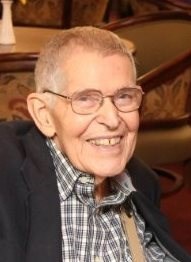
Walt's strong interest in math lead him to Iowa State where he studied electrical engineering and met his future bride and love of his life, Virginia Huffman. He graduated December 18, 1943, married December 20, and one week later was inducted into the Army Signal Corp. After going through OCS, Walt went through technical training as a radio communication officer. His team was to be sent to the Pacific to set up a radio station that would be part of a worldwide network but the war ended first.
Walt's first job was with Stromberg Carlson in New York. Walt and Virginia then moved to College Station, where he taught electrical engineering and earned his doctorate. While at A&M, Walt headed a project in which A&M worked with the US Weather Bureau to convert surplus air force radar sets for meteorological use in tracking tornadoes. This project led to establishment of the Texas Tornado Warning network and was instrumental in the formation of the first advance warning system for tornadoes in the country. After invention of the transistor in 1947, Walt taught the first transistor course at A&M.
In 1957, Walt and family moved to Richardson, Texas where he joined Texas Instruments in its research and development department. After retiring from TI, Walt went to work for Spectronics, an optoelectronics start-up company subsequently purchased by Honeywell , where he worked until he was 79.
Walt had many accomplishments during his long career. He received his first of 26 patents at TI for design of a silicon transistor for use in radiation hardened missiles, the first major use of silicon rather than germanium. It was a highly successful product for TI and published in key technical journals. He also worked on early transistorized DC amplifiers for space missiles, semiconductor devices and circuit design, and optoelectronic devices such as VCSEL which has become the light source for short distance fiber optic connections in large server installations such as Google. Walt also received a patent in connection with a project to develop a 2 color television for Edwin Land of Polaroid Land Camera.
He worked with other distinguished scientists and inventors in R&D at TI during a period of ground- breaking technological developments, including Jack Kilby, Nobel prize winner for invention of the integrated circuit in 1958, which revolutionized the electronics industry and is the basis for computers today.
Walt and Virginia had an active social life and were always available to help a friend. They enjoyed traveling and planned many family vacations. Walt loved playing bridge with his wife Virginia and later with friends at El Dorado, the retirement home where he lived for over 5 years. He cherished spending time with his children, grandchildren, and great grandchildren and provided encouragement and support whenever needed. He was a faithful member of First Methodist Church Richardson for 34 years. He always emphasized that he felt greatly blessed and was at peace with his Lord. He was caring, quiet, kind, modest and generous, with a dry sense of humor. He was a gentleman in every respect and an example of a life well lived.
Walter is preceded in death by his parents Maude Weeks and Walter Sr., siblings Jean, Elise, and Ted, wife Virginia and son Neil. He is survived by daughter Marty Colley and husband David, son Rick and wife Jan, daughter-in- law Linda, grandchildren Katy Tillotson and husband Joe, Brian Colley, Mika and wife Jen, Ben and wife Sunny, Nelson and Grant, step grandchildren Elise Young and husband Jason and Chris Colley, and great grandchildren Avi, Amelia, Kennedy, Lauren, Patrick, Bullock, Shepherd, Bhakti, Laura Lee, Jake, Christopher and Nazareth.
A memorial service will be held at First Methodist Church Richardson on Saturday, January 9 at 11:00. In lieu of flowers, donations may be made to First Methodist Church Richardson.
Show your support
Add a Memory
Share Obituary
Get Reminders
Services
SHARE OBITUARYSHARE
- GET REMINDERS
v.1.18.0