
OBITUARY
Elbert Grady Jolly Jr.
October 3, 1937 – March 16, 2026
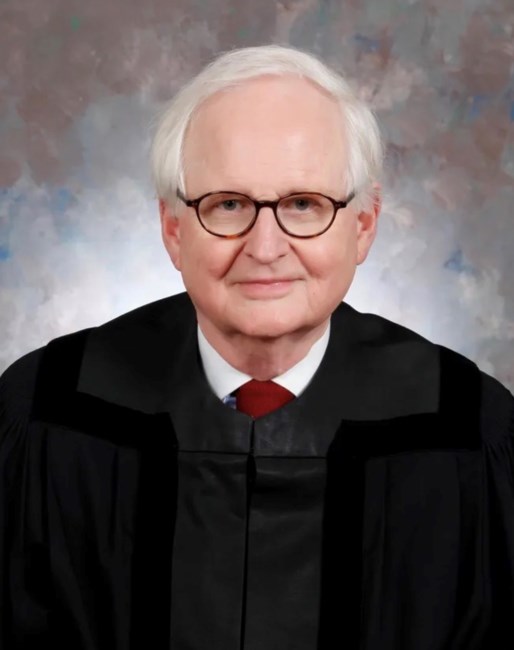
On March 16, 2026, E. Grady Jolly, Jr. passed as one of the most respected and enduring figures in modern federal appellate jurisprudence. He died with thanksgiving in his heart for the life that had been granted him. He was the son of loving, morally exemplary, faithful Presbyterian parents who were fun loving and devoted. According to Grady, of his more than several failures and faults as a person, none could possibly be attributed to his upbringing.
He grew up very happily in the rather small town of Louisville, Mississippi, which instilled within him the sense of community we romantically associate with such places.To the extent that he left behind the certainty and simplicity of those life values was not altogether blameworthy on him but can be laid at least in part on the steps of this inexorably changing world and our understanding of it.
He was a graduate of Ole Miss in 1959 and its Law School in 1962. By his estimation, he did okay, but not great, yet he always felt that he could not have received a better Liberal Arts education than he did at Oxford, Mississippi.He carried with him to his grave his love of literature, poetry and history.These continuing interests shaped the way he understood life and the world in which he lived.
Out of law school, he was an attorney for the National Labor Relations Board for two years in North Carolina attempting to protect the legal rights of workers, particularly those in textile mills, to organize in North and South Carolina. He then served three years as Assistant US Attorney in Oxford, Mississippi, prosecuting moon shiners, bank robbers and civil rights violators as the civil rights movement in Mississippi began in earnest. His focus on these crusades waned as he turned to the private practice of law.
It was, however, in the courtroom during one of these early trials that he met his wife, Bettye, a reporter for the Memphis Commercial Appeal who was covering the trial. They soon were together on their first “outing”. Within thirty days of their first date, they were married and were devoted to each other for 48 years until her death in 2014.
They moved to Washington for a brief while where he was an attorney for the US Justice Department.
Soon they moved to Jackson, where he practiced law for twelve years before being nominated by his dear friend, US Senator Thad Cochran to be a Federal Judge on the United States Court of Appeals for the Fifth Circuit. He was subsequently appointed by President Ronald Regan on July 1, 1982. He served on the court for more than 43 years until his death.
In his words, he was a good, but not great judge. The few great judges over those forty-some-odd years might be said to have sat on the front row. According to him, however, he did have a secure seat on the second row. Across more than four decades of judicial service, Judge Jolly has shaped constitutional law, influenced national debates, and earned a reputation for integrity, intellectual rigor, and unwavering commitment to the rule of law.
Beyond his published opinions, Judge Jolly is remembered for the firm, direct, and disciplined way he ran his chambers. He has been described as a “consummate gentleman” and a no-nonsense jurist whose focus was always on deciding cases rather than theorizing about them. His mentoring style and insistence on clarity and brevity left lasting impressions on generations of young lawyers. He was a great American.
Grady was also a steadfast friend who loved his friends and he was in turn loved by them. They are the Debaters and Trotters, the Wednesday Lunch Bunch, the Weaver Gore Coffee Club, the beloved Pocahontas Mallet Club, his childhood friends from Louisville and Columbus, his friends from Ole Miss undergraduate and Ole Miss law school. These are the people whom Grady would regale with stories and would likely have been on the receiving end of his devious, yet fun loving practical jokes.
Judge Jolly and his wife had no children of their own. But his sister’s child, Anna, was as close to him and Bettye as any daughter could have ever been. It should be said that Mary Ann, his sister died early in life.
To his family and closest friends, he was affectionally known as “Cookie”. He leaves behind many friends, colleagues, kinsmen and people he loved. Chief among them are Phillip, Anna’s husband and the Burnett children – Phillip (Morgan), John Grady (Meredith), Benjamin Jolly (Kiley) and Audrey Kathleen. His sister had other children, all of whom lived in Texas – Colonel Thomas Dewitt Mayfield, III (Suzann), Crawford Henry Mayfield (Carol) and Kathleen Hill (Colonel William Victor Hill, III). Their nine children and Anna’s four children were his grandchildren: William V. Hill, IV (Marissa), Mary Anna Rutlege (Brandon), Caroline Laine (Marshall), Abby Bottisini (Nick), Thomas D. Mayfield, IV (Jessica), Hannah Beall (Connor), and Grady Mayfield (Samantha), Josh Mayfield (Leslie) and Jennifer Mayfield. Cookie loved them and was proud of each of them and their outstanding children. He also leaves behind his dear friend and companion of three years, Nina Moss. Judge Jolly is preceded in death by his father, E. Grady Jolly, Sr. and his mother, Kathleen Adaline Majure Jolly.
We will celebrate his life at St. Andrew’s Episcopal Cathedral in Jackson, Mississippi on Monday, March 23, 2026, with a visitation in the parish hall at 12:30 pm and service to follow at 2:00 pm.
Please consider a contribution to the Mississippi Museum of Art in lieu of flowers
Show your support
Add a Memory
Share Obituary
Get Reminders
DONATIONS
Mississippi Museum of Art 380 South Lamar Street, Jackson, Mississippi 39201
Services
SHARE OBITUARYSHARE
- GET REMINDERS
v.1.18.0