
OBITUARY
Dietmar Gary Wicha
12 June, 1936 – 24 May, 2024
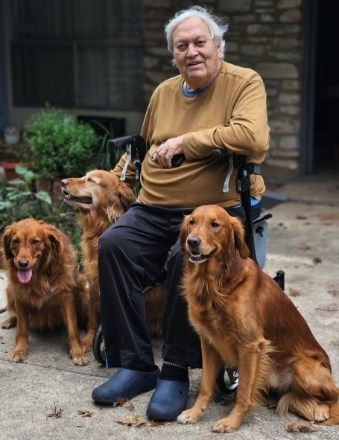
To Gary Wicha, happiness meant a dog at his side, a map in his pocket, and the love of his family around him. He was a man who was always on the move, who saw humor in even the darkest times, and believed that if you knew how to talk to other people, you had pretty much everything you needed to live a good life.
Dietmar Gary Wicha Hoffmann was born June 12, 1936, in Łódź, Poland. The first child of Erich and Aurelie Wicha, Gary grew up with the clouds of World War II around him. He was fond of his Jewish grandfather, who, like many of his relatives, didn’t survive the war. When Gary was eight years-old, his mother took him and his younger brother Gerd through the forest on foot, fleeing from Poland while hiding from the invading Russian army. In his typical glass-half-full kind of way, instead of remembering the hardship the family suffered, Gary would tell funny stories about sneaking into abandoned houses looking for food. He always talked about the courage and strength of his mother, guiding him and his brother on a dangerous journey to a new life.
They sought refuge with family in Switzerland briefly, then later after the war with family in Berlin, where they were reunited with his father, who went on to work for the American Embassy’s Mission Berlin for ten years. It was in Berlin, which was at that time a tumultuous but exciting place, where Gary mastered his ability to navigate hard times through playfulness and adventure. He would recount with joy how he pulled silly pranks like pinning the long braids of the girl who sat in front of him to his school desk. And later how he worked as a jitterbug dancer in the Badewanne, a jazz club that was a gathering place for artists and American soldiers. Or how he appeared as an extra in the movie The Great Escape alongside Steve McQueen. Or rode a single-speed bike from Switzerland to Sicily and later, with another friend, drove to Beirut in an old Citroen just for the adventure.
In the early 1960s, after attending college and saving money from a job at an insurance company, Gary decided to explore the world further and traveled to the U.S. Along the way, he worked odd jobs, which he would later share endearing stories about, including one as a bellman at the Fairmont hotel in San Francisco (jazz singer Ella Fitzgerald, he recalled, was a kind woman). In 1968, he found himself in Mexico City, riding a bus to the Olympic Games, where he met a beautiful Mexican-Lebanese woman named Mary Magdalena Yapor Berumen. They fell in love and returned to the Bay Area to be close to her sister Angela Yapor. On May 25, 1969, Mary and Gary were married at a church in the hills overlooking the San Francisco Bay.
They moved to El Paso, the place where Mary’s parents Bertha Berumen and John Yapor had immigrated to, so they could start their family. Mary and Gary’s four children - Erik, Nicole, Simone, and Rene - were born there. When Gary’s mother-in-law passed away, the family moved to Mexico City. Gary wanted to expose the kids to the rich cultural life of Mexico, to be challenged to learn more languages, and to be surrounded by Mary’s generous family who so warmly took him in. He loved the years he spent in Mexico City - going with Mary and the children to the city’s bustling markets, to operas at the Palacio de Bellas Artes, and on road-trips through surrounding towns.
In 1987, the Wichas moved to San Antonio so their children would attend college in the US. Gary joined the congregation of Temple Beth-El, and at the age of 71 became a Bar Mitzvah. Gary was a salesman throughout his life— starting early on when he bartered chocolate bars from US care packages as a young refugee after the war to later when he started a company selling auto parts or built a business exporting Mexican pottery and weavings that he sourced from local artisans. He enjoyed the freedom of the road (ideally with one of his kids by his side) and he liked the people he would meet along the way.
From their father, his children learned a great deal but especially that the world is a big, wonderful place and how important it is to never lose their curiosity about it. He set high expectations for them, but he passed no judgements on their choices. “Do what makes you happy,” he often told them. And when his grandchildren - Ulan, Helena, Amil, Konstantin and Leontina - came along, he encouraged them in the same way. Gary was proud of all of his children and grandchildren, including his grandchildren-in-law Milo, Georgia and Grace and his children-in-law Edgar, Jasmina and Jeff. It brought him great joy to hear all of their stories, and he told anyone who would listen how amazing he thought each one was.
Gary read the newspaper every day, listened to Beethoven, Dave Brubeck and Sam & Dave, watched too many reruns of NCIS, and talked about the importance of speaking multiple languages. (He learned Yiddish, Polish, German, French, English, Spanish, Greek, Latin and Hebrew). He spent many happy hours watching the Spurs and yelling at soccer games— in person at first but in the later years on television with his family and many beloved dogs around him. His wit and warmth and love of storytelling only deepened over the years. When he woke up in the middle of the night and felt restless, he would tell his wife how much their 55 years of marriage meant to him and often sent group messages to his children and grandchildren. One of the last messages he typed out on his phone was short but, like much of Gary’s life, deeply true to what he valued most: “Wonderful family, what great love.” He passed away peacefully at home on May 24, 2024.
A celebration of his life is being planned for August.
In lieu of flowers, contributions to honor Gary's memory can be made to support Alzheimer's research at the UTHealth San Antonio Biggs Institute for Alzheimer's and Neurodegenerative Diseases at biggsinstitute.org/give or to UTHealth Office of Institutional Advancement, 7703 Floyd Curl Drive MC 7835, San Antonio, TX 78229-3900. (Please simply specify that the gift is in memory of Gary Wicha
Show your support
Add a Memory
Share Obituary
Get Reminders
Services
SHARE OBITUARYSHARE
- GET REMINDERS
v.1.18.0