OBITUARY
Victor J. Ferrari
24 February, 1916 – 5 May, 2007
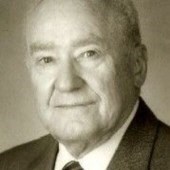
He was born February 24, 1916 in Marion Heights, Pennsylvania, one of 8 children born to Jacob and Catherine Arnoldin Ferrari. After Vic was born, his family moved to Kulpmont, Pennsylvania where he attended elementary school and graduated from Kulpmont High School in 1934. At Kulpmont High, he was very active in school, including lettering on the School's varsity football team. His mother wanted him to go to college, but wanting to help his widowed mother, Vic refused and went to work. After working seven days a week for $12 at a gas station, Vic decided his mother was right after all and agreed to go to college. Ferrari went to Bloomsburg State Teachers College in Pennsylvania. He attended for two years and tried to join Aviation Cadets. Failing the medical exam because of high blood pressure, he stayed at Bloomsburg and graduated in 1939 with a B.A. in Education and began to teach.
In 1942, with the war in full fury, the Aviation Cadets took him in and he began what was to be a very successful career in the Air Force. He trained as a bombardier and a navigator and was assigned to B-24 Liberator bombers. He then went to England as a member of the 578th Squadron, 392nd Bomber Group, 8th Air Force. On November 13, 1943, he flew on his first combat mission to bomb Bremen, Germany. Losing one engine to anti-aircraft fire and a second to an ME-110, his B-24 aircraft began to lose altitude and the pilot ordered the crew to bail out over Holland. With the help of the Underground and after more than five months of harrowing adventures avoiding capture by the Gestapo, Nazi troops, and German sympathizers, Ferrari made his way to Spain and safety. In April 1944, Ferrari returned to the US via England. After serving as a navigator instructor in Louisiana and Texas, the Air Force gave him a choice of assignments because he had been shot down. He chose Middletown, PA, which was close to family and next the University of Southern California/ Los Angeles where he earned a Master's Degree in Psychology. From there he was assigned to Ellington Air Force Base, Texas, to try to solve a very serious dropout problem among aviation cadets. He succeeded. His Commander's evaluation read that "Ferrari had more leadership in his little finger than most people have in their entire bodies." Ferrari then showed his compassion when he volunteered to take a remote assignment to Saudi Arabia in the place of a married officer with a family. From there he was assigned to teach psychology at the Air Force Academy and after two years, he was selected to pursue a Ph.D. in Psychology at Denver University.
At this time, the USAF Academy Dean of Faculty, Colonel Robert F. McDermott, was looking through some officers' records to find a badly needed Assistant Dean. Once he saw the quotation on Ferrari's leadership, McDermott asked Ferrari to volunteer to return to the Academy to take the job. Ferrari agreed and served the Dean for six years and then stayed at the Academy for two more years as the Deputy Commander of Cadets. His last three USAF assignments were as Deputy Commander of Operations and Training at Mather AFB, Professor of Air Science at the University of Notre Dame and as Vice Commandant of the Air Force Institute of Technology in Dayton, Ohio.
Ferrari retired from the Air Force in August 1971 when McDermott offered him a position to set up a Training Department at USAA in San Antonio. He then served various senior executive positions at USAA that included Training and Development, Human Resources, Chief of Staff, and Federal Savings Bank President. After retirement from USAA, McDermott immediately hired Ferrari to begin and operate a USAA Mentor Program. USAA volunteers would serve as mentors to at-risk students in San Antonio ISD. Beginning with 67 mentors in two schools, the program rapidly grew under his direction and the number of USAA mentors ran into the hundreds. With McDermott's encouragement, Ferrari helped other organizations and institutions in San Antonio to begin mentor programs of their own. His initiative continued even after his retirement as head of the USAA mentor program in 1993. By 1997, over 2700 community mentors had joined to mentor in the City with those from USAA. At one point, Ferrari was a member and a leader of 17 different education and public service committees. He helped energize the City's 225-READ program to improve adult literacy in the community. The City of San Antonio and the nation were grateful for his efforts. Unknown to most of the hundreds of children and families he helped, he deserved the recognition that the modest hero did not seek and tried to avoid.
In 1992, President Bush selected Ferrari for the 943rd national "Point of Light" award and in September of 2005 the city dedicated the Victor J. Ferrari Literacy Center.
Ferrari was preceded in death by his parents; his three brothers Isadore, Alfred, and William; and his three sisters Barbara Arnoldin, Esther Marchetti, and Adeline Pakoskey. His wife Doris Gene Alber Ferrari survives him, as do her three daughters and their husbands, Jane and Joseph Reinke of Mounds View, Minnesota, Susan and Steve Brizius of North Royalton, Ohio, and Rebecca "Becky" and Douglas Smock of San Antonio, Texas. His beloved grandchildren by marriage, Joseph and Jesse Reinke, Sarah and Jennifer Brizius, and Megan and Casey Smock also survive him. He always said that being called "Grandpa" brought him one of the greatest joys of his life. In addition, his brother Jack Ferrari from Philadelphia also survives him. He will be missed by all.
In lieu of flowers, the family requests memorial contributions be made to Victor J. Ferrari Memorial Scholarship Fund, San Antonio Area Foundation, 110
Broadway, Suite 230, San Antonio, TX 78205.
Show your support
Add a Memory
Share Obituary
Get Reminders
Services
SHARE OBITUARYSHARE
- GET REMINDERS
v.1.18.0