
OBITUARY
Lily Sen Lee
1 December, 1917 – 14 March, 2012
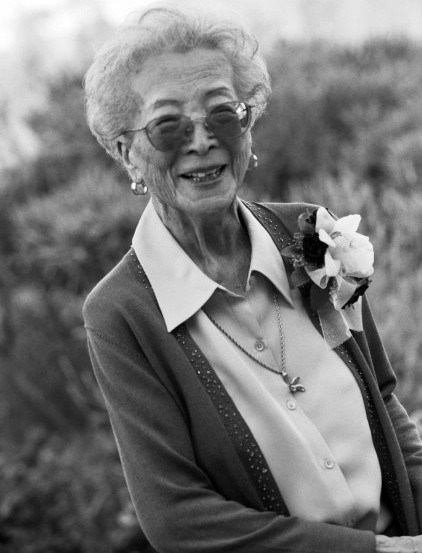
Our mother, Lily Sen Lee was an amazing woman who had such a positive spirit. Throughout her life there were difficult challenges that she accepted with grace and strength. She not only overcame the difficulties that came her way, but successfully raised her family and made a difference in the lives of so many. Her joie de vivre was infectious to all who knew her.
Lily Sen Lee’s story begins with her arrival in San Francisco in 1918. Her parents, Yep Hong Suey and Yep Mo Jing brought over their young son, Herbert, and infant daughter, Lily, in June of 1918. This was actually her father’s return trip to San Francisco. He had won a lottery in Chinatown and used it to finance his trip back to China accompanied by his friend who also happened to be a distant relative (Lok Suk). Both traveled back to China with the intent of returning to San Francisco with their wives and families. As Lily explained: “he got lucky so he went back and was supposed to bring his wife over …they each brought somebody (else) over.” Apparently both her father and his friend enjoyed their newfound wealth in China so much that they came back with new wives and new families. Both left their first wives and families in China.
Lily’s mother, Mo Jing, was a young and beautiful city girl from Canton. They lived for a while in Hong Kong. While there, both a son and daughter were born (Herbert and Lily). In 1918, her father decided it was time to return to San Francisco with his new wife and family.
Lily’s first memory of home was at 721 Clay Street, across the street from Portsmouth Square Park. “We lived in two little rooms, on the second floor.” Their family of four grew to eight, excluding a sister who died as a baby. Herbert, Lily, and Jefferson were the three older children who grew up together and were separated by about six years from the younger three children (Stanley, Chester and Fannie).
The prevailing attitude regarding the education of children was that it was more important for the male children to be educated. “They always say, boys have to take care of family. So Herb, he had to go to school, keep him in school. Girls can work at the factory. That’s the advice of everybody giving Mother. I was twelve years old when I started working at Jung Hing Kai Chong (sewing factory) – no choice. I went to Commodore Stockton (Elementary School) and then Francisco Junior High on a part time basis, continuation school, for 2 or 3 hours a day in the morning and the rest of the day spent at work. …Chinese always stressed education, but in my case, Herbert was supposed to attend school, not me.”
At the sewing factory, Lily formed “childhood friendships” that lasted a lifetime. Since she was only twelve, all the other girls in the factory were a little older than her, but she was able to form close friendships with these girls. This is where she first met Edna Lee. Edna was an orphan, and when her older sister died, she was the sole support for her younger two sisters. As Lily said: “When I look at them, I felt I’m luckier, because she doesn’t even have parents. … So when you think you have it bad somebody (has it) even worse, at least I have my parents.” This attitude of being positive about one’s situation has always characterized Lily’s approach to life.
While the sewing factory enabled Lily to form these lifelong friendships, there were few other positive aspects about the work atmosphere. The boss was very strict. She described him as “I think he looks mean, maybe he is mean. He always had a scowl on his face, like you were always doing something wrong – (laughed) which we did, we talked a lot. Because Edna was there and I’m next to her, we’d talk.” Lily remembered one instance when this boss suspended her and Edna for talking. She recalled that the boss said: “You two like to talk so well, you go home and take a week off!” “Well in those days, I didn’t think anything of it (laughed). We were so young, thought it was like a free vacation, so we went to the beach!” Again, this was so typical of Lily, to put a positive spin on what essentially was a work suspension.
Lily contributed two/thirds of her wages to the family income and only kept the remaining one third for herself. She could not remember exactly how much her wages were, but they were very “meager… I remember the clothes to be ironed was seasonal, so sometimes they could put you to work as a sewer for buttons, but I’m so lousy at sewing buttons – two hours and I made ten cents!” Her sense of responsibility to help support her family was evident at this early age.
Luckily she worked as a presser, so she was not required to sew on a normal basis. As a teenager, Lily continued to work at the sewing factory through the 1930s. She participated in the first strike of a Chinatown sewing factory in the United States as a member of the Chinese Ladies’ Garment Workers Union Local #341 that was chartered by the International Ladies Garment Workers Union (ILGWU). Jennie Matyas was their organizer and leader. There is a photo of Lily on the picket line wearing a strike banner that was published by the Chinese Digest. At that time in 1938, Lily was only twenty years old, but had been working at the sewing factory for more than eight years. She and the other workers (including her mother) were committed to striking for higher wages and better working conditions. “We marched up and down in front of the factory on Washington Street from Kearney Street and back, carrying pickets and banners. Everyone marched including my mother and other older ladies even those who had bound feet.”
Although the strike was settled after a few months with compromises made on both sides, the sewing factory was shut down after one year and all the employees were laid-off. Lily and her mother were able to obtain jobs downtown, outside of Chinatown, but many others were not so fortunate because of discriminatory practices at sewing factories outside of Chinatown.
Lily met Jennie Matyas in Chinatown during 1936-1937. She worked with Jennie throughout the strike activities of 1938, and their friendship grew. Jennie decided to groom Lily for the leadership of the Chinese Ladies’ Garment Workers Union Local #341. At the end of May 1940, Lily accompanied Jennie Matyas to the ILGWU 24th Convention held in Carnegie Hall, New York City. At the conference, not only did she get to meet Eleanor Roosevelt, who gave a keynote address, but she also met David Dubinsky, the President of ILGWU and his wife, Emma Dubinsky. In fact, Lily spoke at the convention on June 5, 1940, and presented a Chinese robe to Mrs. Emma Dubinsky as a token of appreciation for the support and guidance their local had received from David Dubinsky.
When Lily returned to San Francisco, her relationship to James R. Lee (our father) became more serious. (She had met James earlier in 1936 when he was a San Jose State student and since New Year’s Eve of 1937 had “gone steady”.) She was faced with the dilemma of continuing employment with the sewing factory and working as a union activist or following her heart to Los Angeles. Lily chose to leave San Francisco, against the wishes of her mother, and move to Los Angeles to marry James who was attending his first year of medical school. Thus her career as a union leader never came to fruition. For the short while she was affiliated with the union, she did feel strongly about its benefits: “If it weren’t for the union, they (the workers) wouldn’t have a decent livelihood.”
When she went down to Los Angeles in March of 1941, she moved in with distant cousins, Rose and Raymond Yip, for a few weeks until James had his spring break. During spring break, they went to Las Vegas and were married on March 27, 1941. They returned to Los Angeles and began their marriage in a small cottage that they shared with Harry, James’ younger brother. The tiny cottage was about two blocks away from Los Angeles General Hospital so it was convenient for him to attend classes and work as an intern and later as a resident. It was important for Lily to work and help with the household expenses, but since she had very little formal education, her first job in Los Angeles was as a waitress in a Chinese restaurant.
After the United States declared war on Japan and Germany in December of 1941, the armament industries in California started hiring women because so many of the men had been drafted as soldiers. It was an opportunity for many women, whether white, black or Chinese to get better paying jobs in factories that had previously been restricted to male workers. Lily became a riveter working on panels for warplanes at Hillman Kelly. “Some workers are terrible, they don’t do a good job - I just pray that the plane will stay together - that the panels would not fall apart.” She continued to work at Hillman Kelly until her appendicitis attack. At that point her career as a factory worker ended and she required a lengthy recuperation period. During that time, she received care packages from her parents and James’ elder brother, Joe, sent them $50 a month to help cover living expenses.
When James finished medical school, they moved back up to San Jose. Due to family obligations, James had to go into practice with his uncle, who was an herbalist in San Jose. Lily and James shared the house and office with James’ uncle, Goon. At that point, Lily became the suburban housewife who kept the house and cooked the meals. Their first child, Terry was born in 1947. She and James reunited with other young Chinese couples that they had known before in the Bay Area. There was a Chinatown in San Jose, but the few Chinese families that lived in San Jose were spread out in Santa Clara Valley and not concentrated in one neighborhood. They formed an informal social group who got together for a variety of activities, anniversary parties, holiday celebrations, etc. Many of the men were professionals (i.e. doctors, dentists, and engineers) and their wives did not work outside of the home. They all became the typical suburban housewife who took care of the home and children. In Lily’s case, she also took care of the uncle as well. Lily soon had two other children, Gail and Beverly, born in 1950 and 1951, respectively.
When James’ uncle retired, Fred, one of James’ older brothers took over the herbalist function. When James and Fred’s oldest brother, Joe died, Fred left to take over his herbal practice in Salinas. Lily then took over the herbalist practice for James following uncle’s “recipes” for different ailments and using her parents known remedies. Lily was able to continue that part of the business for James’ patients who were interested in being treated by Chinese herbs rather than western medications. Lily assisted James as a herbalist until his retirement in the late 80’s, but she also continued to attend the luncheons and bridge parties with her Chinese girlfriends and play twice a week mah jong games at night with James and two other friends who loved to gamble, Dick and Curtis. In addition, throughout her sixty plus years as a resident of San Jose, she was frequently requested by the San Jose courts to act as an interpreter for Cantonese speaking defendants.
Although she led a very comfortable life, especially over the last sixty years, she indicated that: “being Chinese was really a struggle”. Not only did she encounter discrimination when she left the safety zone of Chinatown as a young woman, certain traditional Chinese beliefs about girls and their roles (i.e. family responsibility (work) was more important than education) were particularly restrictive within her family situation. Despite the difficulties that she faced as a young Chinese girl, she was able to successfully venture outside the confines of Chinatown with confidence and live a life of her own choosing. She did not allow her mother or father to control her life by choosing her jobs or arranging her marriage.
Although Lily’s formal education was limited, she was naturally inquisitive, bright and a quick learner (other than sewing!). She loved to read the newspaper, all kinds of books including the annual Farmer’s Almanac. Her favorite TV shows were Jeopardy, Wheel of Fortune and NCIS.
As you might have guessed, she was a life long Democrat who supported unions, Planned Parenthood and other social initiatives. She was a “late owl” who loved to listen to KGO’s Ray Taliaferro, liberal talk show host, for many years.
Her special gift was her ability to make people feel comfortable and well fed! The unofficial family motto of “Eat, Eat, Eat” is a result of her infamous Friday night dinners, always well attended by family, old friends and new friends. She would cook a full Chinese meal (about 10 different dishes) well into her 80s. As she got older, her sister Fannie and friend Curtis would come and help her shop and cook. After dinner was over, all retired to the Poker table where Lily would have a great time trying to win everyone’s money!
In fact, she not only loved playing poker and mah jong, she also loved going to casinos to play black jack, dice and keno at casinos in Reno, Lake Tahoe, Las Vegas and Cache Creek. She could hold her own at any blackjack table and preferred sitting at the first seat so that she wouldn’t have to play after any “amateurs”.
Lily was a woman who loved life to the fullest. She was a unique mixture of modern and traditional values. She was an amazing wife, mother, grandmother, great grandmother, sister, aunt, and friend. We will miss her, but are thankful for every day she was with us.
Show your support
Add a Memory
Share Obituary
Get Reminders
Services
SHARE OBITUARYSHARE
- GET REMINDERS
v.1.18.0