
OBITUARY
Rev. Canon Elizabeth Kilbourn
18 July, 1926 – 5 April, 2023
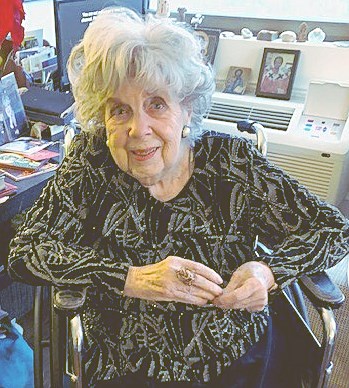
Elizabeth Kilbourn of Toronto died peacefully at her daughter's home on April 5, 2023. Elizabeth was born on July 18, 1926, in Hespeler, Ontario, to Philip Sawyer and Violet Hill. She earned a B.A. in History at Trinity College, University of Toronto, with first-class honours. She then received an M.A. in History on a scholarship at Harvard. Known to many as Betty or Betsy, Elizabeth had an extraordinarily rich and fulfilling life. She married William Kilbourn after they graduated together from Trinity in 1948. Accompanying Bill during his budding academic career at Harvard, Oxford, McMaster and York universities, she gave birth to five children in their first decade of marriage. The couple then settled their young family in the Rosedale neighbourhood of Toronto.
Drawn to fine art and design, Elizabeth and William became avid promoters and collectors of contemporary Canadian painting in the 1960s. They befriended many of the top artists of the day, who often joined their sprawling all-night parties in Dundas and Toronto. Elizabeth and a friend once noisily disrupted an auction at a Toronto art gallery after identifying one of the works as a fraud. Elizabeth worked as an art critic for The Hamilton Spectator, The Toronto Star and the CBC, and as an editor at Canadian Art Magazine. She co-authored the book Great Canadian Painting, a Century of Art, as part of the Canadian Centennial Library. In 1971 she joined a panel sent by the Canada Council for the Arts on a cross-country tour to meet with artists and review grant applications. Another of Elizabeth's enduring passions was music. A skilled pianist, she often livened up social gatherings by rallying guests to sing alongside her as she played. She adored choral and opera music and enjoyed attending concerts at the Arts and Letters Club. Her life-long hero was JS Bach, but she was also a jazz buff and revered (and frequently quoted) Bob Dylan.
Elizabeth was an ardent traveller. She took many trips across the globe for business and pleasure, sometimes to visit her far-flung children. In the summer of 1973, during Soviet times, she embarked on a solo trip to Russia and Uzbekistan, where she acquired a life-long addiction to yoghurt. She toured countries such as India and Poland, but felt particularly at home in the deserts of the Middle East. The Anglican Church featured prominently in Elizabeth's life; and she featured prominently in the life of the Church. Her English-born father was an Anglican priest assigned to the parish of St. Paul's in the town of Caledonia, where she and her two younger sisters grew up. He imparted the calm and wisdom that would serve Elizabeth well during times of trouble. During the 1960s, Betty and Bill became enthusiastic members of historic Holy Trinity Church in downtown Toronto (which they helped rescue from the wrecking ball of the mammoth Eaton Centre construction project). Known for its experimental liturgy, dedication to social justice, and community outreach, Holy Trinity had a powerful liberating impact on Elizabeth.
An unabashed extrovert, Elizabeth's fascination with people and their personalities made her a natural for pastoral work. After receiving training, she served as chaplain at various hospitals, including the Queen Street Mental Health Institute and Toronto General. She flourished in this profession and was elected vice-president of the Canadian Association for Pastoral Education (CAPE). She began representing CAPE at international conferences, an unprecedented feat for a low-ranking laywoman who faced down hostility from certain male colleagues. Energized by these experiences, Elizabeth decided to follow in her father's footsteps and enter the Anglican priesthood. She returned to Trinity College and was awarded a Master's in Divinity. She was ordained a deacon in 1977 and a year later became one of the first female priests in the Anglican Church of Canada. She then served in several parishes, including St. John the Baptist, Norway, in east-end Toronto. Soon after, Elizabeth was named Head of Chaplaincy for the Diocese of Toronto. St. James Cathedral became her new workplace and she put together an eclectic, innovative team to tackle this new challenge.
Meanwhile she bought herself a condo across the street from her office, overlooking St. James. Elizabeth's life took a dramatic turn at age 73, four years after Bill's death. Trinity War Guest sweetheart Richard Mackie got in touch with her out of the blue, after a half century of silence. She unhesitatingly took up his invitation to join him and moved to Warminster, Wiltshire. There she enjoyed the tranquil English countryside and its intriguing history, while caring for Richard. After much perseverance she obtained a licence to practice as a priest with the Church of England, which enabled her to perform weddings and funerals. After Richard died in 2011, she returned to Canada. St. James once again became Elizabeth's centre of gravity during her declining years. Even in her 80s, she continued to preach and participate in church life. One of the reasons she loved the Cathedral so much was that it brought her into contact with people of every age, colour, ethnicity, sexual orientation and demeanour. Elizabeth downsized to a retirement home at age 93, and soon after broke her hip. She could no longer visit the Cathedral regularly, but handled the lack of immobility with dignity and patience.
She continued to draw inspiration from the Bible, offering short services and sermons to her fellow residents right up to the final months of her life. Among the highlights of her career in the Anglican Church was receiving an honorary doctorate in Divinity from Trinity College. As a priest, she was thrilled to marry her elder daughter Pippa and baptize her five grandchildren. Elizabeth faced many difficult moments in her life, but remained buoyant into old age. She took part in the life of her residence, doing arts and crafts and playing bridge. Pippa dropped by often to chat and see to her every need. She was comforted by a steady supply of books, games of solitaire, vintage movies, and the companionship of the trees outside her window. None of these adventures was planned. Spontaneity was Elizabeth's recipe for life. In the first of her three self-published autobiographies, entitled It came to me, she wrote: "For the last 35 years I have been preaching sermons, around 50 a year, and have never put any of them down on paper. I have given hundreds of workshops on various subjects, happiest standing on my feet and talking. I trusted that what I needed to say would come to me."
In addition to Bill and Richard, Elizabeth was predeceased by daughter, Hilary; son, Nicholas; and sisters, Peggy and Nancy. She is survived by daughter, Philippa (Adriano); sons, Timothy (Bella) and Michael; grandchildren, Sebastian (Liana), Kenneth, Oriana (Joshua), Aidana and Benjamin; and great-grandchildren, Norah and Adelaide. She is mourned by brother-in-law, Ted Steele; sister-in-law, Rosemary Kilbourn; and her many nieces and nephews, especially Debbe and Kathy. The Kilbourn family wishes to express their deep appreciation to Dr. Melissa Melnitzer's Palliative Team at Mount Sinai Hospital for their assiduous and compassionate care.
A funeral service will be held at noon on Thursday, April 13, in the Cathedral Church of St. James (106 King Street East, Toronto). Visitation will take place at the Church from 10 a.m. to 12 p.m. and a reception will be held after the service. Instead of sending flowers, friends may wish to make a contribution to the Holy Trinity Refugee Committee.
Show your support
Add a Memory
Share Obituary
Get Reminders
Services
SHARE OBITUARYSHARE
- GET REMINDERS
v.1.18.0