
OBITUARY
Patricia Joan Davitt
16 November, 1940 – 17 July, 2024
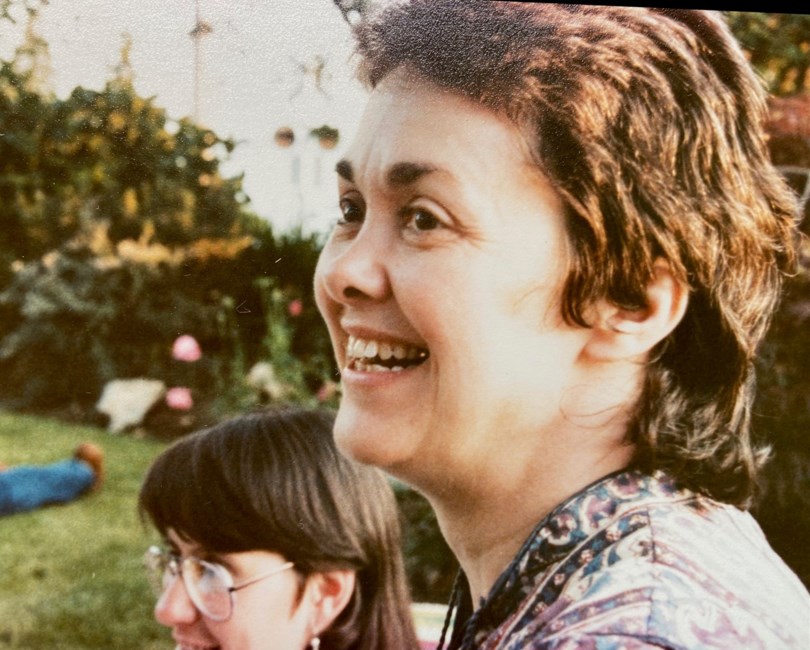
Pat Davitt died July 17, 2024, in her home, in the company of friends. Mourning her passing are numerous relatives in the Davitt/Hunter/Broger/Dunne family; friends from her union, political activism, and artistic pursuits; and many in the Commercial Drive neighbourhood and on Saturna Island. She took pleasure in cats, gardens, community arts, folk music, and friendship; she remained committed to justice her entire life, refusing to succumb to despair or cynicism. She had two brief marriages but ultimately chose a single life. Her greatest talent was for friendship, and among her mourners are friends who have remained close companions for 60 years.
Pat was born in Saskatchewan in 1940, to an Irish immigrant father and German war-bride mother, the youngest of four children (her siblings were Molly, Bill, and Tom). She was academically gifted and her family encouraged her to study at the University of Saskatchewan. She later completed an MA in psychology, and then began a PhD at Simon Fraser University.
She became a writer, illustrator, photographer, and printmaker, and perhaps even more than that, a supporter of local artists. With her song group, the Euphoniously Feminist and Non-Performing Quintet, she sang at hundreds of rallies and picket lines supporting women’s rights, labour, social justice, and peace and self-determination around the world. At the height of the AIDS crisis, they spent five years holding monthly fundraisers for Nkosi’s Haven in South Africa. Her paid employment included decades as the school psychologist at the Jericho Hill School for the Deaf, where she counselled dozens of students impacted by sexual abuse in that institution, an experience that profoundly impacted her sense of the justice owed to children. Learning and using sign language became one of her abiding passions, and she served as editor for the Deaf Advocate, a professional newsletter. She was also a figure skater who taught in the skating program at Britannia Community Centre, and later administered the skating program. While at Britannia, she served as a staff representative to the Board, and as a union shop steward and sometimes president of the then-VMREU (later CUPE 15).
Her political activism began in Saskatoon, but was greatly impacted by her move to Vancouver in the mid-1960s. At SFU she was one of “the 114” who occupied the Administration building in the fall of 1968 in protest of politically-biased admission and hiring practices. She later became a founding member of the Women’s Caucus, Vancouver’s first feminist organization, and designed and laid out its newspaper, The Pedastal. She went on to work on many other feminist publishing projects, such as She Named It Canada Because That’s What It Was Called, and Never Done: Three Centuries of Women’s Work in Canada, and an unfinished video cartoon about birth control called “There Was a Young Woman Who Swallowed a Lie.” With other local women, she ran an underground abortion referral service, and became a member of the 1970 Abortion Caravan, a group organized to pressure the Liberal government to fully decriminalize abortion, which built the foundation for the nation-wide abortion rights movement that supported later legal challenges.
Pat later became active in her union, which included a focus on equal pay for women, paid maternity leave, and other feminist issues. She was a central participant in the multi-union civic strike of 1981, a strike which is credited with creating stronger feminist analysis in the local union movement and presciently arguing for pay equity—equalizing pay for jobs that had similar qualifications and level of complexity, to eliminate the disparity in pay between professions dominated by woman and those dominated by men.
In 1974, Pat bought a Victorian upright house in the Commercial Drive area with Maggie Benston, an SFU professor who had become her close friend, and they set about dividing the house into two living spaces and restoring its period features. Their house on William Street became a central spot for organizing, playing music, and neighbourhood activities. From their house they created the Euphoniously Feminist and Non-Performing Quintet, which often boasted either fewer or more than five members but never changed its name. Their house was a spot where meetings and parties could be held. They both volunteered at the Folk Festival, and became friendly with visiting musicians. Every year, the Monday after the Folk Festival would see anybody still in town gathering at Pat and Maggie’s house to play music late into the night, spilling out onto the back porch and eating whatever food folks happened to bring. When Maggie died in 1991, her wake was just such a party.
Once settled in the East End, Pat became central to building the community. She helped plan and co-ordinate the annual garden tour, which raised money for a Britannia neighbourhood fund. She offered up her house for an annual Christmas Crafts Fair, allowing local artists to sell without paying for a stall at a commercial venue. She talked to the Parks Board about an empty lot behind her house that the developers had seemingly given up on: when the Parks Board bought the lot, Pat enthusiastically helped plan Mosaic Creek Park and made one of the mosaics with her then-tenants Faith and Winnifred. Even in her last years, Pat continued to run into people she had taught to skate at Britannia, neighbours who had participated in garden tours, artists whose work she had championed, musicians she had played with, and people she had interviewed while co-authoring a history of the Britannia Centre.
Pat began to have memory trouble ten years before her death, but her dementia was relatively kind in allowing her to remain cheerful and to take pleasure in the same things that had always sustained her: her cats, her garden, art, music, and friends. A terminal cancer diagnosis in 2023 complicated matters: her stay in hospital was traumatic since she could not remember or process what was happening to her. This conundrum led to a tremendous outpouring of support and love for Pat that allowed her to die at home. Because her friendships spanned generations, younger members of her circle were able to take on a caretaking role. She had no children, yet after nine months of round-the-clock care at home, she died surrounded by chosen family members whose lives she had touched.
On that note, Faith and Winnifred wish to thank the extended Davitt clan across Canada, and the Dunne relatives in Ireland, for sharing their amazing aunt with us. We also wish to thank the friends who have visited her tirelessly, especially those who came week after week, bringing delicious foods and singing with her. Her close friends Marisa Orth-Pallavicini and David Cadman, Ulryke Weissgerber, Ursula Beale, Dave Schroeder, Ed Shaw, and many others made her last months joyous and meaningful. We would like to thank her caregivers Marianela, Mylene and Cathy for their gentle care and kindness to our beloved friend, and for becoming Pat’s friends in these last months. We also want to acknowledge the guidance and medical support provided by the Home Support and Palliative Care teams at the Robert and Lily Lee Centre of Vancouver Coastal Health, especially nurses Elisa and Kim, and Dr. Steve.
In honour of Pat’s life, in lieu of flowers, we request donations to any of the following causes, which were meaningful to Pat:
• Aboriginal Mother Centre Society
• Vancouver Folk Music Festival
• Margaret Lowe Benston Memorial Endowment, SFU
Show your support
Add a Memory
Share Obituary
Get Reminders
Services
SHARE OBITUARYSHARE
- GET REMINDERS
v.1.18.0