
OBITUARY
Helene Annette Sarty
21 September, 1918 – 10 April, 2012
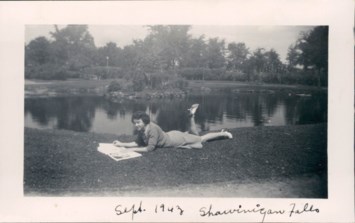
1918 Born in Saint-Didace, Maskinongé county, Québec, one of 15 children.
Parents: Marie Brissette and Thélesphore Ayotte
Schools: High School and Normal School: La Congrégation des Filles de Jésus. Much later in life, Hélène is accepted at Dalhousie University in Halifax. She must first upgrade her English credentials, and pass a grade 12 Equivalency test. Eventually she qualifies to teach for the Halifax Public Schoolboard.
Work: replaced her sister Blanche as school teacher at l’Ecole Saint-Edouard, returning home to the farm near Saint-Didace for school holidays. After a couple of days rest, she would take over the baking for the large family still at home. Blanche had elected to enter the Carmelite convent as a novice nun. Though Hélène enjoyed teaching, she was interested in going “afar”. When the opportunity presented itself, she sprang at the chance for a different life.
1938: Moved to the United States with Jacques and Bernadette Lahière, a French couple who liked to summer in Québec. They met the Ayotte clan the year they stayed in an old house near their farm. The Lahières came often to buy fresh vegetables and to swim in the lake. With only one son, they were fascinated by the way the Ayottes and their enormous brood worked the farm and supported the family. They admired Hélène’s efficiency in the kitchen. Hélène returned with them to New England, and entered the local high school to learn English.
1939: Visit the New York World’s Fair in the summer instead of coming home to Québec. The French vessel Le Normandie is sabotaged in new York harbour while they are visiting.
Hélène begins a second year at the high school. As well as learning English, the Lahières insist on improving her French. She learns a great deal from the French couple re religion, French culture, politics, and business. It was her ticket to a new life. She is on her way to becoming a thoroughly modern woman.
1940: Returns to Saint-Didace, but does not stay long. One of her sisters, Antoinette (Tony) was a Soeur de la Providence, residing in a convent in Misoula, Montana. Hélène earns her train fare working in a pastry shop. Once in Misoula she earns her keep as a Mother’s Helper for a family.
By September, her visa has only 3 days left, so she is sent, as a future novice, to Vancouver where the order runs Saint Paul’s Hospital. Hélène works in the O.R. folding bandages and making tea for the doctors. By December she is sent back to Québec as WWII had begun, and her parents needed her.
1941: Once home from Vancouver, Hélène goes to work teaching for Paul and Françoise Belhumeur at their Shawinigan Commercial College. As well, she tutors in French and in English. It is here that she meet her future husband, Dugald Sarty. He had come to them to learn French, and was not pleased at being assigned to a woman teacher.
1943: Takes a job with paint giant C-I-L.
Works in the Permit Office issuing permits for rubber tires. Dugald is in Manitoba doing his Military Service with the Air Force. He visits when on furlough over the next several years. He meets the Ayotte clan. He is Anglophone, Protestant, and probably a Communist in their view.
1946: Marries. A small, civil ceremony. They live in Montreal. The war ends. The gov’t sponsors courses for returning soldiers. Dugald teaches them at Sir George Willams, mostly Mathematics. He applies to the Protestant Schoolboard of Greater Montreal and begins a long stint teaching High School English, and later, Mathematics.
1947: Rosemarie is born.
1951: Buy their first home in Dorval: 39 Handfield Circle, off Bord-du-lac road.
1952: Diane is born.
1953: Larry is born.
1955: Mel is born.
1956: Christine is born, but dies soon after of a heart defect.
In addition to running the household and bearing children, Hélène acts as Dugald’s secretary. She types his manuscript “Vagabondia”, as well as many of Dugald’s examination questions and report card comments.
1958: Hélène wins a car, a ’56 robin’s egg blue Chevrolet, our first car.
1962: Hélène embraces camping with the family. As Dugald has summers off, the family began by exploring the New England States one year, the Eastern Seaboard South as far as Georgia the following year, Eastern Quebec and a bit of Ontario next. Always the trip included 2 to 4 weeks at the farm in Lapland, Lunenburg County, Nova Scotia
1964: Dugald, now 62, is forced into retirement from the Protestant Schoolboard of Montreal. He accepts a post as high school vice-principal in Dartmouth, Nova Scotia. For the next 2 years, Hélène is a de facto single parent. She takes an office job with the Dorval Airport Authority. Dugald flies home for major holidays.
1966: the family moves to Halifax, leaving Rosemarie to make her way as a young adult in Montreal. An apt is rented on Sherbrooke Street.
1967: return in the summer to visit Expo 67, and to prepare the house on Handfield Circle for sale.
Back in Halifax, Hélène begins Night School, upgrading her English and Math in order to qualify to enter Dalhousie University. There she takes courses that will earn her a teaching credential. She especially enjoys Shakespeare’s oeuvre and spends hours listening to LP recordings of Macbeth, The Merchant of Venice and the rest. In time she lands a job with the Halifax Schoolboard pioneering French as a Second Language at the elementary level. She starts at half time, then full time for the next several years. During the summer she traveled to France to continue her studies, falling hard for Paris.
1972: Dugald retires from teaching and begins construction of the cabin on Sandy Lake. In February Hélène suggests to a very bored Dugald to get away from the dismal Nova Scotia winter. Why not join Diane, traveling in Mexico, and give her some peace?
1974: Hélène and Dugald move to Sandy Lake and complete the finishing of the 4 season cabin. It is Hélène’s dream cottage, a few steps from the lake, quiet, and very beautiful all year around. Hélène takes up quilting.
1976: Hélène and Dugald move again, this time to the Sarty farm near Bridgewater, Nova Scotia. There are endless renovations to do, beginning with the installation of indoor plumbing. They fall into bed each night tired, but sleep well and awake refreshed. The barn had burnt to the ground, so they built another. The soil was depleted, so they built it up. Cattle, chickens, a strawberry field, a huge sawmill, on and on.
1988: Dugald suffers a massive stroke, leaving him paralyzed down his right side, and unable to speak. Hélène brings him home to the farm and undertakes the building of wheelchair accessible decks, among other modifications. Dugald was a big, strong man, Hélène slight compared to him, but she managed his care 24/7 for his remaining years.
1994: Dugald dies after yet another massive stroke. Hélène remains on the farm alone for several more years.
2000: Hélène sells the farm and makes the move to Vancouver Island. She spends several happy years in a sunny apartment in the village of Brentwood Bay, not far from her daughters, Rosemarie and Diane.
2004: Rosemarie and Gordon invite Hélène to live with them in their 4th floor condo on Fort Street in Victoria. Her dementia is advancing, and within a couple of years she begins a series of disastrous falls. A hip fracture and replacement surgery landed her in a wheelchair, and eventually into 24hr care at Glengarry, a Vancouver Island Health Authority facility. There she was well cared for during the last 5 years of her life.
Show your support
Add a Memory
Share Obituary
Get Reminders
Services
SHARE OBITUARYSHARE
- GET REMINDERS
v.1.18.0