
OBITUARY
Stuart J. Land
18 May, 1930 – 25 February, 2026
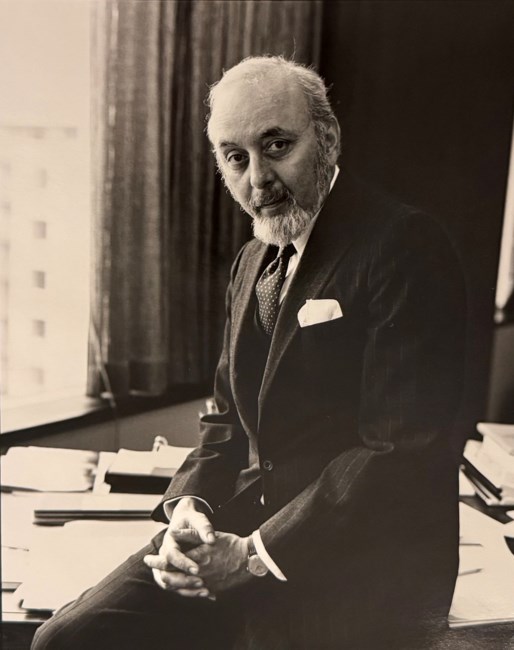
Stuart Land, who not only led one of the country’s most prominent law firms, but also used the law to serve his country, to battle for civil rights, and to oppose the war in Vietnam, passed away at his home in Washington, DC on February 25, after a long illness. Stuart, who was 95, died peacefully in the company of his beloved wife Martha.
Stuart was raised in Haverhill, Massachusetts by parents of Romanian and Lithuanian heritage who were born into poverty and who labored to support Stuart and his brother. Stuart got his name from the fact that he was almost born in the back seat of a cab -- an old Studebaker -- heading frantically for a Chicago hospital. After the young family moved to Haverhill, his father worked as a felt hatmaker while the family lived in a local tenement. His parents were later able to open several millinery stores, but life remained challenging as Stuart had to fight with local boys who tried to beat him because he was Jewish. Life got even harder when his father, who loved to take him to Fenway Park to see Ted Williams play for the Boston Red Sox, died of lung cancer when Stuart was only 13.
But Stuart took away important life lessons from Haverhill. His love of country was fired by the town’s famous 1869 monument to its Civil War dead, which was on the same block as the tenement where the family lived. Haverhill had been both a stop on the Underground Railroad and a center of abolitionism whose most famous son was the poet and abolitionist, John Greenleaf Whitter. The ideals of his hometown lived on in Stuart, who become a fervent admirer of Abraham Lincoln and a life-long civil rights activist.
Although precocious – he read the entire encyclopedia – his schoolwork suffered as he struggled to cope with his father’s death, which led to his rejection by a number of colleges. But his life was changed by a friend who told him “Stuey, you are too smart to stay in Haverhill and sell shoes” and who helped get him into a local college. He was soon off and running, transferring to Syracuse University where he graduated magna cum laude, even though he had to scramble to remain in college after his mother went bankrupt in his final year. He then went to Harvard Law School, where he graduated near the top of his class and became Case Editor of the famous Harvard Law Review, which is the pinnacle of academic achievement there.
Most members of the Law Review go straight to clerkships with leading judges or jobs with well-heeled law firms. Not Stuart. Instead, he astonished his classmates by enlisting in the Marines, where he was able to use his legal skills by becoming one of the Corps’ very first Judge Advocates General (a job previously filled by Navy JAGS). Although he started by serving as a prosecutor, he soon switched to defense work as his reputation as a skilled lawyer caused Marines charged with crimes to seek him out to represent them. A proud patriot, Stuart remained a Captain in the Marine Corps Reserve long after his active duty came to a close.
In the early 1950s, when Stuart was looking for his first civilian job as a lawyer, he was drawn to the Washington firm of Arnold, Fortas and Porter, which was founded by three leading lawyers from Franklin Roosevelt’s New Deal (one of whom went on to sit on the Supreme Court). What
drew Stuart to the firm, however, was not its profitability or its political connections; it was the fact that it was the only law firm willing to represent for free the victims of the red-baiting Senator Joseph McCarthy. After an initial stint as a summer associate in the early 1950s, Stuart became the thirteenth lawyer to work at this then small firm which, due in no small part to his leadership, grew into an international legal powerhouse.
Stuart often joked that, as a young lawyer at what is now known as Arnold & Porter, he was nicknamed “the junkman” because of his willingness to take on any kind of case. Inevitably, due to the nature of the Firm’s commercial practice in his early years, he spent a good deal of his time litigating major antitrust and unfair trade practice cases, including advertising cases before the Federal Trade Commission.
Stuart’s commercial practice evolved as federal regulation of the pharmaceutical industry increased, and his background in cases involving unfair trade practices and advertising brought him to the forefront in major matters involving the advertising of pharmaceutical products. Stuart counseled many of the country’s leading drug manufacturers and also represented them before the FDA and in the courts, work that continued well into his seventies. Under his leadership, Arnold & Porter developed one of the country’s preeminent pharmaceutical practices, a distinction it retains today.
Stuart’s leadership at the firm, however, went far beyond his commercial practice. Late in his career he and two other partners established the firm’s Los Angeles office. More importantly, beginning in 1978 he was continuously a member of the firm’s governing committee, ultimately serving as Acting Chair of the Firm in 1994 and then as Chair until a rule (that he had instigated years earlier) required him to step down when he reached 65. By that time, he had become a truly beloved figure to generations of Arnold & Porter lawyers, many of whom regarded him with the same sort of veneration in which he had held the three founders of the firm for whom he had worked as a young man. This veneration was made formal when he was designated as the firm’s first – and only – “Chair Emeritus” in recognition of both his devoted service and his colleagues’ affection.
Neither Stuart’s success in the commercial practice of law nor his leadership of Arnold & Porter, however, are the full measure of the man. Indeed, one can say that they were not the most important parts of his legal career. For Stuart never forgot his boyhood admiration of those who sought to end slavery or his firm’s dedication to representing pro bono the victims of Joe McCarthy. Throughout his career, Stuart was a brave advocate for social justice who was dedicated to Arnold & Porter’s core values of pro bono and public service, serving two terms as chair of its Pro Bono Committee – the second one after he stepped down as Chair of the firm. Under his leadership, Arnold & Porter doubled down on its early commitment to this work, becoming a pro bono powerhouse that was routinely rated as one of a handful of the very best pro bono firms in the nation.
This work was deeply personal for Stuart. Beginning on the night of April 4, 1968, as Washington DC and much of the nation was convulsed by protests following the assassination of Martin Luther King, Jr., Stuart worked through the night representing and finding counsel for young black protestors who were swept up by law enforcement. Soon thereafter he found
himself doing the same sort of work for those arrested for antiwar protests, as he cofounded the Lawyers’ Committee Against the War in Vietnam, which sometimes worked out of his living room. And he continued to do pro bono work for the rest of his career, especially in the areas of civil rights and, in a nod to the role that his own education had played in helping a poor boy from Haverhill make good, public education, including the charter school movement. His commitment to service was also international in scope, as he marched in protest against apartheid in front of the South African embassy and later journeyed to the African nation of Malawi as part of an effort to give its citizens access to life-changing medicines.
Stuart’s commitment to public interest law, however, was not limited to his leading role in pro bono at Arnold & Porter. Inevitably, he played a major role in the larger legal community, especially in pursuit of his first and greatest legal love: civil rights. Stuart was an early leader of the Washington Lawyers’ Committee for Civil Rights and Urban Affairs, serving on its Executive Committee as of 1973 and then as Co-Chair of its board during the period 1976-78. One of his proudest achievements with the Lawyers’ Committee was his involvement in a landmark case that validated the use of “testers” to determine whether equally qualified black and white job applicants were treated differently. During his tenure Stuart also worked to expand the Committee’s work in the areas of immigrants’ rights and public education.
In addition to his long association with the Washington Lawyers’ Committee, Stuart also worked with the National Lawyers’ Committee for Civil Rights, which had been established in response to President Kennedy’s call for the Bar to do more for the cause of civil rights. Stuart served as the National Committee’s Co-Chair between 1987 and 1989. In that position he played an important role in the successful opposition to the nomination of the archconservative Judge Robert Bork to the Supreme Court. In all of his civil rights work, Stuart was true to the ideals of his boyhood hometown and of his hero Abraham Lincoln.
But in the end, it is the man who that boy from Haverhill became who mattered the most. Stuart lived large, including a life-long love of music. He kept a keyboard in his office symbolic of his devotion to piano music ranging from Chopin to the jazz music he played as the leader of “Stuey Land and His Boogie Band.” He had a playful side that found him doing a striking imitation of Frank Sinatra and looking like a show business celebrity in a white Nehru suit. He also shared a love of the arts with his wife Martha, whose work is in the collections of two of the Smithsonian museums. And in later life he became a beloved member of Martha’s Urban Swing Community, known as Lawrence Bradford’s Smooth and EZ Hand Dancers.
Above all, he was prized for his personal qualities. He dedicated himself fiercely to excellence in everything he did, but he remained unpretentious and warm – a tough but sometimes almost shy man who stood for decency towards all, regardless of social or economic rank. He knew how much he had accomplished, but he retained the humility not to parade his successes before others. These qualities inspired more than just loyalty; they inspired love from the legions of lawyers who had the good fortune to work with him.
Stuart’s greatest legacy, however, is his devoted family that will always miss and love him, but who know how privileged they were to have had him in their lives and to have shared him with a wider world that needed him so much. That family consists of Martha, to whom he was married
for more than forty years, his daughter April, his sons Adam and Nathaniel, his step-son Robert, his daughters-in-law Lezode and Rosalinda, his step-daughter-in-law Jannett, his grandchildren Dylan, Maya, Yves, Eric, Remi, Tristan, and Jeremy, his step-grandson Mark, and his nieces Lisa and Abbey.
Contributions in Stuart’s memory can be made to the Washington Lawyer’s Committee for Civil Rights and Urban Affairs at washlaw.org.
Show your support
Add a Memory
Share Obituary
Get Reminders
Services
SHARE OBITUARYSHARE
- GET REMINDERS
v.1.18.0