
OBITUARY
Mr. Joseph Louis Dureault
9 May, 1925 – 1 July, 2005
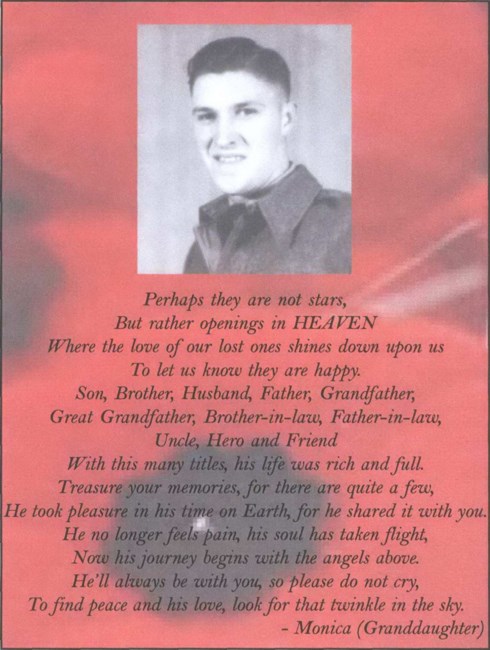
Louis was the son of the late Emile and Angele (Laverdiere) Dureault. He was raised on the family farm situated southwest of Wolseley. He attended Southgate and St. Anne's schools.
During the thirties Louis' family moved to Wolseley where his father obtained employment as agent in the Ogilvie Elevator. Around the age of fifteen Louis began his grocery career with the Red and Whie store in Wolseley under the ownership of J.F. Martin and later at Sid Rogers Garage until he joined the Armed Forces in 1943. Louis was with the South Saskatchewan Regiment at the D-Day Invasion which landed at Juno Beach and was wounded in August of 1944. He spent over a year in various hospitals in France and England until he was sent home in 1945.
Upon his return to civilian life Louis worked for S.I. Cole Department Store in Wolseley and in 1950 met and married Helene Boutin. He took over the family farm and after six years left the farm and once again began working for S.I. Cole and later Robinson Little and Co. as grocery manager and later as general manager until his retirement in the early 1980's.
Louis lost his wife Helene in 1988 and after three lonely years met and married his second wife Mary. Louis loved his family and held a special place in his heart for his grandchildren and great grandchildren. Louis' love of standard bred houses was second to none. He simply loved houses and followed the harness circuit for years. It was only fitting that Louis' last ride to his burial be on a house drawn sucky.
Louis was predeceased by parents Emile and Angele (Laverdiere) Dureault; first wife Helene (Boutin); brother George Dureault; sister Lorraine Sarich; brothers-in-law George Rashbrook and Henry Sarich and nephews Bruce and Kelly Rashbrook and Mark Dureault. He is survived by his loving Wife Mary: Daughters; Dianne (Leighton) Baran: Louise (George) Kidney; Vivian (Roy) Bulani and Lynn (John) Schmidt: Grandchildren: Monica (Darin) Field, Trevor (Kim) Baran, Windy (Grady) Toews, Jordan Kidney, Blair, Corbin and Garrin Bulani, Jay-Lyn and Ray-Lyn Schmidt; great grandchildren: Micholas, Sydney, Carter, Tanner, Kadesia, Angelina, Dylan and Jackson; sisters: Blanche (Paul) Bonneville, Denise (Tuck) Frier, Emileda (George) Rashbrook, Carmelle (Ed) Breese and Maxine (Larry) Nicholson; sister-in-law Maxine Dureault as well as many nieces and nephews.
In the Indian Head-Wolseley News Tuesday, Nov. 9, 1999 ---- Louis was interview by Jamie Gibson and this is what it said.
The head line:
REMEMBERING THE WAR NOT EASY FOR DUREAULT
Each year on November 11th, Louis Dureault of Wolseley takes time to remember those of his comrades who died fighting for their country during the Second World War. Dureault, who joined the militia when he was 15, took part in the D-Day landings in Normandy. After joining up in 1943, Dureault moved overseas just in time to take part in the monumental raid.
"When we got to Scotland they put us on a train and we went straight across to the Cliff of Dover and they put us on Corvettes," he explained. "There we waited. We didn't know what was going on, but we knew something was going on. On June 6th, that is when we attacked."
"I can hardy remember getting off the Corvettes and getting onto shore; I guess just living in fright. I can't recall how we did it."
Dureault was part of the break troops that landed on the French shoreline, and he can recall very little about those first few days of the war, just that he was surprised how quickly they were put into action.
"There had been a lot of boys who had been overseas for four or five years and we thought we would be in England for awhile too. But we weren't. We were just put on these Corvettes and waited for D-Day."
"When we went in on D-Day, we didn't know what (outfit) we were in. After we took Caen, I found myself with the South Saskatchewan Regiment."
Dureault said there was a lot of anxiety, and the troops didn't really know what was going on. But that was the army Dureault said. You just did what you were told to do.
When he went into France, Dureault was a Bren gunner, and it was after Caen that he was restored to a stretcher bearer.
Life was very rough on those troops in the front lines and it was relentless.
"There was one time we were so damn tired we walked and we walked, there was no stopping. When we did stop, there was a big pile of stones there that we just fell asleep on. We were so played out."
In Caen, Dureault remembers the destruction that took place and having to deal with shelling and the snipers.
"Most of the snipers were in church steeples aqnd we would come up with a tank and they would level it off," he said.
When they were between Caen and Falise, their oufit was in an area where there were some big bomb craters. In the morning the German's would shell the Allied positions.
"They had Moaning Minnies. Moaning Minnies where German rockets fired from multiple launchers. These Moaning Minnies would go off and of course most of us in the company would run into these holes."
When I got there, there was no room for me so there was some brush over there and there happened to be a pile of wood. I stacked the wood in front of me to stop the shrapnel."
As it turned out, a shell landed in the middle of the crater where the rest of his company were using it for shelter. There were only eight men left.
Life at the front was rough, Dureault said you would be eating your food and the Germans would start shelling and you would have to take shelter. Soldiers didn't have time to wash or shave.
" There was no stopping once we got going." he said. "We attacked and had them going back."
"There were only two ways out. Get killed or get wounded."
Because a lot of the attacks were done at night, Dureault said one of the toughest jobs as a stretcher bearer was finding wounded soldiers in the dark.
"It is pretty hard to see what you are doing at night, where they are wounded. You dressed them as best as you could and then put them on the stretcher."
A lot of the men didn't make it and soon it was Dureault who would end up being the one needing attention.
"It was around 7:30 at night on August 28th, 1944. We were taking shelter and the other stretcher bearer said you are bleeding...I had just felt a bump and it didn't hurt. My thigh was full of shrapnel, so he bandaged the wound and waved the Bren Gun carrier down to pick me up and take me back to the hospital."
It took seven operations and Dureault spent the rest of the war back in England convalescing. Gangrene set into his leg and he was fortunate that penicillin had just been invented, which saved his life.
"For a long time I never talked about the war." Dureault said. I have had a hard time watching TV if there is a war on. I have night-mares if I watch too much of that."
"It is bound to stay with you, subconsciously."
One thing Dureault is adamant about is how the returning veterans weren't prepared for civilian life.
"I was just 18 years old. Just a kid. I went over there and was trained to fight and kill, fight and kill. That is all you were trained to do. When you came home and got discharged, there was no rehab or anything for you. They just threw you back into civilian life and I think that was very very wrong."
When asked about what he remembers on November 11th, Dureault had to fight back the tears as he answered.
"I think about the boys who died beside me. There was a lot of suffering. Being a stretcher bearer and dressing all the wounds at night, it was kind of hard to know where they were wounded. You couldn't see, so you had to feel with your fingers. Then you think maybe you could have saved that guy. That stays in your mind," he said somberly.
"There is nothing you could do about it. You did the best you could. War is an awful, awful thing and I hope nobody has to experience that. It is terrible."
Show your support
Add a Memory
Share Obituary
Get Reminders
Services
SHARE OBITUARYSHARE
- GET REMINDERS
v.1.18.0