
OBITUARIO
Marfa Sudnykovych
20 marzo, 1918 – 12 diciembre, 2014
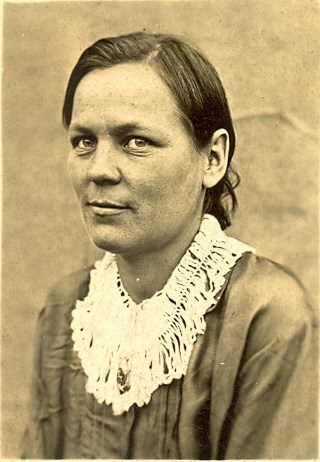
bedside on December 12, 2014. She was born on May 6, 1916 in a log house with a thatched roof upon which storks built their nests in Jurelov, a little village in eastern Belarus not too far from the Ukrainian border. The seventh of eight children born to Larion and Pollyheya Bychocov, she grew up in a time of terror and turmoil in Belarus.
When the invading armies came through during WWI, her family and neighbors buried their belongings and went into the woods to hide carrying the infant Marfa with them. After completing the second grade, Marfa stayed home to tend her family’s flocks in the meadows and learned to spin, weave, and sew as well as how to garden, bake bread, gather the rye, and wash clothes on a stone in the river. As a teenager, her mother taught her to give what she could to those starving and near death fleeing the famine Stalin imposed upon the Ukraine. When the hungry knocked on their door begging for food, she always gave them something even if it was only a slice of bread.
In time, the purges came to Belarus and Marfa watched as friends, family, and neighbors disappeared into the night taken away in “black ravens” by the police never to be seen again. Her father was a prison sentence for not producing enough flax. When he hid in the forest to escape imprisonment, her brother Efim was sent to prison in his father’s place. Her brother Samuel escaped from a Siberian prison. Asked to join a collective, Marfa and her sister Marusha refused. As punishment, they were ordered to cut down a massive number of trees in a forest. They were saved from Siberia by their family and friends who came together to harvest the timber for them. The family survived famine only by burying bags of rye in the ground so that the government could not find it when they came to confiscate the grain they had planted and harvested.
During WWII, Hitler’s occupation brought yet more terror into her life. She was seconds from death when a drunken soldier pointed his gun at her head. Her brother was able to sneak up behind him and hit the soldier with a board. She watched with horror as soldiers set fire to a barn with people hiding in it. When her family, fearful of the Communists as well as the Nazis, fled to escape the fighting and bombing, Marfa stayed behind. Lonely and scared, after a few days she set off on foot to find her family. As she traveled searching for them, she was by chance sitting by the side of the road when they
passed by her. With her family in a wagon filled with bags of rye, they rode through burning villages covering themselves and the horses with wet blankets. Marfa witnessed massive carnage as she journeyed along the road where there laid the lifeless bodies of the people and animals who had tried to run from the blind, relentless bombing at the frontline.
After they had traveled a distance, her family planted their rye seed on an empty field so that they might have food for the winter but before it could be reaped, soldiers took Marfa and many others to the railroad station and then put them into box cars headed to Germany. Upon arrival in Germany, she was taken to a labor camp where she worked in a chemical plant and received rations of half a kilo of bread per week and a bowl of soup once a day. When the war ended and the Allies entered Germany, she found herself in the British sector. With the help of the Red Cross, Marfa made her way to a camp for displaced persons in Hannover. There she met and married Ivan Sudnykovych in 1947.
In 1951, Ivan and Marfa immigrated to the United States. At New York Harbor, they got off the USS Taylor and took their first steps on American soil on March 3rd. From New York City, they traveled by train to the farm of Charles and Donna Woodworth midway between Charlotte and Eaton Rapids, and there they worked as farmhand and housemaid. With the help of Father Donohue, they moved to East Lansing where Marfa attended the St. Andrews Orthodox Church and Ivan worked at the MSU ice rink.
In 1955, they brought their family to Albion settling in what was then a large community of immigrants from eastern and central Europe on the west side of town that had come to work at the Malleable prior to WWI. She loved to garden and bake bread. For many years, she sold raspberries and strawberries on Duck Lake Road. Marfa took pleasure in sharing bread and her garden with her friends and neighbors. They in turn shared fish, berries, wild mushrooms they had gathered, cookies and many other things with her. She always put her trust and fate in the hands of God. When the Chernobyl winds swept westward across her little village in Belarus, her faith did not waiver. When she was no longer able to attend church, Father Joshua gave her communion at home.
She is survived by daughters Maria Sudnykovych of Albion and Olga Sudnykovych of Las Angeles; son Nicholas (Margo) Sudnykovych of Vero Beach, FL; grandchildren Aleksandra Thurman of Macao, China; Nicole Sudnykovych of West Palm Beach, FL, Jaysen (Sonia) Sudnykovych of West Palm Beach, FL and Austin (Jessica) Sudnykovych of West Palm Beach; and one great granddaughter, Taylor Sudnykovych. Her husband Ivan, brother Efim and nephew Russell Raugulin preceded her in death.
Visitation for family and friends will be held Wednesday, December 17, 2014 from 5:00-7:00PM with a Panikhida Service at 7:00PM at the J. Kevin Tidd Funeral Home, 811 Finley Drive, Albion, Michigan 49224. Funeral Service will be Thursday, December 18th at 10:00AM at the Holy Ascension Orthodox Church, 810 Austin Avenue, Albion, Michigan with Fr. Joshua Fragerio officiating. Interment will be at Riverside Cemetery, Albion.
Muestre su apoyo
Comparta Un Recuerdo
Comparta
Un Obituario
Obtenga actualizaciones
Servicios
COMPARTA UN OBITUARIOCOMPARTA
- RECIBIR RECORDATORIOS
v.1.18.0