OBITUARIO
Vedat Salih Arpaci
1 septiembre, 1928 – 31 agosto, 2018
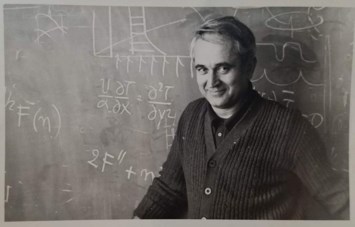
31st, after a fall. He was one day short of his 90th birthday.
Born on September 1st, 1928, in a small village on the outskirts of Istanbul,
he was the son of village grocer Remzi Salih Arpaci and homemaker Aliye Fatma
Arpaci (nee Saydamel). One defining event of Vedat's life was his father's
constant poor health; he passed away when Vedat was just fifteen years old.
Thanks in great part to his mother's love and encouragement, Vedat (on his
third try, and with a bit of luck) was admitted to the Technical University in
Istanbul, where he studied Mechanical Engineering. Vowing never to leave his
life's path to fortune again, Vedat poured himself into his work and graduated
first in his class with a Masters of Science in 1952.
After requisite military service and some time in industry, Vedat decided to
further his studies, and applied to various graduate programs in the US. He
was admitted to and began attending MIT. In his first weeks of study, he
solved a problem that had stumped his advisors for the many months. Under the
supervision of Professor Warren Rohsenow, Vedat earned a doctorate for his
dissertation work entitled "Theory of Transient Heat Transfer in Laminar Flow"
in just two years time.
After returning to Turkey to teach, various frustrations led Vedat to seek
career opportunities back in the US. He soon become a professor at the
University of Michigan in Ann Arbor, joining the faculty in 1959. Vedat was
quickly promoted, first to associate professor with tenure in 1961, and then
to full professor in 1964. He worked at the U of M until his retirement in
May, 2002, a career spanning more than four decades.
Vedat was well-known for his research in thermal-fluid sciences, and his work
had a tremendous impact in both research and educational areas of the
field. His roughly 140 published works extend well beyond thermal-fluid
sciences and penetrate deeply into underlying physics and mathematics. He also
wrote several popular and classic textbooks, including Conduction Heat
Transfer and Convection Heat Transfer (with Poul Larsen), which revolutionized
the way heat transfer is taught. In recognition of his work, Vedat received
the Heat Transfer Memorial Award, the Max Jacob Memorial Award, and Turkey's
National Medal of Science (TUBITAK). He was also named a fellow of the
American Society of Mechanical Engineers.
Vedat dearly loved teaching and mentoring of students. In his time at U of M,
Vedat advised 45 Ph.D. students who went on to occupy prominent positions in
industry and academics; one even became the president of MIT. His passion for
classroom teaching was evident throughout his career; Vedat often spoke fondly
of his time in front of students with chalk in hand. He was recognized for his
teaching with numerous departmental and campus-wide teaching awards.
Of course, family was very important to Vedat. Some time after moving to Ann
Arbor, Vedat spied a beautiful woman walking in the distance at a concert at
Hill Auditorium. He subsequently was introduced to this woman, Dr. Niara
Arabaci (a psychiatrist), who became the one and only love of his life. They
married in 1966, and had a daughter (Lale) and son (Remzi). While daughter
and son moved away, Niara and Vedat remained in Ann Arbor for the rest of
their lives, sharing a passion for classic movies and evenings on the town.
Vedat is survived by his daughter Lale (a television producer in Hollywood), his son Remzi (a professor of Computer Science at the University of Wisconsin-Madison) and daughter-in-law Andrea Arpaci-Dusseau, and two granddaughters, Anna and Madeline, all of whom he loved dearly. He is also survived by his younger sister (Vedia Dokmeci) and her son (Mehmet). Vedat was pre-deceased by his wife Niara who passed away in 2009.
He will be greatly missed.
The family will receive guests from 2:00 - 4:00 p.m. on Sunday, September 16, at Muehlig Funeral Chapel, 403 S. Fourth Avenue, Ann Arbor 48104
Please share a memory of Dr. Arpaci with his family at: www.muehligannarbor.com
Muestre su apoyo
Comparta Un Recuerdo
Comparta
Un Obituario
Obtenga actualizaciones
Servicios
COMPARTA UN OBITUARIOCOMPARTA
- RECIBIR RECORDATORIOS
v.1.18.0