OBITUARIO
Bruce August Flatin
29 mayo, 1930 – 22 octubre, 2022
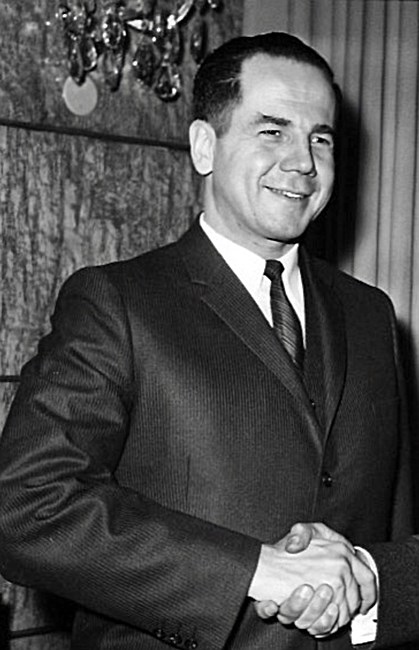
Diplomat, husband, father, historian, traveler, cowboy, sailor, soldier, ad man, beekeeper and storyteller, Bruce led a remarkably colorful and rich life. He was born on May 29, 1930 in Minneapolis, Minnesota to Oscar and Lila Flatin (née Knuti). He dearly loved his childhood, forged by a happy life in Minneapolis, and long summers with his Norwegian-American family on their farm in Spring Grove (Southeastern Minnesota) and his Finnish-American family on the Iron Range (Northern Minnesota). Bruce graduated from Saint Louis Park High School in 1948 and began on an exciting and rewarding life of international travel and adventure. The summer before starting college, Bruce worked as a sailor with the US Merchant Marine. On his way home, he and his close friend, Paul Reese, hitchhiked from Seattle, Washington to Laramie, Wyoming, and then rode on horseback 822 miles to return home to Minnesota. Their ambitious trip caught the attention of local print and radio media, which tracked their progress home. The Minneapolis Star Tribune called them “The Sailors on Horseback". Bruce then attended the University of Minnesota, graduating in 1952 with a B.A. in History, magna cum laude. He was also inducted as a member of Phi Beta Kappa. Bruce was later awarded an M.A. in International Relations by Boston University.
In 1953, during the Korean War, Bruce volunteered to join the US Army. While his entire combat unit was sent to Korea, he avoided that fate because of his fluency in German, and was sent instead to occupied Germany as a translator. Thinking this decision to study German may have saved his life, he later required his children to study German as well.
Shortly after returning from his military service in 1955, Bruce met the love of his life, Jeanne Kathryn (Kay) Johnson in a history class at the University of Minnesota. They married on August 19, 1955 in Kay’s hometown of St. Paul. Bruce frequently made light of the cultural gap between his Minneapolis upbringing and Kay's St. Paul roots. For Bruce, family was always paramount, and not just his nuclear family, but also the ties that ran all the way back to the old country.
After a brief stint as an advertising editor for Honeywell, Bruce joined the US Foreign Service, and was promptly assigned to the Embassy in Kabul, Afghanistan from 1957 to 1959. This Kiplingesque experience in the “Hermit Kingdom” only fueled his appetite for more travel. The next stop overseas was Sydney, Australia from 1961 to 1963 at the US Consulate General. Over the two and a half years there, he made many life-long friends.
After Sydney, Bruce was assigned to Berlin, Germany (then 100 miles East of the Iron Curtain) in the US-occupied sector as Chief of Public Safety, working closely with the West Berlin police and overseeing all security matters. This time interval, 1964 to 1969, was during some of the most anxious days of the Cold War. Bruce was on the front lines of many sensitive and important challenges for the United States, for Germany, and for Western democracy, including managing prisoner exchanges with East Germany at Glienicke Bridge, aka the “Bridge of Spies”, and overseeing security for President Richard Nixon’s visit in February 1969. He was very pleased to be a part of history that ultimately led to the reunification of Germany in a peaceful fashion.
Upon completing his rotation in Berlin, Bruce was assigned to work at the State Department in DC as Director of the Operations Center, a communications hub for overseas operations. He then served as a desk officer for Austria, Switzerland and Liechtenstein. Following this, Bruce spent a year at the National Defense University.
Like bookends, Bruce's final overseas post was again Kabul, Afghanistan, from 1977 to 1979, where he returned to find the country much changed by Soviet influence. Afghanistan became particularly perilous when a bloody, Soviet-backed Communist revolution broke out in the spring of 1978. Separated from his family during the 3 day coup that toppled President Da’ud and his government, Bruce kept in touch with them via short wave radio from the embassy. The violence escalated again on Valentine’s Day, 1979, when Bruce’s boss, US Ambassador Adolph (Spike) Dubbs, was kidnapped at gunpoint and held hostage at the Kabul Hotel. Bruce was the negotiator for the US that day, working with the police and military who surrounded the hotel along with their Soviet security overseers. He spoke to the Ambassador in German, a language his captors didn’t know, through a keyhole of the hotel room in order to assess the Ambassador’s situation. Sadly, the Ambassador died in a hail of bullets as the police stormed the room. That summer, all non-essential US personnel were evacuated, and Bruce remained with a skeleton crew manning the Embassy. He helped shut down the Embassy in November 1979 and returned stateside.
Back in the US, Bruce led the State Department’s Narcotics Bureau, and was later made Director of Refugee Resettlement, responsible for refugee operations around the globe. Bruce closed out his career as a member of the Board of Examiners, interviewing new candidates for the Foreign Service. He relished this assignment, impressed by the quality of people, from all walks of life and ethnic backgrounds, who were seeking to serve this country as diplomats.
Bruce loved to share his appreciation of literature and history with his children, reading from classics like Frank L. Baum's Wizard of Oz stories, histories of Scandinavia, England, and Asia. Bruce is also remembered by his children for his choice to include them in his world adventures. At each foreign post he brought his family with him, and ensured that they all experienced the culture of each country to the fullest.
Bruce’s grandchildren will remember his legendary stories, his wide-ranging interests, his joie de vivre, and his pride in them as he encouraged them to pursue their passions.
Bruce is survived by his loving and supportive wife, Kay; their four children, Heidi, Daniel (Amy), Mark (Barbara), and Paul (Terri); their nine grandchildren, Anne (Alex), Christopher (Jessica), Grace (Michael), William, David, Sarah, Paul, Lachlan, and Ainsley: and six great-grandchildren, Corbin, Lucy, Arthur, Peter, Owen and Jacob; Bruce’s sister, Carol Gildner; nephews Greg (Barbara) and Scott (Laurie) and many beloved cousins. A service will be held on November 11, 2022, at Faith Lutheran Church in Arlington, Virginia. Bruce’s cremated remains will be interred at Arlington National Cemetery.
In lieu of flowers, donations to the Lutheran Immigration and Refugee Service (https://www.lirs.org) would be appreciated.
Muestre su apoyo
Comparta Un Recuerdo
Comparta
Un Obituario
Obtenga actualizaciones
Servicios
COMPARTA UN OBITUARIOCOMPARTA
- RECIBIR RECORDATORIOS
v.1.18.0