
OBITUARIO
Douglas E Beecroft
18 febrero, 1927 – 17 octubre, 2023
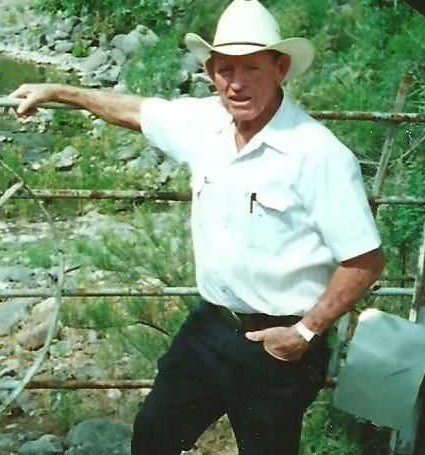
Douglas E Beecroft, 96, of Chandler, Arizona, passed from his mortal life unto the next life on October 17, 2023. He is now able to joyfully dance with his wonderful wife, Patricia Beecroft, who passed Nov 25, 2019. They have three children: Earl Beecroft, Charles Beecroft, Diane Beecroft, eight grandchildren, and several great-grandchildren. The last of eleven children, Doug was born Feb 18, 1927, in Douglas, Arizona, to wonderfully kind parents, Robert C. Beecroft and Nancy Edna Buchanan Beecroft, who never made an unkind remark to each other. Having that as an example, he knew no other way. He was a gentle, humble, dry-humored man who was always quietly singing or whistling almost until the day he passed. His last spoken words two days before he passed were him singing “(How Much Is) That Doggie in the Window?” (And, yes, he loved animals.) He was still whistling a tune until he dropped off into a long nap the day before he died. The last few years, he was able to reminisce almost daily with family about all the family happenings over his lifetime. Even two weeks before he passed, he talked about what a wonderful privilege life is, and how wonderful every aspect of his life was.
While in the process of his passing, a friend told him the following, “You are one of my best friends, ever, Doug. You are one of my favorite people ever. I love you, Doug. I love the wonderful times we had together and look forward to more times together.” These words could have been equally said by any member of his family, extended family, friends, or even acquaintances.
He never felt the need to travel as he always felt that where he lived was the most beautiful place in the world, whether it was the ranch north of Bagdad, AZ, Roll, AZ, or Chandler, AZ. It was the most beautiful place in the world because he worked hard to make it the most beautiful place in the world with his planting of trees, flowers, immaculate yard work and always taking time to fix anything that broke. Doug was the perfect example of “Bloom where you are planted”. He appreciated the beauty of the desert. His favorite spot when he was a teenager was taking a drive to and being at Canyon Lake. He had been introduced to the area because of his father. His father had been one of the original people who bulldozed the Bush Highway on the way to Saguaro Lake. Doug always said, “If you don’t like Bush Highway, blame my daddy.”
When he graduated from 8th grade, his parents gave him seven milk cows for him to milk every day and take care of to teach him many lessons and provide him with what he would need to prepare himself for high school, college, and then a down payment on a farm, which was then used as a down payment on a ranch. The owning of the cows then created the need for him to move to somewhere where he could keep the cows. Consequently, as an incoming freshman in high school he moved from his parents’ home just south of the Mesa Temple to his sister and her family’s place in south Chandler. They had a dairy which enabled Doug to run his cows with theirs. Doug being the last of eleven children meant most of his nieces and nephews were around his age. The family relationships developed with his nieces and nephews during his high school years were priceless and held firm over their lifetimes. He was the most favorite “Uncle Doug” in his high school or anywhere else. He bought his first car at age 14 to be able to have time to milk the seven cows before school, drive to Chandler High School, and then home after school to milk the cows at night. His nieces and nephews loved to pile into the rumble seat of his car so Doug could drive everyone down Arizona Avenue to school.
After high school, Doug attended the University of Arizona where he met his future wife and life-mate. They first made eye contact in a class they had together. She was the only girl in the class of 40 students, and Doug always said that she was the prettiest girl in class (Doug’s words). But they were both too shy to say hi to each other, so their friendship had to wait. Doug graduated in 1949 from the University of Arizona with his BS and became the Manager of Milk Processing in the Dairy Department at the university. This was interrupted by being called into the Korean Conflict in 1950 where he served for a little more than 18 months. When the need arose, he volunteered to be the Forward Observer in his Heavy Morter Company, 180th Regiment of the 45th Infantry Division. He had risen to the rank of staff sergeant in a very short time due to the needs of his Infantry Division.
After his military service, he returned to his job in the dairy department at the University of Arizona. By this time Patricia had graduated with her master’s degree in animal science. While they both had jobs at the U of A, Doug officially met Patricia when friends that had been invited over for dinner, brought Patricia with them. Three months later in 1953 Doug and Patricia decided two could live as cheaply as two (Doug’s words) and were married, quit their jobs, and bought a farm in Roll, Arizona. It was here that their three children were born and raised learning their many life lessons taught by example and sealed with love.
In the early 1960’s, when farming was starting to look up and cattle ranching started taking a turn for the worse, they sold the farm and bought a ranch (Doug’s words) north of Bagdad, Arizona. During this time of farming and then ranching, Doug’s full-time job was as a zanjero for the Wellton-Mohawk Irrigation District and Patrica taught math and science at Mohawk Valley Elementary School. On their days off from their paying jobs, they then worked twice as hard at the cattle ranch. With this limited time (two days a week) to do all the ranch duties a rancher has to do, Doug had to figure how to be the most efficient with his time. He bought a 4-seat Cessna and with a few lessons from a plane mechanic, taught himself how to fly. Doug would park his plane in his pasture at the house in Roll. When it was time to make the flight, he would take off on the county dirt road near his house and make the one-hour flight to the ranch on upper Burro Creek and land on the dirt airstrip on a mesa. Since this dirt airstrip was the only rock-free portion of the mesa, the cows and the antelope loved to sleep on the “soft” dirt airstrip, which always necessitated Doug having to “buzz” them first before he landed. After his ranch-hands (his three children) grew up and moved on to their own lives elsewhere, Doug and Patricia decided it was time to sell the ranch. Lessons of a lifetime for Earl, Charles, and Diane had been packed into the short 18+ years of owning the ranch: fixing fences, fixing roads, taking care of the horses, roping, branding, and herding cattle, and learning to love and treat the outdoors with respect.
The acquaintances Doug and Patricia made in Roll (due to their jobs and their activity in the Church of Jesus Christ of Latter-day Saints) soon became close friends because of the love and selfless service they all did for each other. Besides Doug serving decades in the various capacities within the congregation, he also wanted the church building and grounds to stay well kept, so once a week for several decades he would help in cleaning the building and being the groundskeeper (bringing his children along to help when they were at home). After living in Roll for over 57 years, Doug finally retired at the age of about 84 after 57 years on the job from the Wellton-Mohawk Irrigation District. It was then Doug and Patricia moved to Sun Lakes to live closer to their children and grandchildren. The wonderful Wellton-Mohawk community they had called home for so many years, came out en masse to give them a going away party, which turned into a Celebration of Life party, just without Doug and Patricia having to die to be able to enjoy the Celebration of Life party.
Whatever community Doug and Patrica were in, their legacy in their own humble quiet ways, stood out by never trying to “stand out”, but just to love and appreciate everyone. The name of their ranch, the “Loving U Ranch” could not have been a more appropriate phrase for who they were.
Even later in life, Doug’s standards stood firm. He was still the happy, polite, cowboy-hat wearing guy that was always quietly singing as he was walking around which led others to join in with him quite often, even when the song was “I’m an Old Cowhand (From the Rio Grande)”. Everyone loved him.
A few weeks before he passed, Doug was asked why he volunteered to be the Forward Observer when in the military, and he promptly said, “Someone had to do it.” This would explain why whether he was near enemy lines in a fox hole in the dead of winter in Korea, fixing a road, cleaning buildings, maintaining his yard, shoveling canal banks, shoeing the horses, helping farmer friends during the Great Flood of ‘93, or helping with the taking care of his beloved wife the last few years of her life, he was always the first one in line to do the job.
The family is planning a small private graveside service.
Muestre su apoyo
Comparta Un Recuerdo
Comparta
Un Obituario
Obtenga actualizaciones
Servicios
COMPARTA UN OBITUARIOCOMPARTA
- RECIBIR RECORDATORIOS
v.1.18.0