
OBITUARIO
Ruth Sumiko Ikeda
21 diciembre, 1920 – 8 abril, 2023
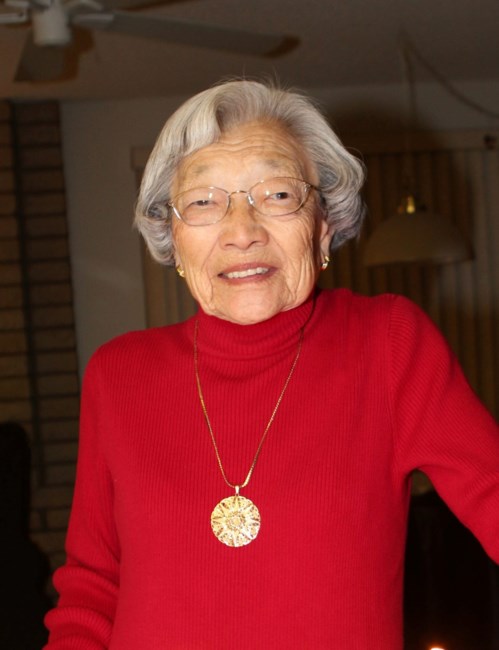
Ruth Sumiko Matsuzawa Ikeda was the second child born to Izumi and Tokuhei Matsuzawa, immigrants from Nagoya, Japan. Tokuhei married Izumi, his chosen “picture bride”. On December 21, 1920, they gave birth to Ruth Sumiko Matsuzawa in Pasadena, CA.
Ruth completed her primary and secondary education at local schools, then attended Pasadena Jr. College. After college, she visited relatives in Nagoya, Japan, until her cousin advised her to return home due to the threat of war between Japan and the U.S.
Ruth’s social life centered around the local church. (Pasadena Union Church, currently called First Presbyterian Church of Altadena). The Matsuzawa parents and Ruth’s younger sister, Mary, lived at 872 Winona Avenue in Pasadena until her father was able to purchase a nursery at 804 Lincoln Avenue in 1931. This became their home and nursery business. Other than church, she and friends swam at Brookside Park on Tuesdays, the day designated for non-Caucasians. She also took piano lessons, sang, taught Sunday School, played tennis and worked at the family nursery. Ruth’s mother taught Ruth to sew, a skill that would be enjoyed by the family’s women.
Ruth was introduced to Carol Kazuo Ikeda, a young man studying chemistry at Cal Tech. They married just prior to World War II. In 1942, the United States entered the war with Japan and President Roosevelt signed Executive Order 9066 relocating all persons of Japanese ancestry from the west coast to incarceration camps inland.
The Matsuzawas and Ruth were taken to Tulare, CA, one of 15 temporary assembly centers. Since Ruth was pregnant, she stayed in Tulare until she gave birth while the rest of her family were interned in Arizona. Alone and pregnant, she recalls, “You just don’t think about it.” Once Ruth gave birth, she and her newborn, Karren, traveled to Gila Bend Internment Camp to join the rest of the family. At the camp, she, the baby and her parents and sister shared a single room in one of the barracks.
Under the guidance of Dr. Linus Pauling, Carol was accepted at University of Wisconsin, but at the last moment, was denied attending due to recent military contracts awarded to U of WI. He was next accepted at University of Nebraska, where he took several odd jobs, requisite for getting Ruth out of camp. Again, alone, Ruth and her baby traveled all night with no food or clothing to Lincoln, NE. She states, “You do what you have to do.” Carol graduated with a PhD in Chemistry and was hired by DuPont de Nemours in Philadelphia, PA. Here, their second and third children were born. After overcoming some initial antipathy toward Japanese Americans, they finally purchased their first home in Pennsylvania. Ruth’s parents returned to their nursery business in 1951, and became U.S. citizens in 1954. Ruth’s sister, Mary and her husband, Henry Takemura, took charge of the nursery around the same time. The Lincoln Avenue Nursery is still at its original location, 804 Lincoln Avenue, Pasadena, CA, but under different ownership.
Ruth was quietly confident in all she did. “You just did what you had to do.” She devoted so much time to her kids’ activities, household maintenance and creating family traditions. She was talented and always busy. One of Ruth’s most notable abilities was sewing. She would downplay her proficiency, but she was a skilled seamstress. Between her 85th and 87th birthdays, she made 2 custom-made wedding dresses to the joy of the family brides.
Once her three children went off to college, Ruth went to work at neighborhood high schools until Carol retired from DuPont. Ironically, they would retire 35 miles from where they were incarcerated. Shortly after they moved to AZ, President George W. Bush issued an apology and reparations to the Japanese American citizens who were interned during the war.
After many trips overseas, they decided to compete their visit to all 50 states by going to Alaska, Unfortunately, Carol became quite ill, and was ultimately diagnosed with pulmonary fibrosis. He lived five more years with Ruth as his devoted caregiver until he passed away in November 1994. Ruth faced new challenges as a widow, “You do what you have to do.” That determination! Ruth continued to socialize with friends and spend time with her two daughters and their families, who relocated to Arizona. Holiday meals and traditions were revived at Ruth’s home with home cooking as the highlight. When asked how she maintained her weight on her slight frame, she always replied, “Moderation, I believe in the moderation diet.” This elicited many groans!
The family celebrated her 80th, her 88th and 90th birthdays as if no time had passed. At age 91. Ruth decided she wanted to move to Mountain Park Senior Living in Ahwatukee. There, she renewed old friendships, made new acquaintances, and celebrated her 100th and 102nd birthdays in style. She participated in tai chi, crafts, bell choir, and other community activities for 12 years and survived the pandemic with no problem. On April 8, 2023, Ruth Sumiko Matsuzawa Ikeda, age 102, completed her journey In Phoenix, AZ. Ruth is lovingly remembered as mother, grandmother, and great grandmother to: Karren Ikeda Wood, Stewart Asa Ikeda, Patricia Ikeda Carper; Stewart David Ikeda, Gillian Cara Wood, Keith Donald Wood, Mariana Carol Carper; Ronen Oren-Ikeda, Josephine Anne Wood and Oscar James Wood, Bernadette Ruth Wood.
Her ashes will rest next to her husband of 53 Years, Carol Kazuo Ikeda, at the Valley of the Sun Cemetery and Mortuary in a quiet, but warm gathering. At Ruth and her families’ request, memorial donations may be sent in her memory to: First Presbyterian Church of Altadena, 2775 Lincoln Ave., Altadena, CA 91001; The Japanese American National Museum, 100 N. Central Ave., Los Angeles, CA 90012. The family wishes to express thanks for the cards and, especially, the personal memories and thoughts expressed about Ruth.
Muestre su apoyo
Comparta Un Recuerdo
Comparta
Un Obituario
Obtenga actualizaciones
Servicios
COMPARTA UN OBITUARIOCOMPARTA
- RECIBIR RECORDATORIOS
v.1.18.0