
OBITUARIO
Maurice E. Leiter
16 enero, 1933 – 8 junio, 2020
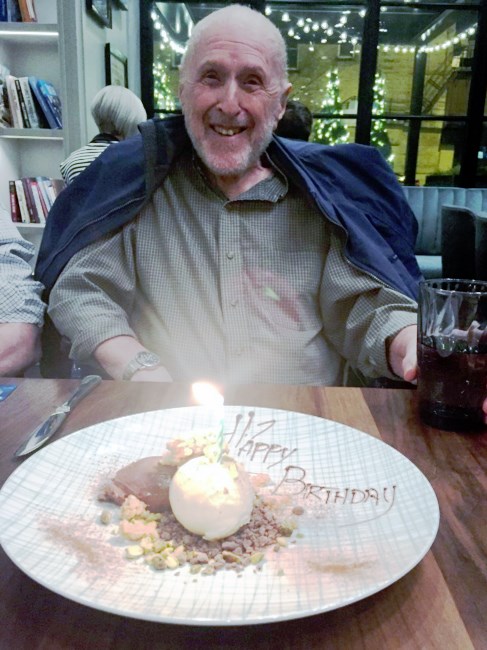
A memorial by Brian Leiter
Maurice Leiter was born January 16, 1933 in Brooklyn and died June 8, 2020 in Chicago from complications due to COVID-19. He is survived by his son Brian, daughter-in-law Sheila, and grandchildren Samuel, William, and Celia, all of Chicago; and his son David and daughter-in-law Jessica, of Miami.
My father was raised as a Jew--his mother's family had fled the Cossacks in Eastern Poland/Russia, who had the habit of forcibly conscripting teenage boys into the czar's army--but he became an atheist at the "age of 4" he told me. Perhaps that was an exaggeration, but probably not far off the truth. He was ill-suited to religion constitutionally: it was an offense against self-respect, among its many other problems. He retained throughout his life fond memories of walking his aged grandmother to and from Yom Kippur services, although he himself never subjected his children to religious indoctrination rituals of any kind.
His father, Harry Leiter, abandoned him and his mother, Rose (nee Harris), when my father was still fairly young (roughly age 9). Harry Leiter fled to Los Angeles some time thereafter, and my Grandmother Rose took my father to Los Angeles for a year during WWII (again, the dates are a bit unclear), hoping to find Harry, or so my father believed. They returned to Brooklyn after a year. Harry Leiter was never accounted for again. There are no just rewards for goodness or wickedness, as the German philosopher Nietzsche often noted, but we sometimes wonder what happened to that cruel and selfish man who abandoned his child.
My father’s mother, Rose, was the youngest of six (to the best of my recollection), the others all boys (hence the need to flee the Cossacks!). Uncles Sam, Max, Joe and Harry in particular stepped in as surrogate fathers to my father. Rose worked hard to support her family; my father always remembered with appreciation (and amazement) the car she bought him when he graduated college. My father graduated from Abraham Lincoln High School in Brooklyn, and went on to Brooklyn College. His life revolved around baseball, radical politics, classical music, literature, and philosophy, which he studied at Brooklyn College.
In the 1950s (after college) and into the early 1960s, my father bounced around between one thing and another, the details are not entirely clear to me. He spent time in Greenwich Village listening (live!) to Charlie Parker; attended the protests of the execution of the Rosenbergs in Union Square (facing down the mounted police in the process); worked in a mailroom with the actor George C. Scott before he had his big theatrical break; taught in the public schools; wrote poetry; and studied English as a graduate student at NYU, where he ultimately wrote an M.A. thesis on the poetry of Gerard Manley Hopkins. The birth of his first child (me) in 1963 necessitated his earning a more regular income, and so his teaching in the public schools in NYC became his primary activity (he had started teaching in the schools earlier, I'm not sure exactly when). When my father (and mother) first started teaching in the public schools in the 1950s, schools were run by principals like personal fiefdoms, with hiring and promotion decisions made arbitrarily based on the whims of the local dictator. The United Federation of Teachers ("UFT"), the teacher union in NYC, changed all that during the 1960s.
My father participated in the Brownsville strikes of 1968, and eventually became a "district rep" for the UFT in Bensonhurst (Brooklyn) during the 1970s. (Besonhurst was then, and for many years after, a Mob stronghold. One thing my father often did was help families with school transfer issues within the district; one appreciative parent said to my father, "If you ever need someone's legs broken, let me know." He did not have occasion to take him up on the offer.) He continued to teach English at New Utrecht High School in Brooklyn, the school featured in the opening clips of the 1970s sitcom Welcome Back Kotter. (My father also gave me the most important advice I ever got about teaching: "never assume.")
My father was a courageous person with unshakeable confidence and self-respect, who never retreated from a fight or wrongdoing. I'll just give a few examples that stand out in my memory and will perhaps give some flavor of the person.
When I was a small child in Manhattan, my father would have to look for street parking in Manhattan when he came home from work. One evening in the late 1960s, while parking the VW Bug, he was accosted by two men, one with a handgun. They demanded he take them to his apartment. He declined, since that was where my mother and I were. They then forced him into the car and made him drive around. As an empathetic working-class kid, my father started to talk to them, asking them about why they had resorted to robbery. It turned out they had both been laid off, and were desperate. They drove around for about an hour, as they unloaded their story of hardship. In the end, he offered them what money he had on him, but they declined, left and let my father go home.
In the late 1960s, the American labor union movement, under the influence of George Meany, lined up behind the then-current U.S. war of aggression, the Vietnam War. At the annual meeting of the American Federation of Teachers, members were instructed to vote in favor of a resolution supporting the Vietnam War. There were roughly 500 members of the New York delegation; there was one 'no' vote, by Maurice Leiter. Despite the defection from the union leadership on the Vietnam issue, my father continued working with the UFT, where he was again the lone dissenter among the leadership from the 1975 plan--fashioned by that representative of his economic class, Felix Rohatyn--to sacrifice teachers and other public workers to save New York from bankruptcy (workers would have fared better under bankruptcy).
The way my father quit smoking is less about courage, and more about tenaciousness and willpower, although perhaps the attributes are related. Like many men of his generation, my father was a heavy smoker, often two packs per day, from his late teens onwards. Around 1981-82, he decided to quit (if he hadn't, this memorial would no doubt have been written many years earlier.) And he decided to quit cold turkey: he simply stopped. He would leave home early in the morning for his commute to Manhattan. He would get to his office at the UFT, go into his office with the lights out, and put his head on his desk. He would then have to resist what he called "the little man" in his head who kept suggesting having just one cigarette. After defeating the "little man," he went about his day. Although he had residual C.O.P.D. from the decades of smoking, by around 2010 his risk for smoking-related illnesses was no different than an ordinary person's.
My father retired from teaching and union work in the mid-1990s. In 2001, after I had turned down a job offer in favor of staying at the University of Texas at Austin, I encouraged my father to move to Austin to be near us and his grandchildren. (My father and mother were by then long-divorced.) Austin suited my father in certain ways (although see this charming poem)--mild winters especially--but most importantly because of the time he got to spend picking up grand-kids from school, getting them to after-school swimming or sports, taking them to book stores (he must have bought them hundreds of books over the years), reading them books, going out for lunch or snacks, or just minding them at our house until we got home. My father, always prone to pessimistic assessments, thought he would die around the time he turned 70. But as he often said of his grandchildren, “they keep me alive,” and they did indeed keep him alive, and deeply happy, well beyond that.
When we decided to move to the University of Chicago in 2008, there was no question about my father staying behind in Austin, even though neither he nor we relished the prospect of Chicago winters. But we were able to get a very nice apartment in a university building right across the street from the University of Chicago Lab School, where all his grandchildren went. Old Austin routines continued, but with less driving: he would pick up the younger grand-kids after school, mind them in the school playground, or just bring them to his apartment after school where they would have snacks, watch a video or read books with him, and then he would drive them home; on weekends, he would take them out for Wendy's or to the Salonica diner, or to the bookstores on 57th street in Hyde Park.
As the years went on, the roles began to change, especially after my father’s atypical dementia began in 2016: his youngest grandchild, Celia, bore the brunt of this (but all the grandchildren helped enormously during the years of his cognitive decline). After school, for example, Celia would go to his apartment to remind my father to take his meds and then remind him how to drive back to our place. After he stopped driving in early 2019 (it was only the grand-kids who could persuade him it was no longer safe), the older boys would often help drive him somewhere, or help me get him to and from a dentist or doctor appointments. Throughout, he would always take great pleasure in their academic and other successes, whether college (or graduate school) admissions or a grade on a paper or a piano recital.
His whole life my father loved poetry and classical music (as well as jazz--but his collection of several hundred tapes was devoted to selections of his favorite classical music). He also had a soft spot for mystery novels and television shows. He wrote poetry while working, and even more after retiring, including revising earlier work. He had published precious little of it over the years, so I suggested he let me post it on my blog, and he agreed. I would occasionally share compliments from readers with him, although he mostly shrugged them off.
My father was, as his regular doctor said shortly after his death, a "great man" and also a "character," with a wicked and sometimes morbid sense of humor (the morbid jokes were always at his own expense.) Once he got to know people, he didn't stand on ceremony, and had little regard for pieties or formalities. For years here in Chicago, we have hosted large Thanksgiving parties, with some colleagues and friends, and always graduate students (usually those from abroad, who would otherwise be stranded). My father was invariably the "life of the party", regaling them with stories, jokes, and suitable displays of disrespect for political and other villains.
My father was famously gregarious quite generally, talking to everyone, everywhere, despite his self-professed preference for solitude. All the janitors and door-persons at his building: he knew them all, their life stories, their families, their difficulties. Give him 30 minutes with a new cleaning or repair person in the apartment, and he had quizzed them about their lives, and knew about their kids or parents, their travails or aspirations. Going to a restaurant with him could be challenging, because he would derail the plans talking with the wait staff or the car valet. Although an elitist about some matters, he was the most deeply egalitarian person I have ever known, genuinely interested in people, especially the working-class people who often pass silently beneath our upper-middle-class radars.
Maurice Leiter was a singular person, unlike anyone I have known or will ever know. We will never forget him.
Muestre su apoyo
Comparta Un Recuerdo
Comparta
Un Obituario
Obtenga actualizaciones
Servicios
COMPARTA UN OBITUARIOCOMPARTA
- RECIBIR RECORDATORIOS
v.1.18.0