OBITUARIO
Thomas Walter Jerardi
18 mayo, 1943 – 16 noviembre, 2024
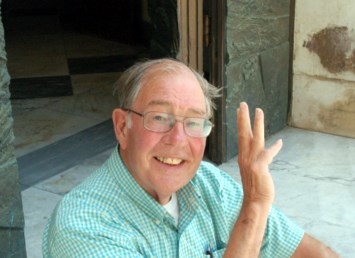
Thomas Walter Jerardi, a mathematician and engineer, died on November 16. The third son of Joseph Victor Jerardi and Mary Agnes McGlannan Jerardi, he was born in Baltimore, Maryland on May 18, 1943. He loved opera; tinkering with electronics; star-gazing; hummingbirds; and elegant mathematical solutions. He was never without a mechanical pencil nestled in his shirt pocket, a pad of Staedlter green graph paper at the ready should some equation-related thinking strike.
After graduating from Loyola High School in 1962, he pursued an engineering degree at Drexel University in Philadelphia on a lacrosse scholarship, finding there a cadre of life-long friends through the Pi Kappa Phi Fraternity. Through the newly-founded Cooperative program at Drexel, he began working at the Johns Hopkins University Applied Physics Laboratory while still an undergraduate student. Loyal to a fault, he never stepped foot into another workplace before retirement. He served as engineer in its Space Department Defense Analyses and Application Group, contributing system architecture, engineering, and analysis expertise to dozens of APL missions and spacecraft starting with his work on the Transit Program. He was particularly proud of his involvement with the Near-Earth Asteroid Rendezvous (NEAR) Program. He went on to receive a graduate degree in Applied Mathematics from Johns Hopkins University in 1976. In 2004, he was awarded the prestigious A.R.E. (Alvin R. Eaton) Award by APL for his career achievement in strategically sensitive programs.
Life changed dramatically after a happenstance night out in May 1970 at the singles bar, The Airplane in Dupont Circle, where he met Jean Litzen, his wife of 53 years. A correspondence of postcards from South-East Asia, a shared adventure in learning to downhill ski, and a stunning ruby ring led them to tie the knot in August of 1971. Dreaming of having a family, Tom and Jean decided to purchase a house in Columbia, a new planned community founded on principles of racial and socioeconomic integration, and religious tolerance. Three daughters in succession arrived into their life, forever tying up his evenings and weekends with carpooling to dance recitals, swim meets, horseback riding competitions, lacrosse and soccer games, and piano lessons. Late night tutorials with his kids’ challenging math homework brought out his sharp mind and attention to detail. Some decades later, during the Covid pandemic, his teaching acumen in mathematics led to a full, online algebra class for his grandchildren and their friends over zoom.
Not content to just help his own kids (and grandkids), he was a tireless advocate for math education and educational equity, sitting on committees to choose textbooks and update math curricula in Howard County, and frequently advocating to anyone who would listen about the important of increasing school funding to provide more holistic support for academically struggling students. After retiring from APL, he turned his attention to teaching Calculus at Howard Community College. He loved mentoring young students, especially those less represented in the engineering field, often writing recommendation letters to secure them scholarships for future study. Retirement also allowed him to return to a childhood passion for HAM radio, where he found kinship with a local community of passionate radio nerds, while programs like “Field Days” connected him to people around the globe. Retirement also gave him time to focus on his grandchildren—Maeve, Fionn, and Astrid—who brought out an infectious boyish joy in him.
Evincing his unending desire for learning, even during the last throes of his illness, a textbook sat by his bedside that outlined algebraic coding theory and cryptography. This drive to know how things go together led him to tinker for nearly all of his adult life from putting together his own Heathkit television, to homemade antennas, to making Raspberry Pi devices. Long before ‘maker culture’ became a thing, he embodied a DIY ethos and was part of a revolution in computation and technology that would lead to the internet.
He lived with neuro-endocrine tumor for three and a half years and made the most of every day. The family would like to thank his caregiving team, particularly Sandy Kotiah, M.D., and Holly Freeman, APN, of the Neuroendocrine Tumor Center at Mercy Medical Center in Baltimore, MD; Michelle Price, MD, of Maryland Primary Care Physicians; Caregiver Erin Reichle and Visiting Angels Jeremiah Nelson, Aisha Daily, Memory Mutesva, Maryama Jalloh, and Adams David; as well as Kelly Kowalczyk of Gilchrist Hospice.
He is survived by his wife Jean Litzen Jerardi, daughters Maria (Doug), Jane, Angela (Carl Johan), grandchildren Maeve, Fionn, and Astrid, and brothers Joseph (Nancy) and Richard (Karen). His older brother Jack preceded him in death in November of last year.
In lieu of flowers, the family requests donations be made in Tom’s honor to a memorial Math Scholarship at Howard Community College or to the Neuroendocrine Tumor Center at Mercy Medical Center in Baltimore. Details can be found at: https://www.janejerardi.com/tomjerardi
A funeral mass will be held at noon on December 13, 2024 at St. John’s Evangelical Church at the Wilde Lake Interfaith Center in Columbia, MD.
Muestre su apoyo
Comparta Un Recuerdo
Comparta
Un Obituario
Obtenga actualizaciones
Servicios
COMPARTA UN OBITUARIOCOMPARTA
- RECIBIR RECORDATORIOS
v.1.18.0