
OBITUARIO
Ed Gillespie
28 julio, 1928 – 9 julio, 2015
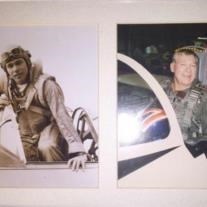
Ed Gillespie, 86 of Gahanna, Ohio, a highly accomplished aviator and test pilot of many high performance military and civilian aircraft, took his final flight to heaven with an angel of God flying “right seat”, on July 9, 2015. Born in Ann Arbor, Michigan on July 28, 1928, Ed passed away July 9, 2015. He was preceded in his death by his parents, Arthur and Rhea Gillespie, brother, Art, and son, Allan Gillespie. A licensed pilot at age of 16, he joined the US Navy at 17 and was accepted into the Navy flight training program. As a carrier based fighter pilot during the Korean conflict he flew many combat missions in service of his country. Passing on an opportunity to join the Blue Angels, he entered Test Pilot Training school where he graduated in 1956. He remained in the Navy Reserve where he retired at the rank of Captain after 26 years of additional service. In 1956 he took a position with North American Aviation, Columbus, Ohio, where he was employed for 30 years, retiring as Chief Test Pilot for Rockwell International. With over 15,000 flight hours primarily accumulated in short, intense flights in single cockpit high performance aircraft, in over 100, jet, rocket, recip, helo and turbo prop military aircraft, his record of aviation accomplishment during his long career is matched by very few, living or dead. Skilled, smart and courageous, he would often describe his most harrowing flight events later simply with: “piece of cake.” Aviation was his passion and the many people he knew that were involved with its history and operations, he proudly called his best friends. His very proud and loving surviving family is his ex-wife and lifetime dear friend, Janette; sons Scott and Dan and daughter Devon Hattey; grandchildren Lauren, Ian and Savannah, and great grandchildren Henry and Cian. Ed’s deceased son, Allan, is surely meeting with his dad now to plan a new adventurous trip that they both so loved. Memorial services will be held at 5:00 pm Saturday, July 18, 2015 at the Schoedinger Northeast Chapel, 1051 E. Johnstown Rd. (at Beecher Rd.), Gahanna, Ohio 43230 where family will receive friends from 2:00pm to 5:00pm. In lieu of flowers the family asks that a donation be made in the memory of Ed Gillespie to Capital Area Humane Society, 3015 Scioto-Darby Executive Court, Hilliard, OH 43026; Or to: Navy-Marine Corps Relief Society, Attn: Development 875 N. Randolph St. Ste 225,
Arlington, VA 22203.
It has been 66 years since Ed Gillespie logged his first flight in a Navy airplane. That was an SNJ at North Whiting Field, FL in March 1949. On July 9, 2015, Ed Gillespie passed away at home after telling his family he had the most wonderful, thrilling life and that he was looking forward to this next exciting adventure he knew he was about to take.
Ed first soloed in September of 1944 at a small airfield near his hometown of Ann Arbor, MI. Ed was a recognized high school athlete who excelled in swimming, football and track. He was always physically active and as much he enjoyed participating in various sports, flying was his true passion. He enlisted in the US Navy’s Aviation Midshipman Program while still a 17-year-old in high school. After schooling in Engineering, at Syracuse University and Western Michigan University, he began Navy preflight training in the summer of 1948 with over 200 civilian flight hours already logged. He completed flight training without a “Down” and carrier qualified in SNJ’s and F4U Corsairs aboard the CVL’s USS Wright and USS Cabot. He was awarded his Wings of Gold, in May of 1950 and was selected to attend Jet Transitional Training (a choice assignment in those days), while still a Midshipman. The airplanes utilized were single-seat TO-1’s (Air Force P-80 Shooting Stars) as there were no two-place jet trainers at that time.
Fleet duty as carrier based F2H Banshee pilot, Ed covered several oceans and as many ships during the next three years, including 80 combat missions in Korea. As the high man in the F2H he also served as technical director and pilot for four USN training fly on to fly the Banshee. This assignment almost cost him his life during filming of an intentional inverted spin when he finally regained level flight barely above the ocean. At that time he was still so naïve that he didn’t know the contractor had not yet successfully tested inverted spins in this airplane!
After three years of squadron duty, Ed was offered the very envious choice of either joining the Blue Angles or attending the US Navy Test Pilot School (TPS). He decided it would be better for his career to know more about aerodynamics instead of joining the air-show circuit, and subsequently graduated in TPS class Eleven in early 1954. From there on Ed was test flying continuously until he was in his 70’s. Ed flew every propeller or jet attack / fighter airplane in the navy’s inventory while serving as a test pilot at the Naval Air Test Center. An example was the infamous F7U Cutlass. Before it entered the fleet, Ed was one of the high time USN pilots in the unusual fighter. Unlike some of the other pilots, he almost began to enjoy the airplane and he believes that it’s rugged airframe later saved his life on at least two occasions.
Following his 1956 graduation from the USN Line School in Monterey, CA, Ed left active duty Navy and began to work for North American Aviation in Columbus, OH as an experimental test pilot. He found that he still had to deploy regularly as more than half his time was spent flying contractor test flights at NATC Patuxent River, NATF Lakehurst, NAWC China Lake, Edwards AFB, or NASWF Albuquerque.
In 1964 he applied for the Astronaut Program when it first opened to civilians but was disqualified because he was few months older than the maximum age limit, which was 36 at the time. That year he also became the Chief Test Pilot at North American Aviation, unfortunately due to the tragic death of one of his best friends during a test flight. For the next 24 years Ed continuously performed almost daily experimental flying in all series of Trojans, Buckeyes, Furies, Vigilantes, Savages, Broncos, Phantoms, Voodoos, and other lesser known, but just as demanding, types. Hundreds of these flights were at or approaching the structural/aerodynamic limits estimated for the aircraft. He further completed USN helicopter training and qualified in AV-8 Harriers and the X-22, both also vertical risers.
Shortly after becoming a civilian, Ed also wanted to continue to serve his country. He missed the tradition and camaraderie of the Navy. He joined the USNR and stayed active in the Reserves for the next 26 years. He eventually commanded an A4 Skyhawk, squadron, tested Phantoms at NAS North Island, performed carrier suitable tests in maximum gross weight Vigilantes at NATF Lakehurst, and instructed at the US Navel Test Pilot School as part of his Reserve commitment. His last assignments were Annual Training as the Commanding Officer of NAS Brunswick, NAS Oceana, and NAF Loges (Azores). In 1982 he retired as a Captain with 36 total years of service in the Navy.
After also retiring from North American Rockwell in 1988, Ed thought his test flying was over…thinking who would want to hire an aging test pilot? It so happened that there were jobs where experience was appreciated and he was soon employed to establish a test program and fly the structural and flutter flight tests on a major modification of the Air Force T-37. In order to satisfy the Air Force that a senior citizen could still safely fly a jet, he completed a three-month training program in the airplane at age 62. This made him the oldest graduate of pilot training ever at Randolph AFB! After two years with the T-37 Tweet, he did test work on a French designed amphibian biplane. Most of this was done while flying from Canadian lakes and seemed to be more fun for Ed than dangerous, however, two other pilots were later killed in the airplane and the effort ended. He also flew first flights in some WW1 replica biplane fighters. This lasted for another two years and proved to Ed that the airplanes of that day were indeed structurally limited, and marginally stable.
In the middle 90’s he began a lengthy flight test program on a civilian single-engine jet the BD-10J. It looked like a small F-18 and climbed like one! It was powered by a 3,000-lbs thrust engine and the airplane weighed only 4000 lbs. Needless to say it was a real screamer and provided plenty of unwanted scares and adrenaline rushes. Most of the testing was done at the Civilian Flight Test Center at Mohave, CA. Ed did all of the first flights (five different wing/tail configurations) and demonstrated the capabilities of this airplane to the US Military at several military installations. A fatal crash of a skilled, but impatient, ex-fighter pilot almost ended the program. With increased emphasis on engineering, and a steadier paycheck promised, Ed resumed testing a modification of the airplane with another company near Lake Tahoe, NV. Unfortunately, due to a mechanical failure, the president of the company was also killed in the airplane, which ended this promising program.
Ed was elected a Fellow in the Society of Experimental Test Pilots in 1977, but has never been in the right time frame or position to participate in any high visibility programs such as Space. On the contrary, he was always a work-a-day test pilot who always managed to complete the often “hairy” mundane test tasks and deliver the necessary engineering data without ever losing an airplane.
Capitan Gillespie served in the US flight test community longer, continuously, and successfully, than any other civilian or military pilot. He was very proud of the fact that he always landed every airplane that he took of in. Some were not all in one piece or they were on fire, but they all got back. Having been within microseconds of death several times during his long career, he credited his survival on a combination of good flight planning, conservative flying, moderate skill and lots of luck! Ed had 15,000 hours of flight time, most in single pilot military airplanes. He would not have traded the excitement of his flight time for any amount of other types of flying. After more than 50 years in his chosen high-risk profession, Ed has finally taken his last flight. On his final day here on Earth, Ed said to his family that he was looking forward to this next adventure and was excited to see what else God had in store for him. It comforts his family knowing that he lived life to fullest. Ed often said that he had the best life anyone could have ever asked for.
Original Article written by Capitan Jim Shaw, USN (Ret.). Wings of Gold, Winter Edition,1999. Edited by Devon (Gillespie) Hattey
Edward A. Gillespie – a career recollection (edited by son, Scott, after his demise)
As a 17 year old high school senior, I enlisted in the Holloway Midshipman program. That ONE decision later proved to determine my life’s path from then on. I had been president of every one of my classes since the sixth grade. I had been flying light planes since age 14 and held a private pilot rating. I had athletic scholarship offers from several universities, but the Navy’s offer was my choice and I thank God to this day that I made the right one. The U.S. Navy provided me the education, the technical training, and taught me the leadership qualities that later allowed me to enjoy an adventurous life, full of excitement, world travel, and public and peer recognition for my efforts.
I entered the fleet in one of the very first jet squadrons. (VF-11) and we proceeded to help standardize many of the procedures for the night and day operation of jets from the straight deck carriers. I “saw the world” from the Mediterranean to South America (first carrier around the horn), to combat in Korea. I turned down orders to the Blue Angels in favor of attending the USN Test Pilot School. My Patuxent tour enabled me to test fly just about every new airplane in the navy’s post war inventory, single and multi, props and jets. I enjoyed the challenge of test flying and in 1956 accepted a position as an Engineering Test Pilot for North American Aviation. I continued in this profession for the next 50 years. In 1974, I was selected by my peers as “Fellow” in the Society of Experimental Test Pilots. I flew high performance, single pilot jets until I was 77 and quit only because I wanted to try something different.
In 1977 (In honor of the 50th anniversary of Lindbergh’s Atlantic flight) another former naval Aviator and I made an Atlantic crossing, from New York to Paris, in a very small, 30’ (8’ beam) single engine boat. We successfully fought some horrendous storms during the 31 days it required for the crossing. It is recognized as the smallest boat of this class to ever make the voyage.
In 1986, I kept pestering the Columbus, Ohio, City Council that the original airline terminal building at Port Columbus was of historical significance. They wanted to tear it down which was their business choice due to the asbestos and PCB which was contained in the structure. Without their financial help or encouragement, I therefore undertook the restoration, using my own money. I hired several retired senior citizen friends to assist me and in the following 4 years we restored the 50,000 sq. ft., four story building to the original 1927 configuration with authentic “Art Deco” landscaping and architecture. I converted it to rental office spaces and it was later bought back from me by the Columbus Port Authority. It is now designated a National Historical Landmark. I received much publicity for “saving” this beautiful piece of history for posterity and by 2001 I had managed to recover the very costly restoration expense.
In 1964, I applied for the Astronaut Program when it was first opened to civilians but was disqualified due to being over the age limit (36), however I was made the Chief Test Pilot for NAA and became the only person to retire, still alive, having been a pilot for my entire company career. I was also appointed a Director for the B-1 program.
I became active in the USNR because I missed the people, the uniform, and the satisfaction of serving my country. USNR assignments included CO of an Attack Squadron (A-4s), instructor (several years) at the USN Test Pilot School and as the reserve CO of NAS Brunswick, NAS Oceana, and NAF Loges (Azores). I retired as a Captain with 36 years of service. Patuxent River NATC requested my occasional return to active duty to perform specialized flight tests for which they considered me to be particularly qualified. It was “nice to be needed” if only for two weeks at a time.
The following was published in Naval Aviation News:
It is believed that Captain Ed Gillespie has served the U. S. flight test community longer, continuously, and obviously successful (he is still alive!) than any other civilian or military pilot. He is most proud of the fact that he has always been able to complete his missions without losing the airplane (lots of damage though) and in the thousands flight hours in his profession, that is rare, if not a record.
This is one of my Dad’s many “sea stories”, as was relayed in a letter to a friend. I include this here to give a little taste of my father’s ability to tell funny, exciting and true stories from his exciting career
Scott Gillespie
7-11-15
Dear Roy,
Whenever I think of my time at Jax main side, I am reminded of your mentioning that when I was flying Banshee -1s and -2s, you once mentioned that you were a teenager living there, on the base, I assume, and that you used to watch us flying. Good thing you couldn't see in our cockpits 'cause we were sure inexperienced in jets and making many mistakes with our transition from Bearcats to jets.
Our skipper at the time was an old "Horse soldier" named Ralph Werner. He was a great leader and you would have liked his blunt, no messing around ways to get the job done. He had actually been in the Army’s Horse Calvary during early WWII and later had gone through Navy flight training. In 1950 I was assigned to VF-11 (Red Rippers.....another story) I was still a "flying midshipman' and he didn't know what to do with a Middie with wings. To watch me closer, I became his wingman, also due to my young good eyes and the fact that his were showing signs of his age. He was then only a LCDR and in his thirties, but he still was an old guy for a fighter pilot in those days. He was gruff, not particularly academically talented, but he was fearless and didn't take crap even from his immediate seniors. He had a mug like an oft beat-up boxer. We called him "Bull", not to his face, but I think he secretly liked the nickname. He had guts, was a rough pilot, and was an outspoken leader. Later in my career he was the detail officer for the Blues and he got me orders to join them in Corpus. At the same time I had a chance to go to USNTPS, so I more or less reluctantly went to Pax as I thought it would be better for my USN career... and it probably was.
In the fall of 1950, we flew aboard the brand new straight-deck Oriskany off Mayport which was on its way to Gitmo for initial shakedown sea trials. Their new H-8 cats were "down" so Skipper Werner told the captain that we would land, do a 180 and taxi to the deck's fantail and then, as the only airplane on the whole deck, use the whole length for takeoff.. We had practiced this on the beach and knew it could be done if we didn't fill our tips and had at least 15 knots across the deck.
The first four plane division flew to the boat and I followed the skipper around the pattern. When he took a fouled deck wave off, I continued to motor on as the LSO was giving me a steady "Roger" and I took his “cut”. Needless to say, I also took some flak from the other guys in the flight as they thought I should have let him make the first jet landing on the new boat. But I was just a dumb nugget and so therefore made the first jet landing on the "Big Risk." It was actually the 3rd landing as the ship's SNJ had made the first two the previous day. Incidentally, Skipper Werner and I (the oldest and youngest) were the only two pilots in the squadron who had any previous jet experience. He had been at Pax for a time and I got mine as a Middie going through JTU-1 at Whiting, flying single seat P-80s which the Navy called TO-1s.
In Gitmo, the H-8 cats were finally declared operational but the learning curve of the ships’ company was pretty flat. I once was fired, at night; with my engines at idle while I was bent over in the cockpit checking my circuit breakers. After jam accelerating, (eight seconds from idle to MIL). I was blowing foam when I finally got to MIL. Luckily I couldn’t see the water because of darkness but the guys on board could and they figured I was not going to stay airborne.
During the ship’s shake down the number four screw vibrated severely during flank, or even moderate speed runs. The ship was then recalled to the Brooklyn yards to fix that problem so VF-11 was off loaded and billeted in tents at Leeward Point, across the bay from mainside. Great flying and the whole squadron’s uniform was shorts, no shirts, for two months. We flew lots of night FCLPs at mainside, McCalla (about 4000’ with 60’ cliffs at both ends). In the flight pattern, we had to dodge the several blimps moored on and around the field.
By mid-February, it became apparent that the Oriskany was not going to come back for us in the near future so we were told to return to NAS Jacksonville and wait for deployment on the Wasp. Our maintenance sailors really worked and somehow got all 16 Banshees up for the mass flight home. I flew the skipper’s wing. We all rendezvoused ok and proceeded to stay VFR with cloud tops at about 25,000 in the US. After two hours we were at 35,000’ above the low freq beacon (NIP) at Jax and getting a bit “skosh” on fuel. GCA was not operating and there was no Approach Control or other radio aids then.. ..Just the tower.
The Skipper called “Jax tower, this is Accommodate One Zero One over you at 35,000 feet with sixteen Banjos. What’s your weather?”
The tower replied “Stand by Sir and I’ll get you the latest sequence”
The skipper replied with heavy voice inflection, “I don’t want to listen to you reading anything!
LOOK OUT YOUR BIG GOD DAMN WINDOW ANF TELL ME WHAT THE WEATHER IS!!”
The poor guy stammered “Well Sir the ceiling is about a thousand feet and we have light rain.”
The skipper said, “Can you see the river?”
“Yes Sir”
“Can you see the other side of the river?”
“Just barely, Sir”
“We’re coming down!”
And with that said he proceeded to make his own IRF tear drop descending approach, out over south side Jacksonville, with a sixteen plane formation to a VFR break at 250 knots, 800’ and everyone was happy ever after.
Skipper Werner was a leader but very rough!
Muestre su apoyo
Comparta Un Recuerdo
Comparta
Un Obituario
Obtenga actualizaciones
Servicios
COMPARTA UN OBITUARIOCOMPARTA
- RECIBIR RECORDATORIOS
v.1.18.0