
OBITUARIO
William H. "Bill" Johnson
11 enero, 1921 – 6 marzo, 2013
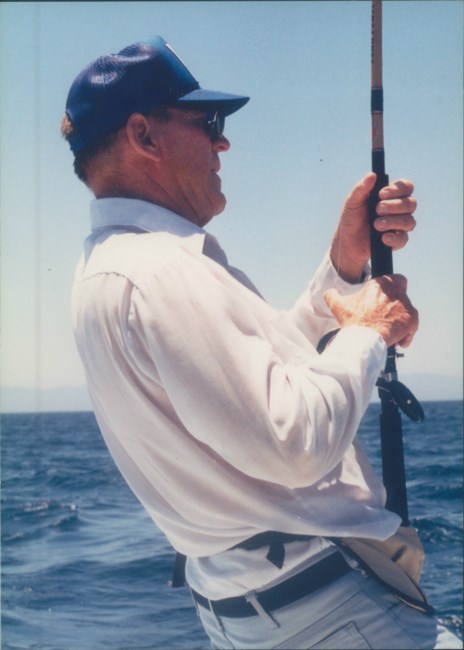
William H. “Bill” Johnson
Born: January 11, 1921
Bill was born at home on his family’s small farm in Two Harbors, Minnesota on January 11, 1921. He was the 4th, and youngest child, of scandinavian immigrant parents. They lost their first child shortly after her birth, so Bill grew up with one sister Evelyn, the eldest, now deceased, and one older brother Ed, who survives Bill at 94 years old, and still lives in Minnesota at the Scandia Shores Retirement Home in Shoreview, Minnesota. Despite the distance, Bill and Ed were very close their entire lives. Ed even went along on Bill and Clarie’s honeymoon in Lake Tahoe, CA.
Bill’s father, Henry Gustaf Johnson, was born in Finland. He was 40 years old and worked as a supply clerk for the railroad when Bill was born. He later became station master of the small Two Harbors railroad station, located on the banks of Lake Superior, where the railroad primarily transported iron ore. He lived to age 92. Bill and Clarie visited him in Two Harbors in the morning, and he passed away that same afternoon. Bill lived to the exact same age as his father, age 92.
Bill’s mother, Anna Esther Gustafson, was born in Sweden. She was 32 years old when Bill was born. She called him “Billie Boy”.
Bill’s father was very devout. He never set foot in a movie house, and considered playing cards a sinful waste of time. Bill’s mother, not so much. But she would make certain that Henry was sound asleep before she slipped out to her card parties.
The family farm was a few acres on the two-lane highway heading out of Two Harbors toward the larger port city of Duluth. What they raised on the farm, they ate, primarily. Sometimes Bill and Ed would sell surplus corn to the restaurants in town for spending money. The boys were never able to participate in after school sports because there were always cows to milk and other chores to be done at home. Consequently, they spent much of their childhood together on the farm and fishing on the creek that ran through the rear of their property. Ed loved to fish so much that Bill would often comment that “Ed would rather fish than eat”. They made their own fishing poles from twigs and made reels from empty thread spools.
The 3 kids, all in different grades, attended classes together in the same one room country schoolhouse, until a new, more conventional, school was built to serve them. The old schoolhouse was just down the road from the family farm, and the school kids all enjoyed a small deer that would often come right into the schoolhouse to visit them. One day, someone shot the deer, and Bill lost whatever taste he had for hunting after that day.
When Bill graduated from high school, he and an older friend hopped a train out of town and rode the freights all the way out to the northern Central Valley in California. When they arrived, they had about 50 cents between them, and they were hungry. They found farm work “shuckin’ sugar beets” for room and board and a little spending money. Bill stayed on to spend a season fighting forest fires in the northern Sierra Nevada mountains before catching a train back home, this time with a ticket his station master father sent him.
Northern Minnesota ranks right up there with Fargo, North Dakota as one of the coldest spots in the continental United States. Bill told a story of a local man who rode a horse drawn carriage across a frozen section of Lake Superior one particularly cold winter. The horse brought the carriage into town with the driver frozen to death, still sitting in place on his seat in the carriage. Bill never forgot how much he enjoyed the warm California weather.
When Bill returned home to Minnesota, he attended trade school and went to work as a carpenter. He traveled to Minneapolis where there was work available in the building trades. While he was there, he attended youth group activities at the local Lutheran church. He met a guy named Al Johnson who introduced him to a beautiful strawberry blond from Rockford, Illinois. Her name was Clarie. She was visiting Minnesota for the summer and it didn’t take long for a summer romance to blossom.
Bill was about 23 years old when World War II was raging and he joined the Navy. He went through boot camp at Norfolk, Virginia, and was assigned to the Construction Battalion (CBs) because of his carpenter training. He was ordered to San Diego, to await further orders to a floating dry dock somewhere in the Pacific, where he would be repairing ships damaged in the war.
Clarie was home in Rockford, and Bill called her from San Diego. That night they decided to get married and spend whatever time they had together until he shipped out. She caught the next train to San Diego where they hurriedly got married on leap day, January 29, 1944 anticipating that he would depart at any time.
Just 4 days later he got his orders. But instead of sending him overseas, the Navy ordered him to San Francisco where he was to await further orders. So the newlyweds traveled up to San Francisco where they had almost 9 long happy months together before Bill finally did ship out to a floating dry dock in Seeadler Harbor at Manus Island in the Pacific theatre.*
On November 20, 1945, Bill was honorably discharged from active duty in the US Navy.
He re-united with Clarie, who had returned to Rockford during his absence. It was a very cold winter in Illinois that year, and the call of the warm weather in California proved too intense to resist. So that winter they said goodbye to friends and family and headed to the warm weather and booming economy of Los Angeles, where Bill soon found work as a carpenter.
Bill got his contractors license, and partnered up with another carpenter friend named Fleming Astrup to establish a general contracting business. Soon they were building custom homes, apartments, and subdivisions. They called each other “Oogie” and “Lump” and they remained friends their entire lives. In 1946, they pooled their G.I. Bill eligibility and bought a small lot on a dirt road in North Hollywood in the San Fernando Valley. They worked their regular construction jobs by day, and spent every night and weekend day building a duplex together for themselves on their lot. They did every single trade themselves, just the two of them. That year Bill and Flem worked every single day except Christmas. By the end of the year, they moved in. Kids and dogs soon followed.
Bill and Clarie had 3 boys. Allen, Kent, and Bob. Bill was a deacon and one-time president of the congregation at Emmanuel Lutheran Church in North Hollywood where all 3 boys went to school through the 6th grade. Clarie raised the boys while Bill supervised construction projects all over Southern California.
In the early 1970s, Bill was tiring of commuting to projects in Orange County, and he convinced his reluctant wife to move, first to Fountain Valley, and then to Newport Beach, where he worked for the Irvine Company. They’ve lived there ever since.
February 28, 2013, was Bill and Clarie’s 69th wedding anniversary. Bill had fallen, was bedridden, and was failing, but he was characteristically thanking all of his family visitors for coming to his “going away party”. He smiled and winked right to the end. At about 12:30 pm on March 6th, he passed away at home with Clarie by his side.
Bill is survived by his wife, Clarie, his brother Ed, his 3 sons, Allen, Kent, and Bob, and his 7 grandchildren, Amber, Dane, Laurel, Natalie, Sam, Chad, and Talli.
He was a wonderful man.
May he rest in peace.
* On November 10, 1944, shortly after Bill arrived on the floating dry dock, the USS Mount Hood, a 459 ft. long ammunition ship with a crew of 267 officers and enlisted men, anchored close by awaiting repairs. 18 crew members left the ship and had just reached the dock when a huge explosion rocked the Mount Hood, killing all 249 remaining crew members, obliterating the ship itself, and sinking or severely damaging 22 smaller craft nearby. Bill’s floating dry dock suffered only minor damage and injuries, but the18 men who had disembarked the Mount Hood for shore were the only surviving crew members. Over the years, Bill remained in contact with other witnesses to that explosion, being bonded together by the common tragedy. Bill was always a reliable supporter of wounded military veterans.
William Henry Johnson – Eulogy March 17, 2013
On behalf of our family I want to thank you all for being here today to celebrate the life of Bill Johnson. We owe a special debt of gratitude to Carrie and Edi, two remarkable caregivers who served Dad with compassion and love over the past year. They are both angels. They made it possible for Dad to stay at home and they tended to every need, Mom’s as well as Dad’s. And we have been blessed by the friendship of Jo Skibby who showed up at all the right times with her great energy and support. Thank you Jo.
Dad’s story starts as a Minnesota farm boy, the first generation of Scandinavian immigrant parents, Henry and Anna. Henry, station-master at the local rail yard, was a quiet pious man who never watched movies, drank alcohol or even played cards. He married a strong woman who managed the farm and family…and sometimes played Whist with the ladies in spite of Henry.
Doing the farm chores taught Dad a strong work ethic at an early age; he was always productive and worked hard. He left his imprint all over the landscape of Southern California in the residential projects he managed. Last year we drove past the huge apartment complex Promontory Point right up the street. The project had more than its share of construction challenges, and became known as “Purgatory Point” after two superintendents before Dad were stricken with heart attacks. But he got the job done. He always got the job done. His word was his bond. He always walked the walk. As we passed by I asked him how many units there were and without missing a beat he said, 520.
Dad’s life was defined by two events that shaped his entire generation: the great depression and World War II. He was part of what Tom Brokaw called “the Greatest Generation”.
Sacrifice for the common good was the order of the day. His experience in the Navy instilled the values of country before self and trust in leadership. After the war Dad’s generation built the most productive economy the world had ever seen, sacrificing so their children could enjoy a better life. Mom and Dad were entirely devoted to their children, and later their grandchildren. We never lacked for anything. Their love and support was never questioned. Our lives have been blessed in every way.
Dad was a great team player. At work he had to orchestrate the demands of vendors, subcontractors, architects, inspectors, marketing people and the bean-counters from the front office. He loved a great team effort. And he loved watching the Lakers, his favorite team!
We often called dad “Henry”. It was a term of endearment started by Al and with few exceptions, used only within our family. Henry had his own terms of endearment for us. Sometimes over the past year I would come to visit when Dad was groggy and not seeing well.
He’d look up and say, “Alfonso!”
“No Dad.”
“Oh, Roberto!”
“No, Dad. It’s not either one of your Hispanic sons…”
“Oh, Willy!”
“Yes, its Willy.”
When people grow old their true nature becomes more and more pronounced. The mean get meaner and the sweet get sweeter. In his old age, Dad’s innate gentleness, kindness and gratitude ripened into a warm glow that touched everyone around him. In his life he never made an enemy. He never held a grudge. He always appreciated a funny story. He always put matters into good perspective. He was always ready to lend support.
The great Jewish theologian of Dad’s generation, Abraham Heschel is quoted as saying: “When I was young, I admired clever people. Now that I am old, I admire people who are kind.”
Dad was kind at his core. His kindness showed in his love for animals and dogs in particular. When he was still able to walk around the neighborhood and we would see someone out with their dog, he would perk up and say, “Oh, there goes so-and-so”… referring to the dog! And then, as an afterthought, mention that so-and-so belongs to thus-an-thus neighbor!
What made the greatest impression on me over the last year of Dad’s steady decline was his unrelenting gratitude.
He accepted every new limitation with grace and dignity. He would say, “Well, things could be worse; I feel very lucky.” He never said it as a backhanded way of complaining. He was sincerely thankful. At times he was simply brimming with gratitude. To my mind, that’s the sign of a highly evolved soul. In the last months, as his body faded, I saw his soul shine brighter and brighter. The other beautiful thing about the last year was seeing the tender affection between Mom and Dad after a lifetime together as mates.
When Bob and I were talking to Mom on the recent occasion of their 69th anniversary, she told us a story I’d never heard before. Shortly after their hurried marriage in San Diego during the war, dad was transferred to San Francisco. They moved there together and found a room in the house of Mrs. Olson who they’d met through the local Lutheran church. One day, dad came home early unexpectedly and he and mom enjoyed a spontaneous afternoon together before he had to return to the base. Unbeknownst to mom, he had orders to ship out that night. He left a love note under her pillow.
Dad hated hospitals and rehab centers. He never complained about them; but whenever he was “in”…he just wanted “out”. During one hospital stay late last year he asked if I could get him out! I finally said, “Dad, if you don’t want to come back here you have to tell Mom not to call 911… even if the doctor says you’ll die if she doesn’t!”
He thought for a moment and said, “Well…there’s not a lot of future in that!”
They say that people die the same way they’ve lived. Dad was born at home with a midwife, and he died at home with a midwife. Dad took his last breath cradled in Mom’s arms… a graceful passage after laboring for just one day…to get his last job done.
I will always remember Dad…and the life he lived… like it’s a love note left under my pillow…a love note left under all our pillows. Amen.
Muestre su apoyo
Comparta Un Recuerdo
Comparta
Un Obituario
Obtenga actualizaciones
Servicios
COMPARTA UN OBITUARIOCOMPARTA
- RECIBIR RECORDATORIOS
v.1.18.0