
OBITUARIO
Hauv Chhith
24 octubre, 1923 – 4 junio, 2020
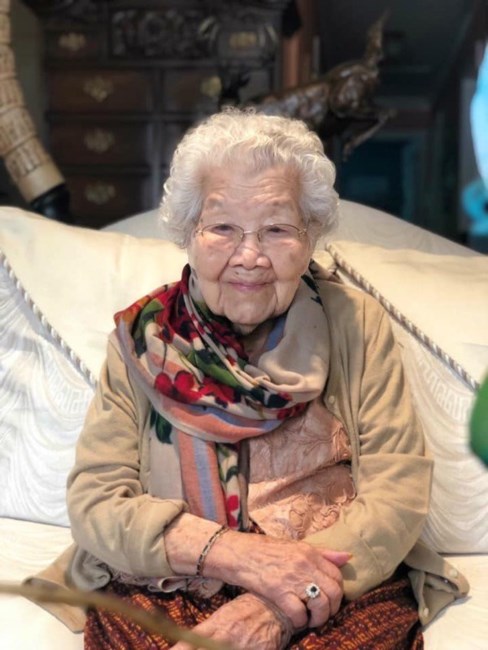
On the evening of June 4, 2020, Mrs. Hauv Chhith passed peacefully in her home at the age of 96 due to natural causes. She was a beloved great-grandmother, grandmother, mother, wife, sister, daughter, and friend, born on October 24, 1923, in the Battambang province of Cambodia. She was the daughter of a town mayor and arbitrator, Prach Chhith, and his wife Sang Moui (both suffered from malnutrition and died during the Khmer Rouge regime (KR)). Her parents were kind, compassionate, and deeply devoted to their Buddhist faith. These beliefs and values were cultivated in her at a very young age. As a child, she spent a lot of her time at the temple, where she was fortunate to have teachers who instilled in her the importance of being strong and independent. She also received a traditional education in Sanskrit, Khmer, her native tongue, Thai, and mathematics. She was highly skilled in the abacus, a counting frame and calculating tool, which she used to support her husband, Seantho Ky, a successful entrepreneur (executed during KR). They have 11 children (from oldest to youngest): Polly, Yoklan, Rangsith (presumed deceased during KR), Hong Lean (France), Hong Eang, (presumed deceased during KR), Sotheany, Nach, Vilady, Noch (Billy), Koch, Veasna (Wes), 23 grandchildren, and 21 great-grandchildren.
Her Work?
By the age of 51, before the dismantling of the Cambodian government and Khmer society in 1975, Mrs. Chhith had already held 11 Kathina festivals, the largest alms-giving ceremony in the Buddhist year consistent with the Theravada Buddhist faith for Buddhist temples or Vatts in Cambodia.
In February 1981, as a single mother, she led her eight children and five grandchildren to the United States, from Khao I Dang refugee camp in Thailand to New York City and eventually to her new home in the DC Metropolitan Area.
As the family began to rebuild their lives, her greatest contribution was caring for her young grandchildren and maintaining Khmer cultural traditions within the family. She was also actively involved in the growing Khmer community, especially through the practice of the Buddhist faith and the organization of fundraising campaigns to help vulnerable communities in Cambodia. In the latter part of her life, she was ordained as a nun for three months and served as the President of Women Volunteers and Nuns for two terms (10 years), where she managed the operations of the Cambodian Buddhist Temple (Vatt Buddhikarama) in Silver Spring, Maryland. She continued to organize Kathina festivals at Vatt Buddhikarama and Watt Buddhacheya Mongkol in Woodbridge, Virginia.
Mrs. Chhith completed three “Pajoch Seyma Ceremonies,” the blessings of the groundbreaking for constructions of temples in Maryland, Virginia, and Florida. Additionally, she led several fundraising events to support Buddhist temples in Cambodia.
Her greatest accomplishments?
She returned to her birthplace to build a crematory in honor of her parents to service cremation for the people in that town and others from nearby communities. She asked people to gather the remains of those who were killed during the KR. This effort resulted in collecting 70 bags (100 kilograms each) of bones and skulls of loved ones and burial rituals were performed. One of her hopes was that her two missing sons (both presumed deceased) would be amongst the gathered remains and that they would receive these same blessings. Her efforts healed the hearts of the people and mended the broken land. For this, she will always be remembered.
Additionally, her lifetime of humanitarian efforts included providing clean water through well drilling; facilitating the ordaining of five monks; advocating for the education of monks by printing Buddhist bibles; restoring the monks’ sanctuary and providing necessities for their well-being. Furthermore, she rebuilt the Urgent Care Center in her husband’s hometown of Phnom Srok by donating 50 beds and medical supplies to provide people access to health care.
Her dream for the world?
That all human beings, animals, and planet Earth can live in harmony and that we may appreciate, learn, and accept differences between one another.
Muestre su apoyo
Comparta Un Recuerdo
Comparta
Un Obituario
Obtenga actualizaciones
Servicios
COMPARTA UN OBITUARIOCOMPARTA
- RECIBIR RECORDATORIOS
v.1.18.0