
OBITUARIO
Irene Kostro
1 diciembre, 1919 – 8 mayo, 2019
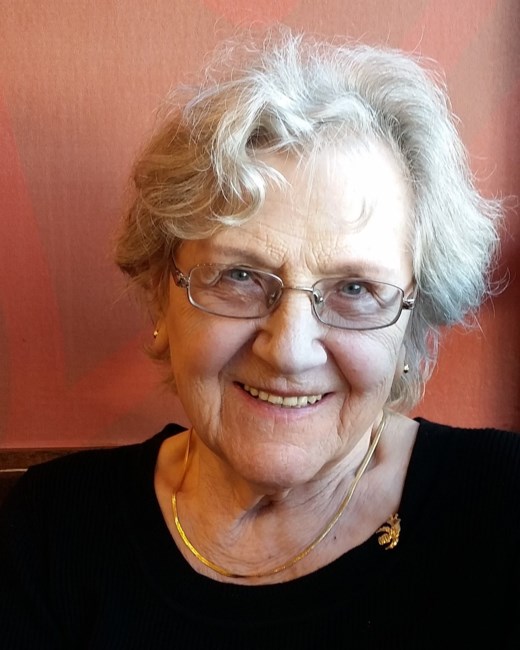
Irene Kostro
Irene (“Irka”) Kostro was born with a twin brother in Leszno, Poland, in 1919. As the smaller, weaker twin she was not expected to live, yet 99 years later she had outlived her immediate family and most of her friends. During her childhood, Irka contracted severe meningitis and was brought back to life by the continued efforts of her loving father who called in several doctors to save his daughter, until finally an homeopathic herbalist concocted a potion which was spoon fed throughout the day and night until the fevers broke and Irka started to recover. The stage was set with a determination to live and a deep abiding faith in the presence of God’s grace as a protective and guiding force in her life.
Life was an adventure to Irka – she was always ready to face the next challenge. During World War II, Irka became a nursing student in Warsaw, Poland; but, because of her scandalous behavior (wearing a beret, with a lock of hair hanging off to the side of her face, and darkened eyebrows), she was asked to leave Nursing School. At her mother’s suggestion and encouragement by her former professors, Irka successfully sought admission to medical school with the intention of becoming a missionary doctor, thus serving God as a nun and helping people through medicine.
Medical schools were prohibited by the occupying German forces – officially, the school was called Dr. Jan Zaorski's Private Vocational School for Auxiliary Medical Personnel (the name, not denoting its university character, was supposed to mislead the Germans). It was staffed by the professors from the prewar medical university in Warsaw, Józef Piłsudski University. Irka attended medical school from 1942 until 1944, when her medical studies were interrupted by the Warsaw Uprising.
During the War, Irka was also a partisan in “AK,” the Polish Home Underground Army. A significant indicator of her deep faith and loving heart was her stance as a pacifist in spite of actively taking on dangerous missions during her service, i.e. Irka would never carry or shoot a gun because she considered human life sacred and would not take it upon herself to end one Her involvement in the war ended as a prisoner in a POW Camp, in Oberlangen, Germany.
After being liberated from the Prisoner of War Camp in 1945, she worked at a Red Cross Headquarters in Bavaria; then, went on to Brussels, Belgium, to continue her medical studies under the auspices of the Polish Army in exile. There, she met an engineering student, George, who had been released from Dachau concentration camp and also found his way to seeking scholarships for study in Belgium. When George saw her enter the waiting area of the Red Cross station, he told his friend standing beside him: “Look! See that woman, she is going to be my wife!” Yes, love at first sight. George spent the next 6 months helping Irene and getting to know her. Irka considered his marriage proposal deeply and consulted a priest about the conflict between entering the convent and marriage. The priest reminded her that marriage is also a sacrament and one can serve God in many ways outside a convent.
From Belgium, the young couple submitted an application to enter the USA, then traveled to Buenos Aires, Argentina awaiting permission. As years passed by, George set up his engineering business while Irka gave birth to Paul, Tom, Alejandra, Anna and Elizabeth. Almost ten years after arriving in Buenos Aires, Irka and her husband were informed they were finally qualified to emigrate to the United States.
Irka’s husband went to America first, to get a job as a civil engineer, and to find housing for the family; Irka took care of her five children, alone for nine months withstanding hardships and neighbors suggesting that her husband, like so many others, had disappeared. Again, Irka’s deep faith supported her until the family reunited in Forest Hills, New York, in the summer of 1959.
Although Irka chose to focus on being a homemaker for her family, her talents in music (performed in piano recitals and sang in a choir) and art (kept a secret sketchbook & improvised her own paintings while watching Bob Ross on TV) surfaced in countless ways. She encouraged her children’s blossoming artistic skills in drawing/painting, playing the piano, singing and writing. She designed and sewed clothes for herself and her children for many years; she prepared delicious feasts for parties within the bounds of a tiny kitchen with 2 square feet of counter space (miracles!); Irka studied books on New York City so that she could explore the sights with deeper understanding of their history and significance, later taking visiting friends/family on tours of Manhattan filled with fascinating facts.
Irka attended night school to study English, then read the NY Times daily and wrote out unfamiliar words, looked them up in the dictionary and wrote out the definition and sample sentences. This led to a large vocabulary, but her shyness in speaking English always remained. Irka also studied bookkeeping with the intention of taking a part time job, but George requested she stay at home since bringing up five children was a full-time job in itself.
Irka loved to travel to learn about new places and explored the world with trips accompanied by her husband, or her daughters, to Europe, Mexico, Canada and Australia. This also gave her an opportunity to use her love of photography. Throughout her life, Irka loved taking pictures. She took a few courses, she read photo magazines and created a photo-diary which resulted in over 90 scrapbook albums chronicling the adventures of her family, including a few home movies. Up to her final days at home, Irka daily viewed the photos in her camera and reviewed albums to remember names and stay connected to her family now scattered around the world.
Irka’s life was deeply devoted to God. She recited the rosary daily, she always first gave the benefit of the doubt and never harshly judged anyone; she reminded us that, no matter what hardship came along, one should turn it over to God and seek refuge in His guidance. She often said that her experiences during the war, including facing imminent death several times, did not destroy her faith because she felt an angel watching over her and trusted things would all work out for the best. As her body took on various illnesses over the years, as her brain started losing memories and connections toward the end of her life, her radiant smile, her loving heart, her strong hugs or gentle caresses were all a blessing to those who knew her.
Irka’s five children graduated college, and became involved in various careers within finance, advertising, music, teaching, and art. Irka’s loving husband, George, died unexpectedly in 1984. Irka (“Mamusia” “Babcia” “Pra-Babcia” “Ciocia”) is survived by her five children, her six grandchildren, and her six great-grandchildren, plus nephews and nieces in the US & Europe -- all of whom will miss her greatly. She is being laid to rest at Maple Grove Cemetery, by her husband, in Kew Gardens, New York.
Muestre su apoyo
Comparta Un Recuerdo
Comparta
Un Obituario
Obtenga actualizaciones
DONACIONES
St Jude Children's Research Hospital262 Danny Thomas Place, Memphis, Tennessee 38105
American Red Cross
Servicios
COMPARTA UN OBITUARIOCOMPARTA
- RECIBIR RECORDATORIOS
v.1.18.0