
OBITUARIO
Captain Simpson Evans Jr. Retired USN
22 junio, 1918 – 27 diciembre, 2010
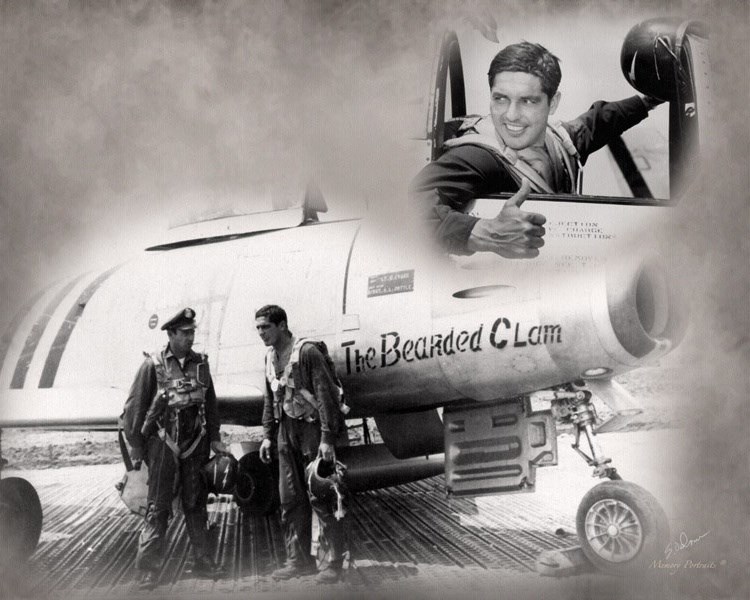
Simpson Evans was born in Cartersville, Oklahoma on June 22, 1918, and was the only child of Bella and Simpson Evans. His father, a Native American Choctaw Indian, died of tuberculosis when Simpson was eighteen months old. Simpson’s mother married Earnest Burt eight years later and moved the newly formed family to Tulsa. In 1933, the family moved to Cartersville and then to Arkoma, Oklahoma where Simpson graduated from Spiro High School in 1937.
Following high school, he joined the Civilian Conservation Corp, a public work relief program purposed to employ young men during the Great Depression. After spending two years working in Wyoming and Colorado where the Corp, in Simpson’s own words, “made a man out of me” he returned to Oklahoma and farmed 140 acres of the family’s property.
Eight months after the Japanese attack on Pearl Harbor, Simpson joined the United States Navy. Later, his application to become an aviation cadet was accepted and he received orders to attend civilian pilot training at the local flight school in Fort Smith, Arkansas. Soloing the primary trainer aircraft in just eight hours, his initial pilot training was completed in only three months. From December 1942 through January 1944, Ensign Simpson Evans Jr. stepped through the various stages of flight training required to become a Naval Aviator. This included initial training in Pensacola flying SNJ “Texan” advanced trainers to operational training in Melbourne, Florida, piloting F6F-2 “Hellcat” fighters. Although he had no way of knowing at the time, this recently introduced “Hellcat” fighter would be the aircraft that he would fly in parade over the USS Missouri during the historical signing of the surrender by Japan. He would soon earn his aircraft carrier qualification and build experience as an instructor pilot before being assigned to combat duty in the South Pacific. During his combat tenure off the shore of Japan during WWII, he participated in numerous missions bombing and strafing enemy airfields but never engaged a Japanese aircraft in aerial combat.
Simpson continued his role as an accomplished instructor pilot following the end of WWII while teaching at the Naval Air Center in Corpus Christi, Texas, in a variety of aircraft. His skill was formally recognized by a commanding officer when he was given the option of joining a newly formed Navy flight demonstration team that would later be called the “Blue Angels.” Not realizing the significance of this opportunity, he passed on the “Blue Angels” to serve with a former commanding officer on the USS Valley Forge in an all-weather fighter squadron. During his tour, the USS Valley Forge became the first aircraft carrier to sail around the world.
In June of 1948, he attended the first Navy Test Pilot Training Class. Now a Lieutenant Junior Grade, his test pilot training put him in the seat of some of the first military jets, including the P80 “Shooting Star” which was the first operational jet fighter used by the United States. Because of his jet experience and combat tours during WWII, Simpson was selected in a pilot exchange program with the Air Force. While participating in the exchange program during the Korean conflict, he flew the F86 “Sabrejet” with the 4th Fighter Group in the 336 Fighter/ Interceptor squadron. During a mission near the Sinanju area of North Korea, escorting B-29 bombers, he received a call for support from several bombers under attack by North Korean Mig15 jet fighters. Quick to respond, he and his flight group encountered sixteen enemy aircraft. This moment of aerial combat yielded his first of two victories and merited him being awarded with the Distinguished Flying Cross.
During the remainder of the decade, he rose to the rank of Commander and served in numerous command roles. He was a test pilot and Flight Test Director at McDonnell Aircraft, piloting aircraft such as the F4 “Phantom” and F101 “Voodoo”, Operations Office on the USS Hornet and an atomic bomb delivery pilot. Even though he was busy flying twice the speed of sound during this time period, the 39-year-old bachelor also made time for dating and he met his wife, Julia, while stationed at Virginia Beach, Virginia. They married in 1957 on Simpson’s birthday – June 22nd. In 1964, Commander Simpson Evans Jr. was promoted to Captain. One step below a Rear Admiral, this was quite an accomplishment for a farm boy from Oklahoma that entered the Navy as an enlisted man during the early part of World War II. Over the next ten years, Captain Evans further distinguished himself as a senior officer by leading the innovative Fleet Work Study Group and serving as Commanding Officer of the Naval Air Facility in El Centro, California, and the Naval Reserve Center in Tulsa.
Simpson Evans Jr. retired in July 1974 after 40 years of military service, 6,000+ hours of flight time, 300 aircraft carrier landings, flight combat in two wars, piloting over 21 different types of aircraft, soaring at twice the speed of sound, receiving the Distinguished Flying Cross, Soldiers Medal, Air Medal with 2 Silver Stars with 1 Oak Leaf Cluster and rising to the rank of Captain.
After retiring from the Navy, Simpson returned to the Fort Smith area where he ranched and farmed for several years before devoting his time to his two children, Kandy and Scott; his wife, Julia, and a legacy that would grow with eight grandchildren and three great grandchildren. Although Simpson never actively flew as a civilian pilot, he remained very supportive of the aviation community. He was a charter member of the Fort Smith chapter of the Quiet Birdmen aviation fraternity. He was also a member emeritus of the Golden Eagles which is an aviators association that honors significant contributors to naval aviation. Simpson Evans Jr. touched the lives of so many providing inspiration, encouragement and love for his family and country. He will be remembered as a man of honor, integrity and a true patriot.
Muestre su apoyo
Comparta Un Recuerdo
Comparta
Un Obituario
Obtenga actualizaciones
Servicios
COMPARTA UN OBITUARIOCOMPARTA
- RECIBIR RECORDATORIOS
v.1.18.0