
OBITUARIO
Lee Houston Gericke
21 diciembre, 1928 – 6 marzo, 2023
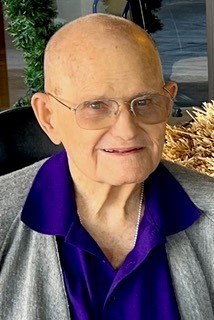
Bronze Star winner Lee H. Gericke, one of the first cops to walk the beat in America’s original “G.I. Town”—south suburban Park Forest, Illinois, the nation’s first community designed for the G.I.’s coming home from World War Two--died March 6, 2023, at his home in Glendale, Arizona. He was 94.
His wife of 68 years, Almarimor “Mary” Gericke, and their three children survive him.
Mr. Gericke’s life was rich and varied, and included thirty years at the Park Forest Police Department; building bridges under enemy fire in the Korean War, for which the U.S. Army awarded the young combat engineer the Bronze Star; serving as scoutmaster of Boy Scout Troop 270 in south suburban Frankfort and school board member in Lincoln Estates, the rural hamlet in which the Gericke family lived; helping his fellow officers on Team Illinois win Ford Motor Co.’s national police driving competition held at Daytona International Speedway in 1961; was among the first people in the nation to examine the new AR-15 rifle unveiled by Colt Firearms at the International Police Combat Pistol Match in 1959; and was an avid tradesman, artist, outdoors enthusiast, world traveler, and, most important to him, family man.
Mr. Gericke was born Dec. 21, 1928 in San Bernardino, California, where he and brothers John and Frank and sisters Arlene and Maxine roamed the hills of rural California under the watchful gaze of father Ora “Pat” Gericke, a railroad worker, and mother Wanda Gericke, a housewife. He attended high school and then commercial art college, where he developed a serious talent for detailed pencil sketches.
But he grew bored with sitting and drawing, so in 1948 he moved to Illinois with his brothers to work on the pipeline network starting to crisscross the booming postwar Chicago. He bought a house in Lincoln Estates, forty miles south of Chicago and a block from the Lincoln Highway, which amused him because he grew up a block from Route 66. His brother John landed a job in the water and sewer department of Park Forest, which sprang to life in 1948 as the nation’s first village planned specifically for the soldiers, sailors, and fliers returning from World War Two. John told Mr. Gericke there were openings in the police and fire departments, and he should grab one because they’d provide more financial security than pipeline work.
Mr. Gericke did, and in 1950 became one of the village’s original officers. “I had no experience in police work, but I thought it would be fun,” he told his son, Shane Gericke, a crime novelist and former financial news editor at the Chicago Sun-Times. “The chief liked that, so he gave me handcuffs and a ticket book, lent me a gun until I could buy my own, showed me around town, then said to go out and protect people and property.”
He did, greatly enjoying postwar policing and its very different game of cops and robbers. “We had burglars, robbers, and hard guys, same as cops do now. But we both played by the same rule back then: “Don’t give me a hard time and I’ll treat you with respect,” he said. “It wasn’t my job to punish suspects, that was up to the courts. My job was to arrest them with as little fuss as possible, and I found that being nice to crooks did the trick.”
The bad guys always seemed to have better gear than the cops, though. Mr. Gericke found workarounds.
“I was chasing a burglar hightailing it out of town,” he said. “I hit the lights and siren and went real fast, but they had better cars than us. So, when the taillights faded, I called the next department south and said, “Catch my fish, I’ll come clean him.’ They obliged, I bought them coffee, then I drove the burglar back to the station. On the way, I asked about his family and how the crook business was these days. He wound up telling me something we used to arrest some other guys. No downside to being nice, you can always go the other way if you need.”
But as he was settling into the routine, Uncle Sam sent him a letter: We want YOU to join the U.S. Army. The Korean War was on, he was old enough to serve as his brothers had in WWII, and so he reported to the draft board as directed.
“Nice Army man said, ‘Well, son, what kind of job do you think you’d do best in the Army?’ I said, ‘Well, I’m a police officer, so I guess the MPs sounds right.’ Army man said, ‘That does sound right, the MPs. But you’re going to be a combat engineer. Next!”
Whereupon Mr. Gericke rode an Army bus to Fort Leonard Wood, Missouri, where he became a combat engineer. He took a troop ship to Korea, was promoted to corporal, and spent the war tightening bolts and welding steel plates while ducking machine gun fire—he and his men worked in front of the front lines, because troops couldn’t advance until they had a bridge over which to drive. "We built floating bridges,” he said. “We built them nice and tight. Enemy blew them up. We built more. Enemy blew them too.” He chuckled. ”Good job security if you could handle the working conditions.”
Corporal Gericke was awarded the Bronze Star for meritorious service. The Bronze is third behind the Medal of Honor and the Silver Star for bravery during combat. “He claims he never knew why they gave him that medal,” his wife, Mary, said. “He said he earned it for not screwing up too much. But they don’t hand out Bronze Stars for just anything, do they?” She said he never talked about the war with her.
He returned to Park Forest after discharge, where he met Almarimor, who went by Mary, the young Chicago woman who would become his wife of 68 years. They married in 1955, had a son, Shane Gericke, followed by two daughters, Marianne Taylor and Diana Gericke. Mr. Gericke became scoutmaster of Boy Scout Troop 270 in Frankfort, Illinois, two miles from Lincoln Estates. Mary Gericke was a Brownie leader, director of the area’s Brownie summer camp, and regional chair of the annual Girl Scout Cookie Drive fundraiser.
They loved visiting family and friends, working on their house and yard, Scouting, playing cards, and spending time with their children, an important part of which was taking long driving vacations whenever they could “so our kids could see the United States,” Mary said. Mr. Gericke was an avid camper and hiker, and he could repair anything, from cars to roofs to plumbing to the water well. He and Mary spent years enlarging and remodeling their rural home to accommodate the growing family, which included a series of cats, each named Smoky.
But he always came back to police work. He spent thirty years behind the wheel of a squad car, never wanting to advance beyond sergeant because that would keep him in the station doing paperwork. He helped solve the village’s first murder, arrested hundreds of suspects, helped thousands of residents, and retired as a sergeant in 1980. While son Shane chose to stay in Chicago for work and marriage, Mr. Gericke and the rest of his family moved to a house in Glendale, Arizona. He spent the next fifteen years maintaining F-16 fighter jet simulators at Arizona’s Luke Air Force Base. He and Mary both retired from work life at 65, and began years of traveling around the world, their favorite trips being river cruises in Europe and the Copper Canyon Train Tour in Mexico.
When maintaining their Glendale home proved too physically burdensome, they moved into a nearby retirement complex. As Mr. Gericke’s health declined, he moved to an assisted living apartment down the hallway from Mary, making it easy for the couple to visit. In 2022 he entered hospice, and on March 6, 2023, died in his sleep.
He is survived by his wife, Almarimor “Mary” Gericke, sister Maxine Gray, son Shane Gericke (the late Jerrle Gericke), daughters Marianne Taylor (David Taylor) and Diana Gericke (Gary Caswell), granddaughter Christina Pahia (Joe Pahia), and grandsons Lee Taylor (Amanda Taylor) and Hunter Taylor (Tiffany Toms). He was preceded in death by his parents, brothers, sister Arlene, and his dearest friends from high school: a pair of white ducks who met him at the school bus every day, grabbed the back of his trouser legs with their beaks, and “water-skied” the gravel driveway as Mr. Gericke walked them to the house. They did that for years, he said, never missing a day, and it became his favorite story to share.
A memorial service will be held at the National Cemetery in Phoenix, Arizona, in May. In lieu of flowers, the family asks you to donate to Hospice of the Valley in Glendale, or to the police or military charity of your choice.
Muestre su apoyo
Comparta Un Recuerdo
Comparta
Un Obituario
Obtenga actualizaciones
FAMILIA
Almarimor “Mary” GerickeWife
Shane GerickeSon
Jerrle GerickeDaughter-in-law (deceased)
Marianne TaylorDaughter
David TaylorSon-in-law
Diana GerickeDaughter
Gary CaswellSon-in-law
Maxine GraySister
Granddaughter Christina Pahia (Joe Pahia), and grandsons Lee Taylor (Amanda Taylor) and Hunter Taylor (Tiffany Toms). He was preceded in death by his parents, brothers, sister Arlene, and his dearest friends from high school—a pair of white ducks who met him at the school bus every day, grabbed the back of his trouser legs with their beaks, and “water-skied” the gravel driveway as Mr. Gericke walked to the house. They did that for years, he said, never missing a day, and it became his favorite story to share.
Servicios
COMPARTA UN OBITUARIOCOMPARTA
- RECIBIR RECORDATORIOS
v.1.18.0