
OBITUARIO
Josephine K. Ault
30 marzo, 1931 – 5 abril, 2016
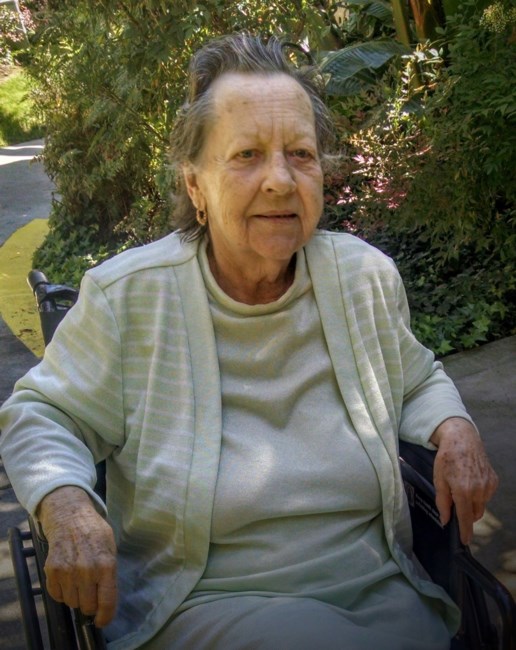
J. K. Ault Bio Josephine Kaetchen (Stephan) Ault, passed away April 4, 2016, of complications stemming from hip surgery. She was 85. A long-time resident of Sun Valley, Ca., she is survived by her life partner of thirty-seven years, Ramon Molina Abraham, of Los Angeles, and a son, Charles H. E. Ault, and daughter-in-law, Barbara A. Cohen, of Narberth, Pa. Visitation on Tuesday, April 12, from 5 pm to 8 pm at Callanan & Woods Scovern, 511 South Central Avenue, Glendale, Ca. In lieu of flowers, donations may be made to the Alzheimer's Association, www.alz.org/donate. (The following biography is based on family history as told to me by parents, relatives, and friends, and supplemented with my own memories.) Josie, my mother, was smart and strong-willed, and therefore a survivor. The only child of Anna (Dietl), a shopkeeper, and Wilhelm Stephan, a painter's assistant and goalie for the local soccer club, she was born March 30, 1931, in Furth, an ancient urban enclave where the Pegnitz and Regnitz rivers meet in the southern German state of Bavaria. She was barely eight years old when WWII began and her father was conscripted to fight on the Eastern Front. He sent home elegantly penned letters, beautifully illustrated with hand drawn pastels of flowers and small landscapes populated with animals and small children. He was reported missing after an assault on Crimea and never heard from again. At home, Josie knew the devastation and privations of war first hand. Once, caught in the open during an Allied air attack, she saw a schoolmate running beside her wounded by strafing fire on a city street. A jagged piece of shrapnel the size of a man's hand just missed her during another raid and was kept ever after as a family heirloom. After the war, Josie and her mother supplemented their meager rations with produce and fresh eggs from relatives in the countryside. They had gotten fairly well established again when Josie, at seventeen, met the young American soldier who would become my father, Ellsworth "Al" Rehwalt Ault. Al came from the Pacific Northwest, the son of migrant farm workers George and Thelma (Rehwalt) Ault. Before I was born in 1949, the U. S. Army sent him off to another war, on another continent. With Al thousands of miles away in Korea, Josie was left with only her widowed mother to help raise an infant son. In 1954, Al came back to Germany, where he reunited with Josie, met his son for the first time, and packed them both off to his new posting at a military base in the French countryside. He also took the opportunity to have the Army and U. S. State Department belatedly recognize his marriage and his son. And so began a six-year odyssey of military postings every eighteen to thirty-six months to far-flung places with strange new people and unfamiliar cultures. In France, Josie set up housekeeping in rooms rented from a farmer not far from the village water pump. That's also where she began to learn English and despite strong reservations--"That's animal food!"--relented to try eating corn at the dinner table. Eighteen months later it was on to Salinas, California, The Salad Bowl of America. There, with skills acquired in a German trade school, she began her career as a bookkeeper, a job she had no trouble landing wherever her peripatetic soldier-husband took her. In California, Josie loved spending weekends with Al and me motoring along the Seventeen-Mile Drive near Carmel-by-the-Sea. And it was a bonus if Al managed to poach an abalone or two from the tidal pools along the shoreline. After her eighteen-month sojourn in the United States, it was back to Germany for a three-year tour in the midland city of Manheim. There were many summertime visits to the magnificent city water park, with its ten-meter high dive, wading pool, and acres of lawns perfect for picnics. The young family cruised the Rhine and toured the Heidelberg Castle, with its gargantuan wine tun and turret peaks. The last military posting came in 1960, to Fort Hood in the scrub-Spruce mesas of Central Texas. This was a culture of another sort. The Texas twang spoken by locals was almost indecipherable and the overt racism was appalling. The day President John F. Kennedy was shot, too many people made no effort to hide their glee. This is also where Al decided to end his military career of more than twenty years. But Al had a hard time finding and keeping a job in the small town where we lived, and after I finished high school in 1967 the family decided to head west, to Los Angeles, where it was said jobs were plentiful and a family could make a new start. Los Angeles in the late 1960s was a haven of hippie culture, and it didn't take me long to leave home and become a flower child. Josie found good work handling credit accounts for a company that supplied industrial glass for the gleaming skyscrapers that were sprouting like mushrooms in the Downtown district. Al found he didn't have the skills, or the temperament, to hold a decent job. Largely by dint of her earnings alone, the two of them managed to buy a house in the Sun Valley community on the eastern edge of the sprawling suburban expanse called the San Fernando Valley. Before long, however, the marriage soured. There had been problems before, but in 1971 Josie got a divorce. She moved into a rented apartment with her mother, Anna, who had come to the States in the 1960s and had lived with the family since. A few years later Josie bought out Al's interest in the Sun Valley house and moved back in, bringing her mother with her. But Anna was then in her 60s and wanted to spend the rest of her life in her native Bavaria. Which, a short time later, she did. Now, Josie, a relatively young divorcee in her early forties, was living alone in a three-bedroom suburban homestead. Before long she got to know the Hispanic fellow who pumped her gas at the station she used. Turns out, he was a mariachi and pumping gas was his day job. He invited her out, and that was the beginning of Josie's new life as a queen of the mariachi circuit. Hard to believe that my strict, conservative, neat as a pin, everything-in-its-place-and-a-place-for-everything German mother was kicking up her heels in dance halls every week! Josie kept working though, now at the nearby headquarters of Price-Pfister, the plumbing hardware manufacturer and distributor. She was tired of fighting the traffic on the Golden State Freeway into downtown Los Angeles five days a week, and the twenty-minute drive up the San Fernando Road was a lark. As happened with all her employers, Josie's hard work, efficiency, and uncanny attention to detail soon made her indispensable. Her boss rewarded her with a slot on the executive team as Customer Service Manager. It was the high point and proudest moment of Josie's work life. She stayed with Price-Pfister for more than a decade, until a lingering back injury from an automobile accident years before nudged her into retirement in 199?. But she didn't retire from the mariachi circuit. Far from it. She began to date Ramon Molina, the singer and guitar player who would go on to share the next thirty-seven years of her life. Josie put her accounting skills to work helping to manage Ramon's mariachi career and Ramon's business prospered. And did I mention that Josie learned Spanish? Ramon's English left a lot unsaid. But no matter, Josie was now fluent in three languages! Ramon was devoted to Josie. There was nothing he wouldn't do to make her happy and put a smile on her face. Mariachis mysteriously appeared on Josie's birthdays. On the days Ramon wasn't working, they were on the road. He drove her to the ocean to watch the surfers ride the waves off Malibu. To the upper plateaus beyond Sylmar to watch the desert bloom in spring. To the Verdugo Mountains to top the Angeles Crest and view the snow-capped peaks of the Sierra Madre. To the Hanson Dam. To the Descanso Gardens. Occasionally, to Mexico. More often to Alpine Village for the buffet and shopping in the German deli. Josie loved a Sunday drive. After Josie was diagnosed with dementia in the summer of 2010, Ramon became her constant companion, her most vocal advocate. It was hard watching the disease progress, sometimes more than Ramon could handle. But he stayed with her throughout. My wife helped me find Dorothy Fried, a social worker certified to manage the care of older persons with problems like my mother's. More than a dozen caregivers were hired over the next several years to help with Josie's in-home care, twenty-four hours a day, seven days a week. Maria Cazun stayed with her for more than three years, and I came to see her as part of the family. When Dorothy retired in the spring of 2015 to spend more time with her children and grandchildren, Wendy Doring, a similarly qualified registered nurse, took over the professional management of Josie's care. Before Josie and Ramon moved in December of 2014 to an assisted living facility in Van Nuys called the Gardens at Park Balboa, the two of them would spend most evenings sitting at the edge of their driveway, watching the setting sun. Around 5 or 6 pm, the ice cream truck would jingle down the street and Ramon would bring Josie a vanilla ice cream. On New Year's Day, 2016, at Park Balboa, Josie fell and broke her hip. She underwent two surgeries and extended stays in two rehab facilities, where she got round-the-clock medical care. A new private caregiver, Cindy Cardona, rendered especially kind and tender care during that very trying time. And, of course, Ramon was at Josie's bedside every day.
Muestre su apoyo
Comparta Un Recuerdo
Comparta
Un Obituario
Obtenga actualizaciones
Servicios
COMPARTA UN OBITUARIOCOMPARTA
- RECIBIR RECORDATORIOS
v.1.18.0