
OBITUARY
Robert Bellarmine Schaefer
December 18, 1939 – March 3, 2026
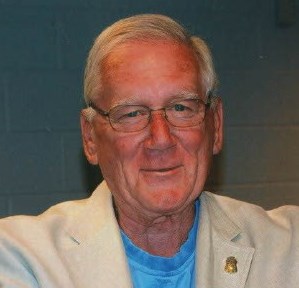
Born on December 18, 1939, in Floral Park, New York, his family later relocated to Douglaston, New York, where he attended grammar school and high school. As a child, he dreamed of becoming a Navy pilot or a Secret Service agent. His path to earning his bachelor’s and master’s degrees was a long and winding road. He began in 1957 at Queens College and later transferred to Fordham University in New York City, where he studied until enlisting in the United States Navy.
Bob served on active duty in the U.S. Navy from 1960 to 1962 aboard the USS Wasp as an Air Traffic Controller Third Class. The USS Wasp was the first U.S. warship to respond to the Cuban Missile Crisis in 1962, deploying to Guantanamo Bay Naval Base during the negotiations. After his discharge from the Navy, he returned to civilian life and became a New York State Trooper while continuing his education by taking classes at Queens College during evenings and summers. He earned his Bachelor of Science degree in Sociology with a minor in Psychology from Queens College and later continued his education while working full-time, eventually earning a Master’s degree in Public Administration from the John Jay College of Criminal Justice.
He met the love of his life, Sarah Philbin, on a blind date in April 1963. They were married in December of that same year and began raising a family with the birth of their first of four children in 1965. Bob and Sarah remained devoted to each other until her passing in 2008.
In April 1971, Bob resigned his position as a State Trooper to become a Special Agent with the Federal Bureau of Investigation. His assignments with the FBI included two stints in Florida, followed by ten years in the Philadelphia Field Office working on the Bank Robbery Squad, eight years at the FBI Academy in Quantico, Virginia, and six years in the Norfolk Field Office, where he served as Supervisory Special Agent of the Drug, Organized Crime, and Surveillance Squad until his retirement on April 4, 1996. During his time at the FBI Academy in Quantico, he served in the renowned Behavioral Science Unit (BSU) as an adjunct professor with the University of Virginia. There, he taught sociology, psychology, stress management, the use of deadly force, and critical incident and peer support. He published numerous pamphlets and articles and was the co-founder and first manager of the FBI’s Critical Incident and Peer Support Program under the direct supervision of Executive Assistant Director John E. Otto.
In this capacity, Bob responded to shooting incidents across the United States, particularly those involving severe injuries or fatalities, providing support to FBI agents and their families as well as to local law enforcement agencies. Over a period of more than five years, he maintained contact with every participant involved in an FBI shooting incident and encouraged them to attend his three-day seminar designed to provide psychological support in coordination with the Bureau’s staff psychologists. This program was a precursor to what is now known as modern Psychological Services in Law Enforcement.
Bob’s retirement from the Bureau was prompted by the diagnosis of early-onset Alzheimer’s disease in his beloved wife, Sarah. He dedicated the next twenty-two years to caring for her as she progressed through the later stages of this devastating disease.
During this time, Bob became a committed advocate for Alzheimer’s awareness. He began volunteering with Alzheimer’s support groups and soon immersed himself in learning about caregiving, dementia-related incidents, and the importance of training first responders to recognize and interact with individuals affected by Alzheimer’s and other forms of dementia.
Over the next four decades, he devoted much of his time to this cause, serving in many roles including:
• Appointed by Governor Mark Warner to the Governor’s Commission for Alzheimer’s and Related Disorders, serving a ten-year term from 2002 to 2012
• Trainer for the Virginia Department of Criminal Justice Services for fifteen years, teaching first responders—including police, fire, EMT, and search-and-rescue personnel—how to communicate with dementia patients
• Member of the Department of Criminal Justice Services Alzheimer’s Training Committee overseeing statewide training programs
• Lecturer at the FBI Academy on the topic of first responders communicating with victims of Alzheimer’s and dementia
• Member of the Board of Directors and Chairman of the Patient and Family Services Committee for the Southeastern Chapter of the Alzheimer’s Association
• Member of the Board of Directors and Speaker’s Bureau for the Greater Richmond Chapter of the Alzheimer’s Association
• Co-author of an article for the October 2011 issue of the FBI Law Enforcement Bulletin entitled “Awareness of Alzheimer’s Disease”
• Presenter at the National Missing Persons Conference, the Virginia Crisis Intervention Teams Conference, the Virginia Federation of the National Association of Active and Retired Federal Employees Annual Event, and the Virginia Coalition for the Prevention of Elder Abuse Conference
• Founder and co-facilitator of an early-stage support group for individuals with dementia and their care partners
• Facilitator for numerous Alzheimer’s support groups in the Richmond area
• Organizer of bereavement workshops for those who lost loved ones to the disease
• Facilitator for the Bereavement Ministry at St. John Neumann Catholic Church
• Volunteer facilitator for a men’s bereavement discussion group at Bliley’s Funeral Home in Richmond
He was recognized for many of these efforts, including:
• Recipient of the 2006 Humanitarian Service Award for the Mid-Atlantic Region of the Former Special Agents of the FBI Foundation for his volunteer work in Alzheimer’s advocacy
• Recognized by The New York Times in May 2010 for a Department of Criminal Justice Services article titled “More Wander Off in a Fog of Age”
• Recipient of the 2014 Advocacy Award from the Greater Richmond Chapter of the Alzheimer’s Association
• Featured in a Richmond Times article in 2017 titled “Helping First Responders Understand Dementia”
• Appeared in the PBS documentary Alzheimer’s: The Caregiver’s Perspective, which was included in the Westminster Canterbury “When Words Fail” instructional video
• Presented with an award from the Chesterfield Crisis Intervention Team (CIT) for teaching Alzheimer’s and dementia awareness to more than 500 first responders at the Chesterfield Police Academy
Drawing upon these experiences, Bob later authored a book titled Alzheimer’s – The Identity Thief of the 21st Century. In it, he coined the phrase that those caring for Alzheimer’s patients are not “caregivers” but rather “care partners.” His book sought to make the journey through Alzheimer’s disease more understandable and manageable for families and care partners.
Bob often said that while the path he followed was not always one he chose, if he had the opportunity to do it all over again, he would follow the same path without hesitation or regret.
He will always be remembered for his dedication and perseverance—illustrated by his long academic journey, his distinguished career in the FBI, and his unwavering commitment to helping families affected by Alzheimer’s disease. He was a devout member of St. John Neumann Catholic Church, where he served on the parish Safety Committee.
Bob was known for his quick wit, and you never knew what prank he might pull next. An eloquent speaker and instructor, he was never a stranger to the spotlight. Anyone who knew him from his “Bureau” days remembers the eclectic collection of neckties he wore—nothing was too unusual to accompany his business suit.
To his family and many friends, he was simply known as “Pops,” a nickname given to him by his eldest son during his college years. Though he initially resisted the name, it eventually became the affectionate title by which he was known to all.
He remained a fighter to the very end, insisting that he return to his apartment at Westminster Canterbury to spend his final hours on his own terms.
Bob was preceded in death by his wife, Sarah. He is survived by his children: Tom (Lori) and their children Kelsey (Nick) and their son Oliver, and Kyle (Anne); Sean (Robin) and their children Corey (Cydnee) and their children Blake and Jamie, Taylor (Ben), and Megan; Bobby (Jen) and their children Tristen, Jules, and Mikayla; and Kathy (Scott) and their children Kourtney (Nick) and their daughter Sarah Mae, Sommer, and Holly.
In lieu of flowers, donations can be made to the Alzheimer's Association, reflecting Bob’s passion for raising awareness, education, and finding a cure.
A Funeral Mass will be held on Friday, March 27, 2026, at 10:00 a.m. at St. John Neumann Catholic Church, 2480 Batterson Road, Powhatan, Virginia. A brief reception with light refreshments will be held at the church immediately following the Mass.
Interment with military honors to be held at the Virginia Veterans Cemetery at Amelia at 1:00pm at 10300 Pridesville Road, Amelia Court House, Virginia. Family, Friends, and Acquaintances are respectfully invited to attend.
Show your support
Add a Memory
Share Obituary
Get Reminders
Services
SHARE OBITUARYSHARE
- GET REMINDERS
v.1.18.0