
OBITUARIO
Charles Gross
13 mayo, 1934 – 24 marzo, 2026
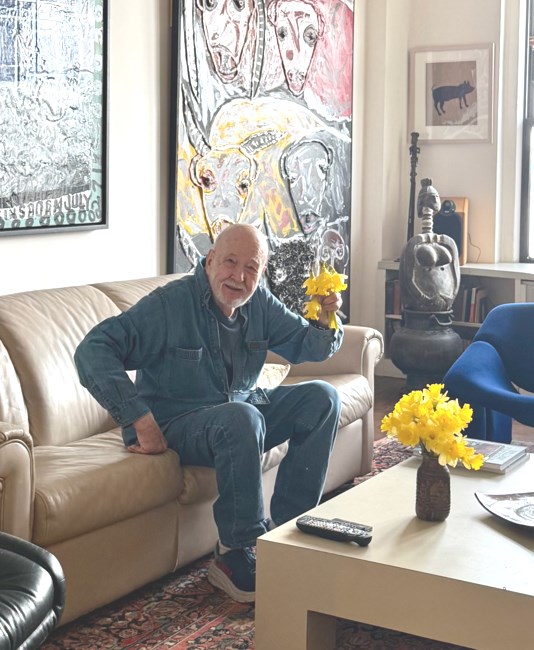
Born on May 13, 1934, in Brookline, Massachusetts, Charlie was the son of Harold Kritzman Gross and Evelyn Freeman Gross. He grew up in Brookline and attended Brookline public schools and the Browne & Nichols School before continuing on to Harvard College.
Named after his great-great-uncle, Charles Henry Gross—believed to be the first Jewish professor at Harvard—Charlie would later joke that his own academic career there was somewhat less illustrious. A self-described political science major who “never took a class before 11 a.m.” and claimed to have majored in “Whiskey Sours.” Charlie nevertheless discovered his true calling during his college years: music. He began composing while at Harvard, writing for the Hasty Pudding Theatricals, and set the course for what would become a remarkable career. Even his piano teacher, he liked to say, would have been surprised that he turned his passion into such a successful and enduring profession.
After graduating from Harvard in 1955, Charlie pursued further musical study at the New England Conservatory and at Mills College, where he was a pupil of renowned composers Darius Milhaud and Leon Kirchner. Following his studies, he was drafted and spent three years serving as an arranger for the United States Military Academy Band at West Point—an assignment he wryly noted came “at the insistence of the U.S. government.”
Charlie went on to compose extensively for film, television, and theater, building a distinguished career marked by both critical acclaim and popular success. He received an Emmy Award for his score to Rodeo Red and the Runaway. His score for Heartland earned a Wrangler Award from the National Cowboy & Western Heritage Museum, and the film itself received the Golden Bear at the Berlin International Film Festival. His work also includes the score for Robert Frost: A Lover’s Quarrel With the World, which won the Academy Award for Best Feature Documentary, as well as music for films such as Another You, Country, Punchline, Turner & Hooch, a Family Thing and Air America.
For television, Charlie composed the highly regarded score for The Dain Curse and wrote music for series including NYPD, Call to Glory, Nurse, and A Rumor of War. He also contributed to numerous television films, including the widely recognized The Burning Bed, starring Farrah Fawcett.
In the theater, Charlie created incidental music for a wide range of productions, including Richard III (with Al Pacino), The Blacks, King Lear for the New York Shakespeare Festival, The Great White Hope, and The Condemned of Altona at Lincoln Center Theater.
Perhaps most meaningful to Charlie, beyond his professional accomplishments, was the philanthropic work he shared with his wife, Joan DuBrow Gross. In 2005, they founded the Charles & Joan Gross Family Foundation, dedicated to supporting dance through the commissioning of new musical scores and choreography. The Foundation reflects the union of their lifelong passions—Charlie’s as a composer and Joan’s as a dancer—and has supported more than 100 commissions for dance companies across the country.
Charlie is survived by his beloved wife of 59 years, Joan DuBrow Gross; his daughter and son-in-law, Emily Gross O’Neil and Doug Hatfield; his brother and sister-in-law, John and Ila Gross; his three grandchildren, Chloe, Lila, and Caden; his cherished nephews, grand-nieces, and grand-nephew.
In honor of Charlie's love of music, those who wish may make a memorial donation to the Charles H. Gross Scholarship Fund at New England Conservatory. Gifts can be made at www.necmusic.edu/give. If you give, please mention the "Charles H. Gross Scholarship."
Muestre su apoyo
Comparta Un Recuerdo
Comparta
Un Obituario
Obtenga actualizaciones
Servicios
COMPARTA UN OBITUARIOCOMPARTA
- RECIBIR RECORDATORIOS
v.1.18.0