
OBITUARIO
Charles Wadsworth
21 mayo, 1929 – 29 mayo, 2025
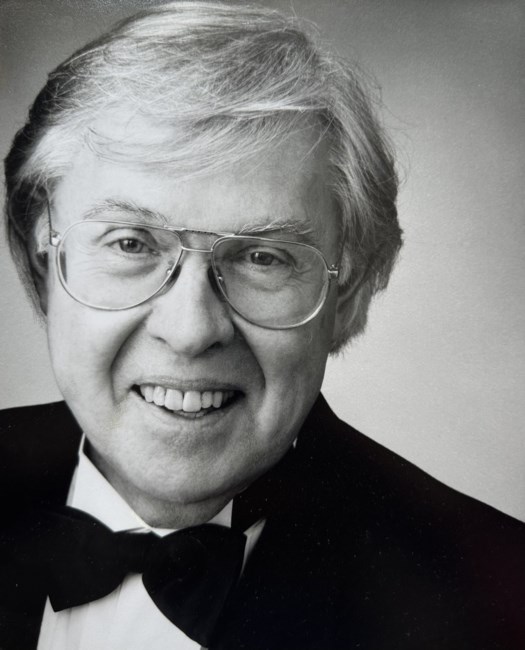
Charles Wadsworth, a pianist who parlayed his Southern charm and his passion for chamber music into a career as the founder, director and host of important chamber series — including the Chamber Music Society of Lincoln Center in New York — and whose work helped propel the chamber music boom that began in the 1970s, died on Thursday in Manhattan. He was 96.
During his two decades as director of the Chamber Music Society, Mr. Wadsworth was the face of the organization, likely at any time to stride onto the stage of Alice Tully Hall with a broad grin, tousled blond hair and a boyish gait and offer folksy introductions to the music at hand. “I discovered very early that when people laugh, they relax,” Mr. Wadsworth told an interviewer in 2014. “They may be at a chamber music concert for the first time, or they may be unfamiliar with the repertory, but my feeling was that if I could get them relaxed, they would be open to listening, and to letting the music happen to them, rather than worrying about whether they understand it. And that seemed to work very well.”
He also performed with the society, playing the piano, harpsichord or even the organ in staples of its repertory as well as some of the oddities he found while assembling the society’s programs — works like Anton Arensky’s Suite No. 1 for Two Pianos, François Couperin’s “Le Parnasse, ou L’Apothéose de Corelli” or Jan Zelenka’s Trio Sonata for Two Oboes, Bassoon and Continuo. But since the society’s roster included pianists who by Mr. Wadsworth’s own admission were more accomplished, he often deferred to them.
His real accomplishments took place behind the scenes. Not least was the creation of the society itself, an organization meant to explore the breadth of the chamber music repertory, regardless of the instrumental (or vocal) combinations required. Mr. Wadsworth assembled a core group of “artist members” — string, wind and keyboard players with active careers, who would commit to performing with the society throughout the season — alongside guest musicians, who would expand the instrumental possibilities and bring an extra measure of star power.
New music was to figure into the mix as well. During Mr. Wadsworth’s tenure, the society commissioned and premiered more than 60 works, including John Corigliano’s“Poem in October,” David Del Tredici’s “Haddocks’ Eyes,” Pierre Boulez’s “ … explosante/fixe …,” Ned Rorem’s “Winter Pages” and Oliver Knussen’s “Ophelia Dances,” all of which became staples. Mixed ensemble programs of the kind Mr. Wadsworth imagined are common now. But in 1969, chamber music concerts were typically played by groups with fixed rosters — string quartets and piano trios, for example — and were therefore devoted to the repertory for their combination of instruments. Consequently, works for mixtures of strings, winds, keyboard and voice were rarely performed. Such works became the society’s calling cards. The fresh exploration of this music drew new listeners, and young musicians began to consider chamber performance as a viable alternative to solo and orchestral careers. New groups formed, established stars created chamber collaborations, and other chamber music societies followed.
Charles William Wadsworth was born on May 21, 1929, in Barnesville, Ga. His father, Charles, a grocer, was an avid country fiddler; his mother, Ethel Capps, worked in a woman’s clothing shop. The family later moved to Newnan, about 40 miles southwest of Atlanta. When Mr. Wadsworth’s mother saw him dancing the hula to music playing on the family’s Crosley radio, she began taking him to concerts in Atlanta (the first two, as he remembered it, were by Sergei Rachmaninoff and Vladimir Horowitz) and then found him a local piano teacher.
When he was 12, his teacher arranged for him to study in Atlanta with Hugh Hodgson, the founder of the music department at the University of Georgia. Mr. Hodgson encouraged young Charles’s interest in both contemporary and chamber music. He also studied the organ, played in churches and at religious revivals, and began touring as an accompanist for some of the church singers he worked with. He later built a thriving career as a vocal coach and accompanist for a long list of singers, including Jan Peerce, Reri Grist, Shirley Verrett, Frederica von Stade, Dietrich Fischer-Dieskau and Beverly Sills.
At 19, Mr. Wadsworth moved to New York to enroll at the Juilliard School, where he studied with Alton Jones and the Bach specialist Rosalyn Tureck. During his Juilliard years, he directed and accompanied a church performance of Gian Carlo Menotti’s “Amahl and the Night Visitors,” a Christmas opera composed for television in 1951. Mr. Menotti sent him a note thanking him for undertaking the piece, and the two met in 1958 when Mr. Wadsworth accompanied a singer who was auditioning for a role in one of the composer’s works. Shortly after that audition, Mr. Menotti invited Mr. Wadsworth to play Carlos Surinach’s Piano Concerto at the Festival of Two Worlds, which Mr. Menotti had just established in Spoleto, Italy. And in the winter of 1959, Mr. Menotti invited Mr. Wadsworth to start a chamber music series at the festival, drawing his players from the festival roster, which ranged from superstars like the pianist Sviatoslav Richter to promising but as yet little-known players like the cellist Jacqueline du Pré.
Mr. Wadsworth presented a different program every day of the monthlong festival. There were no printed programs, and neither the works nor the performers would be announced in advance — partly to discourage listeners from turning up only to hear established stars, and partly because it was never clear, until shortly before curtain time, which works were sufficiently rehearsed and ready for the stage. In the absence of printed programs, Mr. Wadsworth began introducing the concerts in broken Italian. “What I would do is start combining English and Italian, in very strange ways that got the people laughing a lot,” he said in 2014. “All of our concerts, including my commentary, were broadcast in Italy, and after about two seasons, I was told by some of the Italians that I’d become one of the most popular radio comedians in the country because of the mistakes I would make.”
At the festival, Mr. Wadsworth met Susan Popkin, who had recently started Young Concert Artists, an organization that presents classical music performances by winners of annual auditions. They married in 1966. In addition to his wife, Mr. Wadsworth is survived by their daughter, Rebecca Banks; two children, Beryl Rajnic and David Wadsworth, from his former marriage to Sarah Wadsworth; and three grandchildren, Ahmed Diallo, Aria Rajnic Schmitt, and Aliya Rajnic.
Mr. Wadsworth’s Spoleto concerts brought him to the attention of the composer William Schuman, then the president of Lincoln Center. In 1965, Mr. Schumann invited him to submit a proposal for a chamber music series at Alice Tully Hall, which was then in the planning stages. Mr. Wadsworth outlined his ideas in a 40-page proposal, and in 1966, Mr. Schuman appointed him artistic director of the new Chamber Music Society of Lincoln Center. The society opened Alice Tully Hall on Sept. 11, 1969, with a program that included Bach’s Trio Sonata in C; Schumann’s “Dichterliebe,” sung by the baritone Hermann Prey, with Mr. Wadsworth at the piano; and Schubert’s “Two Cellos” Quintet.
In the meantime, Mr. Menotti was searching for ways to expand his Spoleto festival to the United States. Mr. Wadsworth was among the team scouting out cities that could host the new festival, and he was among those who argued in favor of Charleston, S.C., which became the home of the Spoleto Festival U.S.A. in 1977. Again, Mr. Wadsworth oversaw the chamber music series. He remained involved in various capacities (as director, host or figurehead)through 2009.
After he relinquished the directorship of the Chamber Music Society, Mr. Wadsworth continued to appear with the group as a guest artist. He also directed several other series, including events in Old Lyme, Conn., and Cartagena, Colombia. He played concerts annually at the Kravis Center for the Performing Arts in West Palm Beach, Fla., and in his hometown, Newnan, where in 1998 the city’s main concert hall, built in 1938, was renovated and renamed the Charles Wadsworth Auditorium.
In 1996, Mr. Wadsworth organized a concert for the 1996 Summer Olympics, which included peformances by Pinchas Zukerman, Itzhak Perlman, Lynn Harrell, and Frederica von Stade. Mr. Wadsworth was invited to perform at the White House for Presidents John F. Kennedy, Richard Nixon, Gerald Ford, Jimmy Carter, and Ronald Reagan.
[By Allan Kozinn; Ash Wu contributed reporting. A version of this article appears in print on May 31, 2025, Section B, Page 11 of the New York Times with the headline: Charles Wadsworth, 96, Pianist And Face of Chamber Music, Dies.]
Obituary photo by Christian Steiner.
A funeral service will be held at Riverside Memorial Chapel, on the corner of Amsterdam Avenue and West 76 Street, New York, NY, 10023, United States. The service is scheduled for June 1, 2025, starting at 11:00 am.
Muestre su apoyo
Comparta Un Recuerdo
Comparta
Un Obituario
Obtenga actualizaciones
Servicios
COMPARTA UN OBITUARIOCOMPARTA
- RECIBIR RECORDATORIOS
v.1.18.0